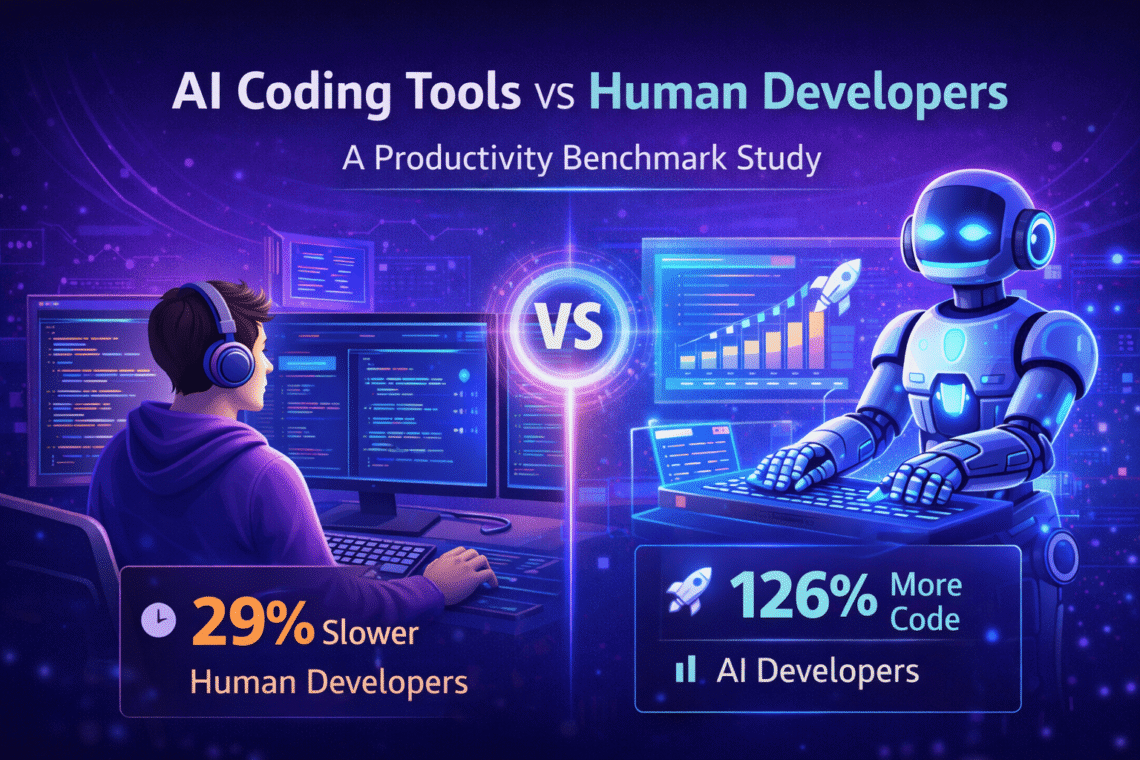
Over the past few years, AI powered coding assistants have moved from experimental tools to mainstream development environments. Integrated into popular IDEs and cloud platforms, these systems can generate functions, suggest refactors, write tests, and even draft documentation within seconds. As adoption increases, a central question emerges: are AI coding tools more productive than human developers?
Productivity in software engineering is difficult to measure. Lines of code written per hour do not reflect architectural quality. Faster output does not guarantee maintainability. Automated suggestions may reduce typing time but still require validation, testing, and integration. To assess real impact, productivity must be evaluated across multiple dimensions, including speed, accuracy, debugging effectiveness, code quality, and system level thinking.
This benchmark study compares AI coding tools and human developers across structured development tasks. The goal is not to declare a winner in absolute terms, but to understand where automation accelerates workflow and where human expertise remains essential. By separating repetitive implementation tasks from complex architectural decision making, the comparison becomes clearer and more practical.
Study Framework and Methodology
To compare AI coding tools and human developers fairly, productivity must be measured across structured and repeatable tasks. This benchmark evaluates performance using controlled task categories, standardized environments, and defined quality metrics.
Test Environment
All tests were conducted within a modern development setup using:
-
A standard IDE configuration
-
A consistent programming language environment
-
Identical project requirements
-
Predefined task instructions
Both AI tools and human developers worked under the same problem constraints to reduce variability.
Task Categories Evaluated
The benchmark included four primary categories:
-
Code generation for common application features
-
Code accuracy and logical correctness
-
Debugging and error resolution
-
System design and architectural planning
Each category was designed to measure a distinct aspect of productivity beyond simple typing speed.
Metrics Used
Performance was evaluated using measurable indicators:
-
Time to task completion
-
Logical correctness of output
-
Edge case coverage
-
Security and validation handling
-
Code readability and structure
-
Post implementation error rate
These metrics provide a more comprehensive view of productivity than raw output volume.
Quality Review Process
Generated solutions were reviewed against predefined correctness criteria. Human written and AI generated outputs were evaluated for:
-
Functional accuracy
-
Maintainability
-
Modularity
-
Scalability considerations
This ensures that faster completion does not compromise structural integrity.
Benchmark Category 1: Code Generation Speed
The first benchmark category evaluates raw implementation speed across common development tasks. Code generation speed measures how quickly a working solution can be produced under defined requirements.
Tasks Included
The benchmark focused on structured, repeatable tasks such as:
-
Creating CRUD operations for a database entity
-
Building REST API endpoints
-
Implementing authentication logic
-
Writing form validation functions
-
Implementing common algorithms
These tasks reflect real world development activities frequently performed in application projects.
Time to Completion
AI coding tools demonstrated significantly faster initial output for boilerplate heavy tasks. Template based implementations such as REST endpoint scaffolding or basic data validation were generated within seconds.
Human developers required more time for manual implementation, especially when writing repetitive structures. However, human developers often spent additional time planning structure before writing code.
Output Consistency
AI tools produced consistent formatting and syntactically correct code in most template driven scenarios. Boilerplate repetition was handled efficiently.
Human developers occasionally introduced minor syntax errors during rapid implementation, though these were quickly resolved through standard debugging processes.
Adjustment and Refinement Time
While AI tools generated initial implementations quickly, refinement time varied. Generated code often required:
-
Manual review for logical consistency
-
Adjustment for edge case handling
-
Integration into broader project architecture
-
Naming standard corrections
Human developers, although slower at first pass generation, often required fewer structural adjustments after initial completion.
Benchmark Category 2: Code Accuracy and Quality
Speed alone does not determine productivity. Code must function correctly, handle edge cases, and remain maintainable over time. The second benchmark category evaluates logical correctness, structural quality, and robustness of implementations.
Logical Correctness
AI generated solutions performed well on clearly defined tasks with standard patterns. When requirements were explicit and aligned with common use cases, functional correctness was generally high.
However, ambiguity in requirements occasionally led to assumptions within generated code. Human developers were more likely to request clarification or explicitly define constraints before implementation.
Edge Case Handling
Edge case coverage varied significantly. AI generated code often handled primary scenarios correctly but sometimes required additional refinement to address:
-
Null or undefined inputs
-
Invalid parameter values
-
Boundary conditions
-
Concurrent request scenarios
Human developers tended to incorporate defensive checks when they anticipated potential failure cases.
Code Structure and Readability
AI generated code was generally readable and followed common formatting conventions. In simple modules, structure quality was consistent.
However, in more complex implementations, structural organization sometimes lacked modular separation or scalability considerations. Human developers were more likely to refactor code into reusable components aligned with project architecture.
Security Considerations
Security handling depended heavily on prompt clarity. AI generated code did not consistently include:
-
Input sanitization
-
Proper authentication validation
-
Secure error handling
-
Protection against injection vulnerabilities
Human developers with security awareness were more deliberate in incorporating safeguards, particularly in API and database interactions.
Maintainability and Scalability
Maintainability depends on naming consistency, modularity, documentation clarity, and adherence to architectural standards. AI generated solutions required human review to ensure alignment with project conventions.
Human developers generally demonstrated stronger long term scalability planning, particularly when integrating features into larger systems.
Benchmark Category 3: Debugging Performance
Debugging performance measures how effectively errors are identified, analyzed, and resolved. This category evaluates root cause analysis, correction accuracy, and risk of introducing new issues during fixes.
Error Identification Speed
AI coding tools were able to quickly suggest potential causes when provided with error messages or stack traces. In straightforward cases such as syntax errors, missing imports, or common runtime exceptions, suggested fixes were delivered rapidly.
Human developers required time to inspect logs, trace execution paths, and reproduce issues. However, experienced developers often narrowed down root causes efficiently through structured investigation.
Root Cause Analysis Depth
For surface level errors, AI tools performed well. In more complex scenarios involving multiple interacting components, debugging required contextual understanding of system architecture.
Human developers demonstrated stronger performance in:
-
Tracing cross service failures
-
Identifying race conditions
-
Diagnosing memory leaks
-
Understanding environment specific configuration issues
AI generated suggestions sometimes addressed symptoms rather than underlying architectural causes.
Fix Accuracy
AI suggested fixes were often correct for isolated code segments. However, when errors involved broader system logic, fixes occasionally required refinement to prevent regression.
Human developers were more likely to evaluate side effects and consider how changes might impact other modules.
Explanation and Learning Value
AI tools provided structured explanations alongside fixes, which can accelerate learning for less experienced developers. These explanations help clarify why an issue occurs and how a resolution works.
Human developers, particularly senior engineers, rely on internal reasoning and experience to guide debugging decisions. Their explanations may be more context specific and tailored to project architecture.
Benchmark Category 4: System Design and Architecture
System design and architectural planning represent a higher level of software development productivity. This category evaluates scalability planning, database modeling, API structure, error handling strategy, and long term maintainability considerations.
Architectural Planning
When asked to propose system designs, AI tools were able to generate structured outlines that included common components such as:
-
Service layers
-
Database integration
-
Authentication modules
-
Caching mechanisms
-
Logging systems
These responses were generally well formatted and aligned with standard architectural patterns.
However, architecture quality depended heavily on prompt clarity. Broad or ambiguous requirements produced generalized designs without detailed tradeoff analysis.
Human developers demonstrated stronger performance in identifying:
-
Capacity planning constraints
-
Performance bottlenecks
-
Cost considerations
-
Deployment environment limitations
-
Business specific requirements
Database Schema Design
AI generated schema suggestions handled common relationships effectively. For standard entity relationships and indexing strategies, outputs were structurally sound.
Human developers showed greater nuance in:
-
Anticipating query performance under scale
-
Designing normalization versus denormalization strategies
-
Managing migration plans
-
Handling transaction isolation requirements
Schema planning often requires awareness of long term data growth and access patterns.
API Structure and Error Handling
AI tools produced REST style API structures with appropriate endpoint definitions. Basic validation and response formatting were included in most cases.
Human developers were more likely to define:
-
Consistent error response standards
-
Rate limiting strategies
-
Versioning policies
-
Authentication token lifecycle management
-
Monitoring and observability integration
These considerations are critical for production environments.
Scalability and Maintainability
AI generated designs were generally technically correct but sometimes lacked depth in scalability planning under high traffic conditions.
Human developers evaluated tradeoffs between horizontal scaling, caching strategies, load balancing, and infrastructure cost. These decisions often depend on contextual business requirements rather than generic patterns.
Where AI Coding Tools Outperform Human Developers
Benchmark results indicate that AI coding tools demonstrate clear advantages in specific task categories, particularly those involving repetition, pattern recognition, and structured template generation.
Rapid Boilerplate Generation
AI tools significantly reduce time required to produce repetitive structures such as:
-
CRUD operations
-
REST API scaffolding
-
Data validation functions
-
Configuration templates
-
Unit test skeletons
These tasks follow predictable patterns, making them well suited for automated generation.
Syntax Accuracy and Formatting
Generated code typically adheres to language syntax rules and standard formatting conventions. Minor syntax mistakes common in manual rapid typing are largely eliminated during generation.
This reduces time spent correcting trivial errors.
Documentation Drafting
AI tools can generate inline comments, function documentation, and usage examples quickly. This accelerates early stage documentation processes, especially when drafting initial explanations.
Human developers may write more context specific documentation, but automation reduces baseline effort.
Code Translation Between Languages
Converting logic between programming languages is handled efficiently by AI systems. While manual translation requires familiarity with syntax differences, AI tools can produce a functional starting version rapidly.
Rapid Exploration of Alternatives
AI tools can quickly propose multiple implementation approaches when prompted. This enables faster experimentation during early development phases.
Where Human Developers Outperform AI Coding Tools
While AI coding tools demonstrate speed advantages in repetitive tasks, benchmark results show that human developers maintain clear strengths in areas requiring contextual reasoning, architectural awareness, and strategic decision making.
Complex Problem Solving
Human developers performed better in scenarios involving ambiguous requirements or multi layer logic dependencies. When problems required interpretation beyond explicit instructions, developers applied domain knowledge and reasoning to determine appropriate solutions.
AI generated outputs were limited by prompt clarity and predefined context.
System Level Context Awareness
Software projects often involve legacy systems, evolving business rules, deployment constraints, and performance limitations. Human developers evaluated solutions in relation to:
-
Existing codebase structure
-
Infrastructure capacity
-
Organizational standards
-
Compliance requirements
AI tools did not independently account for these contextual constraints unless explicitly defined.
Performance Optimization
Human developers demonstrated stronger performance in identifying:
-
Memory inefficiencies
-
Database query bottlenecks
-
Latency sources
-
Scalability risks
Optimization decisions often require measurement, profiling, and tradeoff analysis that extends beyond static code generation.
Risk Assessment and Tradeoff Evaluation
Architectural decisions frequently involve balancing speed, cost, maintainability, and scalability. Human developers assessed tradeoffs based on project priorities and long term goals.
AI generated recommendations generally reflected common best practices rather than tailored strategic evaluations.
Ownership and Accountability
Human developers are responsible for code review, production deployment, monitoring, and incident resolution. Accountability includes anticipating downstream impacts of changes and maintaining system reliability.
AI tools function within defined instructions and do not independently assume operational responsibility.
Productivity Multiplier Effect: Human Developer Using AI
While individual category comparisons highlight strengths and weaknesses, the most practical benchmark outcome emerges when evaluating a combined workflow. Instead of AI versus human developers, the more relevant comparison is human developers using AI tools versus human developers working alone.
Reduced Time on Repetitive Tasks
Developers who incorporated AI assistance completed boilerplate implementation significantly faster. This allowed more time to focus on:
-
Architectural refinement
-
Edge case validation
-
Performance testing
-
Code review participation
The reduction in repetitive typing improved overall task completion speed without reducing quality oversight.
Faster Iteration Cycles
AI assistance enabled rapid prototyping of alternative solutions. Developers could test multiple approaches in shorter time frames, improving iteration efficiency during early stage development.
Human judgment remained central in selecting final implementations.
Improved Documentation Baseline
Automated comment generation provided a starting point for documentation. Developers refined and contextualized explanations rather than drafting from scratch, saving time while maintaining clarity.
Enhanced Learning for Junior Developers
Junior developers using AI tools were able to review suggested implementations and explanations, accelerating exposure to patterns and best practices. However, independent reasoning remained necessary to validate correctness.
Quality Control Still Required
Combined workflows did not eliminate the need for human validation. Developers reviewed generated outputs for:
-
Logical correctness
-
Security implications
-
Architectural consistency
-
Performance impact
Without review, automated output could introduce hidden risks.
Limitations of the Benchmark Study
While the benchmark provides structured comparisons, several limitations must be acknowledged to interpret results accurately. Productivity in software engineering varies widely based on experience, project type, and development environment.
Variability in Human Skill Levels
Human developer performance depends on experience, specialization, and familiarity with the problem domain. A senior engineer may significantly outperform a junior developer in system design tasks, while less experienced developers may rely more heavily on tooling assistance.
The benchmark reflects controlled conditions rather than the full diversity of real world teams.
Dependency on Prompt Clarity
AI coding tool performance is highly dependent on input quality. Clear, detailed instructions typically yield better outputs. Ambiguous or incomplete prompts can reduce accuracy and increase revision time.
Human developers often request clarification before implementation, which may influence comparison outcomes.
Project Context and Legacy Systems
The benchmark tasks were structured and isolated. Real world software projects involve legacy codebases, organizational standards, deployment constraints, and evolving business requirements. These contextual factors influence productivity significantly.
AI tools do not independently access historical project decisions unless explicitly provided.
Security and Compliance Considerations
Production environments often require adherence to security policies, regulatory standards, and internal governance processes. Benchmark testing may not fully replicate these constraints.
Human developers must integrate security awareness into implementation decisions.
Measurement Scope
Productivity was measured across defined task categories such as speed, accuracy, debugging, and architectural planning. However, broader aspects such as team collaboration, mentorship, stakeholder communication, and long term maintainability extend beyond quantifiable benchmarks.
Practical Implications for Development Teams
Benchmark results suggest that the most effective strategy is not choosing between AI coding tools and human developers, but defining how they work together within structured workflows.
When to Use AI Coding Tools
AI tools are most effective for:
-
Generating boilerplate code
-
Drafting repetitive structures
-
Creating initial test cases
-
Translating code between languages
-
Drafting documentation
These tasks benefit from pattern recognition and rapid generation.
When to Rely on Human Expertise
Human developers should lead:
-
Architectural planning
-
Scalability design
-
Security implementation
-
Performance optimization
-
Risk assessment
-
Production deployment decisions
These responsibilities require contextual awareness and strategic judgment.
Establish Clear Review Protocols
To maintain quality, teams should define review standards for generated code. Recommended practices include:
-
Mandatory code review before merging
-
Automated testing integration
-
Security validation checks
-
Documentation updates
AI output should enter the same review pipeline as manually written code.
Train Developers in Tool Literacy
Teams that provide structured training on AI tool usage often see stronger productivity gains. Developers should understand:
-
How to craft clear prompts
-
How to validate generated code
-
When to reject automated suggestions
-
How to refine outputs efficiently
Tool literacy enhances effectiveness without compromising quality.
Maintain Accountability Structures
Automation does not replace responsibility. Developers remain accountable for system reliability, compliance, and long term maintainability. Clear ownership prevents overreliance on generated output.