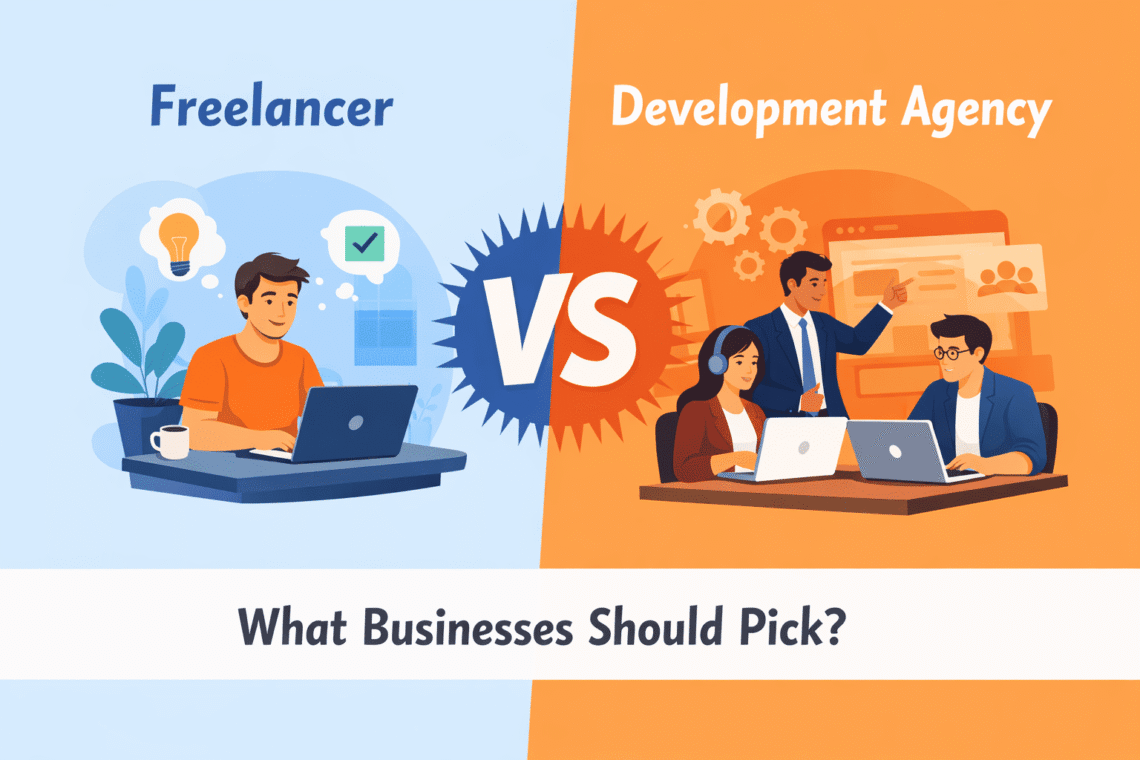
When businesses plan to build a website, mobile app, ecommerce store, SaaS platform, or enterprise software, one critical decision shapes the entire project outcome.
Should you hire a freelancer or partner with a development agency?
This is not just a budget decision. It affects code quality, scalability, communication flow, project timelines, accountability, long term maintenance, and even security standards. The wrong choice can delay product launches and increase costs. The right choice can accelerate growth and create a stable digital foundation for years.
Choosing between a freelancer and a development agency is one of the most important decisions a business makes when starting a digital project. Whether you are building a website, mobile application, ecommerce store, SaaS platform, or enterprise software, your choice will directly impact cost, quality, scalability, and long term success.
Some businesses prioritize affordability and flexibility. Others prioritize structure, reliability, and scalability. The right choice depends on your goals, budget, timeline, and project complexity.
Should you hire a freelancer or a development agency?
Hire a freelancer if your project is small, has a limited budget, and requires a specific skill set. Choose a development agency if your project is complex, requires multiple specialists, long term support, structured project management, and scalability.
In this detailed guide, we will explore freelancer vs development agency from every practical angle. You will understand differences in cost, expertise, communication, risk, scalability, project management, and long term support. Each section includes clear explanations supported by structured comparison points so you can make a confident business decision.
Understanding the Freelancer Model
A freelancer is an independent professional who works on a contract basis. They typically specialize in a focused skill set such as web development, mobile app development, UI design, backend engineering, or DevOps configuration.
Freelancers usually operate solo. They manage their own workload, communicate directly with clients, and execute tasks without a formal team structure.
Key Characteristics of Freelancers
Freelancers typically:
- Work independently
- Charge hourly or per project
- Handle communication themselves
- Use their own preferred tools and workflows
- Work with multiple clients simultaneously
Because they have lower overhead costs, freelancers often provide more affordable solutions for small projects. They are flexible and can adapt quickly when requirements change.
However, flexibility can also mean variability. Availability, workload capacity, and process consistency depend entirely on the individual.
Understanding the Development Agency Model
A development agency is a structured company that delivers digital solutions through a team of professionals. Instead of one individual managing everything, agencies assign specialized roles to ensure higher efficiency and quality control.
Agencies often handle projects from strategy to post launch support.
Typical Roles Inside a Development Agency
Most agencies include:
- Project managers
- Front end developers
- Back end developers
- UI and UX designers
- Quality assurance testers
- DevOps engineers
- Security specialists
This team structure allows agencies to manage complex projects more effectively. They usually follow documented workflows, testing procedures, milestone tracking, and communication protocols.
While agencies charge more, businesses benefit from collective expertise and reduced operational risk.
Quick Comparison
| Factor | Freelancer | Development Agency |
|---|---|---|
| Cost | Lower upfront cost | Higher initial investment |
| Team Size | One individual | Multi specialist team |
| Project Management | Self managed | Dedicated project manager |
| Scalability | Limited | Highly scalable |
| Risk Level | Higher single dependency risk | Lower due to team redundancy |
| Quality Assurance | Limited testing | Dedicated QA team |
| Best For | Small projects, MVPs, short term tasks | Complex systems, enterprise projects |
| Communication | Direct and informal | Structured and documented |
| Long Term Support | May vary | Usually contract based ongoing support |
Cost Comparison: Freelancer vs Development Agency
Freelancers generally charge lower hourly or project rates because they operate independently without corporate overhead. This makes them attractive for startups and small businesses.
Cost is often the first filter when businesses evaluate options. However, looking only at the hourly rate can be misleading.
Freelancer Cost Structure
Freelancers generally have:
- Lower hourly rates
- Fewer operational expenses
- Flexible payment models
- Minimal administrative overhead
This makes them ideal for:
- Small websites
- Landing pages
- Minor redesigns
- Feature updates
- Quick technical fixes
But there are hidden considerations. If a freelancer lacks expertise in certain areas, you may need to hire additional specialists. That can increase coordination complexity and cost.
Agency Cost Structure
Agencies charge higher rates because you are paying for:
- A full development team
- Structured project management
- Testing and quality assurance
- Documentation and reporting
- Post launch support
Although initial costs are higher, agencies often reduce long term expenses by preventing rework, minimizing bugs, and delivering scalable architecture from the beginning.
Quality and Expertise Depth
The depth and range of expertise is one of the biggest differences between freelancers and agencies.
Freelancer Expertise Model
Freelancers typically excel in a focused area. For example:
- A React developer builds strong front end interfaces
- A backend engineer handles server logic and databases
- A WordPress developer customizes themes and plugins
However, most freelancers do not specialize in all areas simultaneously.
This means:
- Architecture decisions may lack broader perspective
- Security best practices may not always be prioritized
- Testing may not be comprehensive
That does not mean freelancers produce poor work. Many are extremely skilled. The challenge arises when a project requires multi disciplinary coordination.
Agency Expertise Model
Agencies combine specialists, which allows them to address:
- System architecture
- UI and UX strategy
- Backend performance
- Security standards
- Automated testing
- Deployment pipelines
Because responsibilities are distributed across experts, the final product is often more robust and scalable.
For complex platforms, enterprise systems, or SaaS applications, this structured expertise becomes essential.
Communication and Project Management
Strong communication determines whether a project runs smoothly or becomes stressful.
Communication with Freelancers
Freelancer communication is usually direct and simple.
Benefits include:
- Faster decision making
- Fewer approval layers
- Personal interaction
- Flexible scheduling
However, challenges may include:
- Time zone differences
- Limited availability
- No backup if unavailable
- Informal documentation
If the freelancer becomes sick or overloaded, project progress can stall completely.
Communication with Agencies
Agencies follow structured communication systems. You often interact with a project manager who coordinates with developers internally.
Advantages include:
- Clear reporting structure
- Defined milestones
- Progress tracking
- Risk management planning
- Backup team members
The downside is slightly less flexibility and more formal processes. However, for medium to large projects, structured communication reduces misunderstandings and delays.
Scalability and Future Growth
When choosing between freelancer and agency, consider not just your current needs but your future expansion plans.
Freelancer Scalability
Freelancers are ideal for:
- Early stage startups
- MVP development
- Small business websites
- Limited scope projects
But scaling may require:
- Hiring additional freelancers
- Managing multiple contractors
- Coordinating communication yourself
This can become complex as the project grows.
Agency Scalability
Agencies are built for growth. They can:
- Add more developers when needed
- Increase testing capacity
- Expand feature development
- Provide long term maintenance
If your project roadmap includes future integrations, automation, mobile versions, or performance optimization, agencies are better equipped to scale smoothly.
Risk Management and Accountability
Risk is often overlooked during vendor selection.
Risks When Hiring Freelancers
Potential risks include:
- Dependency on a single individual
- Limited contractual protection
- Inconsistent documentation
- No formal QA process
- Sudden unavailability
While many freelancers are reliable, businesses carry more operational risk when relying on one person.
Risk Control in Agencies
Agencies mitigate risk through:
- Contracts and SLAs
- Team redundancy
- Formal testing procedures
- Version control systems
- Documentation standards
This reduces single point failure scenarios and improves accountability.
Which Businesses Should Choose a Freelancer?
Freelancers are usually a strong fit for:
- Small businesses with limited budgets
- Early stage startups building MVPs
- Simple website redesigns
- Short term technical tasks
- Projects under tight cost constraints
If your project scope is clear, limited, and manageable by one expert, a freelancer can deliver excellent value.
Which Businesses Should Choose a Development Agency?
Development agencies are ideal for:
- Medium to large businesses
- Enterprise software development
- Complex ecommerce platforms
- Multi integration systems
- Long term digital transformation projects
- Projects requiring ongoing maintenance
If your project involves multiple technologies, integrations, security compliance, or future expansion, an agency provides greater stability and scalability.
Decision Framework: How to Choose
Instead of focusing only on cost, evaluate your project based on:
- Project complexity
- Timeline urgency
- Budget flexibility
- Long term growth plans
- Risk tolerance
- Need for ongoing support
If the project can realistically be handled by one skilled professional, choose a freelancer.
If it requires coordination across multiple disciplines, structured management, and future scaling, choose an agency.
Final Thoughts
Freelancer vs development agency is not about which option is better universally. It is about which option aligns with your business goals, project complexity, risk tolerance, and growth strategy.
Freelancers offer flexibility and cost efficiency for focused tasks. Development agencies provide structure, scalability, and long term reliability for complex initiatives.
Before making a decision, clearly define your requirements, roadmap, and expected outcomes. The clarity of your project vision will determine the right partnership model.
FAQs
1. What is the difference between a freelancer and a development agency?
A freelancer is an independent professional working alone, while a development agency is a structured company with multiple specialists handling different aspects of a project such as development, design, testing, and project management.
2. Is hiring a freelancer risky?
Hiring a freelancer carries some risk because the project depends on one individual. If the freelancer becomes unavailable, project continuity may suffer. Proper contracts and milestone payments reduce risk.
3. Do development agencies provide better quality than freelancers?
Development agencies often provide more consistent quality for complex projects because they include dedicated QA testers, project managers, and specialists. However, highly skilled freelancers can also deliver excellent results for focused tasks.
4. Which option is more scalable for growing businesses?
Development agencies are more scalable because they can assign additional resources as project demands increase. Freelancers may face bandwidth limitations.
5. What is better for building an MVP?
Freelancers are often better for simple MVPs due to lower cost and flexibility. Agencies are better for MVPs that require complex integrations or advanced architecture.
6. How do I decide between freelancer and agency?
Evaluate project complexity, budget, timeline, scalability needs, and risk tolerance. Small and clearly defined projects favor freelancers. Complex and long term projects favor agencies.