



| What organizations actually pay in 2026, with hidden costs exposed | ||||
|
The real cost is never the one on the pricing page
Canvas costs $50,000 to $300,000 per year. Nobody at Instructure will tell you that until you sign an NDA.
Moodle is free to download. Running it costs $20,000 to $80,000 annually once you account for hosting, IT staff, plugin updates, and security audits. That fact does not appear on Moodle.org.
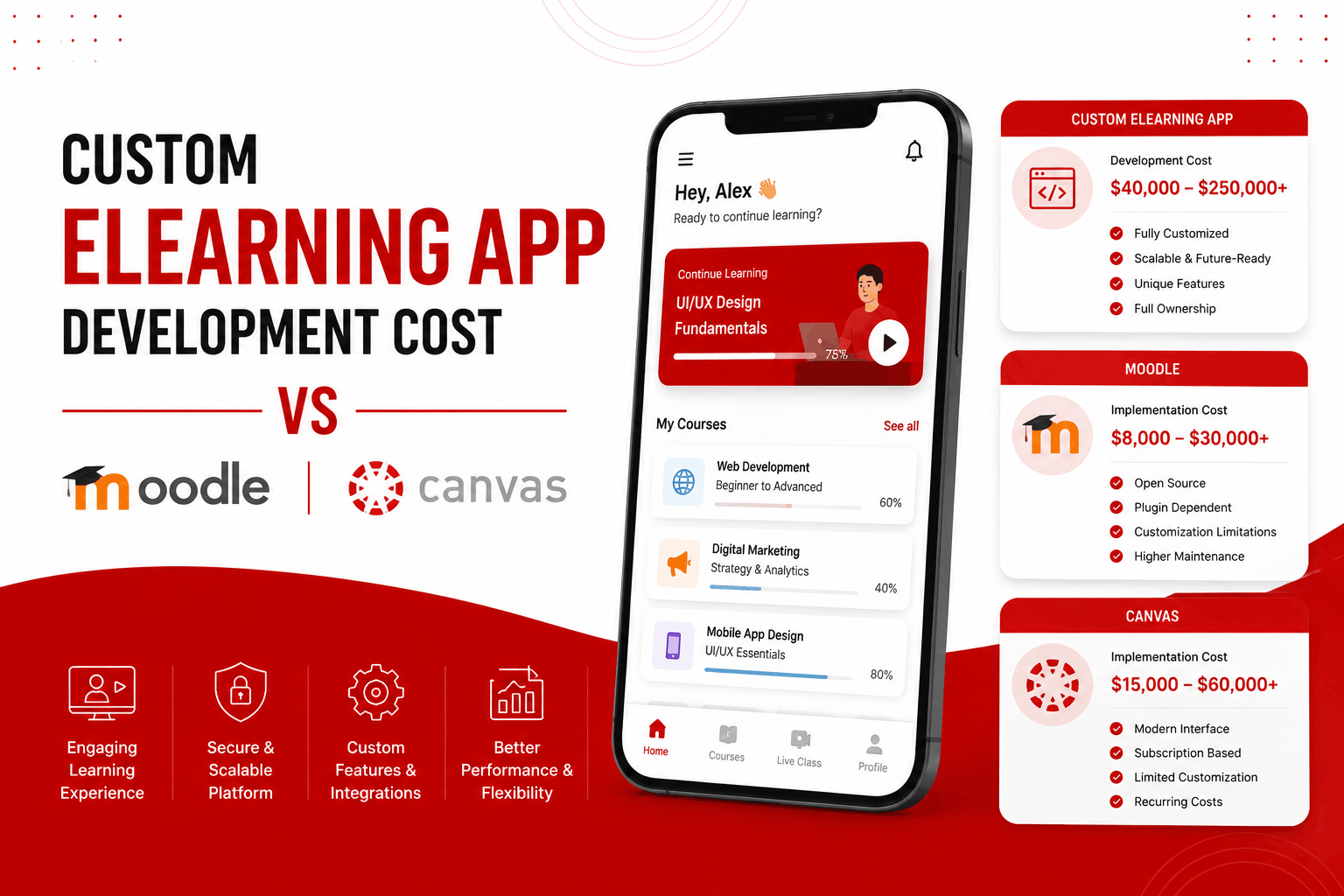
Custom eLearning development costs $80,000 to $300,000 upfront. At 5,000 users, that build cost amortized over five years is cheaper than Canvas. Almost no organization knows this because the comparison is never presented honestly.
This report calculates the true five-year total cost of ownership for all three paths at three user scales, exposes the hidden costs that inflate each option, and gives IT decision-makers and EdTech founders the numbers they need before a contract is signed.
Canvas: the $4.8 billion platform that hides its prices
KKR and Dragoneer acquired Instructure for $4.8 billion in 2024. They own the platform used by 6,000 institutions and 30 million users worldwide, holding more than 35% of US higher education LMS market share (Softabase, 2026).
Canvas does not publish pricing. Instructure negotiates each contract individually. Vendr’s anonymized transaction dataset from 2026 puts the actual numbers at: small institutions under 5,000 users paying $25,000 to $75,000 annually; mid-size institutions from 5,000 to 20,000 users paying $75,000 to $300,000 annually; large institutions above 20,000 users paying $300,000 to $1,500,000 annually.
The per-student rate lands between $3 and $12 per active user per year for the core LMS product. Add Canvas Studio (video), Canvas Catalog (course marketplace), Canvas Credentials (badges), or Impact (analytics) and the annual bill grows substantially. Most institutions buy bundles. Formswrite’s 2026 pricing analysis puts typical institutional spend at $5 to $30 per student per year when add-ons are included.
| The Canvas negotiation lever nobody uses
Instructure’s fiscal year ends in January. Deals signed in November and December consistently receive 15 to 25% deeper discounts than deals signed in February. K-12 districts that cite Google Classroom as an alternative achieve 15 to 30% discounts on Canvas pricing, according to Vendr’s 2026 contract data. Multi-year commitments of three years or more typically unlock volume pricing that reduces per-student cost by 20 to 40% versus annual contracts. Instructure does not advertise any of this. |
Moodle: the free platform with a $60,000 price tag
Moodle is open-source. The license costs nothing. The platform costs $20,000 to $80,000 annually to run in production, according to AllenComm’s 2026 cost analysis, once server infrastructure, IT staff time, plugin management, security patching, and upgrade cycles are included.
Moodle Cloud, the hosted version, charges $120 per year for the Starter plan and $1,710 per year for the Large plan (SaaSworthy, 2026). That pricing covers hosting only. It does not eliminate the IT overhead of managing a complex plugin ecosystem, handling SCORM content uploads, administering user roles, or executing quarterly upgrades.
The specific cost drivers most Moodle evaluations miss: every major Moodle upgrade requires testing all installed plugins for compatibility. Organizations with 20 to 50 active plugins spend 15 to 40 hours per upgrade cycle in testing and remediation. At $75 per IT hour, a twice-annual upgrade cycle consumes $2,250 to $6,000 in staff cost before a single learner notices the platform changed.
| The Moodle scenario where costs spike unexpectedly
Moodle organizations that grow from 500 to 5,000 users rarely model the infrastructure scaling cost. A self-hosted Moodle instance serving 500 concurrent learners with video content requires load-balanced servers, a dedicated database cluster, and a CDN for media delivery. The AWS or Azure infrastructure bill for that configuration runs $1,500 to $4,000 per month, or $18,000 to $48,000 annually. Most organizations discover this cost six months after growth begins, not during the procurement decision. |
Five-year total cost of ownership: the comparison nobody publishes
The table below models five-year total cost of ownership for three platform paths at two user scales. Moodle self-hosted includes estimated IT staff cost at 0.5 FTE equivalent. Canvas uses Vendr’s anonymized 2026 contract data for the per-user range. Custom LMS assumes an $80,000 build amortized over five years plus $7,000 per year in maintenance and $6,000 to $12,000 per year in cloud infrastructure.
| Platform path | Yr 1 cost | Yr 2 cost | Yr 3 cost | 5-yr total | What drives cost |
| Moodle self-hosted | $22,000 | $32,000 | $48,000 | $74,000 | IT staff, hosting, plugins; scales with admin cost |
| Moodle Cloud (hosted) | $7,200 | $12,000 | $21,600 | $34,800 | MoodleCloud pricing; $1,710/yr largest plan; add hosting upgrade |
| Canvas (1K users) | $30,000 | $50,000 | $75,000 | $125,000 | $5-12/user/yr + SIS integration + support; 5-yr projection |
| Canvas (10K users) | $150,000 | $250,000 | $375,000 | $625,000 | Volume discount applies; add-ons (Studio, Catalog) extra |
| Custom LMS build | $95,000 | $115,000 | $155,000 | $215,000 | $80K build + $7K/yr maint + infra; flat cost post-build |
| Custom (5K users, yr 3+) | $95,000 | $115,000 | $155,000 | $215,000 | Same platform cost regardless of user count above |
| The crossover point that changes the decision
At 1,000 users over five years, Canvas costs $125,000 and a custom LMS costs $215,000. Canvas wins by $90,000. At 10,000 users over five years, Canvas costs $625,000 and the same custom LMS still costs $215,000. Custom wins by $410,000. The crossover occurs between 3,000 and 4,000 users. Organizations that expect to reach that threshold within the five-year window should model both scenarios before signing a Canvas contract. Most do not. |
Custom eLearning app development: where the budget actually goes
Custom eLearning development costs $50,000 for a basic course delivery MVP and $300,000 or more for an enterprise-grade platform with AI personalization, mobile apps, and employer-facing analytics. The component breakdown below applies to a mid-tier B2B or institutional build.
| Custom eLearning platform: development cost by component (mid-tier build) | |||
| Course authoring and content management |
|
$25K-50K | |
| Video delivery and streaming infrastructure |
|
$20K-45K | |
| SCORM/xAPI player and LRS |
|
$15K-35K | |
| Assessment engine and auto-grading |
|
$18K-40K | |
| Student progress tracking and analytics |
|
$15K-35K | |
| Multi-tenant organization management |
|
$20K-50K | |
| SSO and SIS integrations |
|
$15K-40K | |
| Mobile app (iOS and Android) |
|
$35K-65K | |
| WCAG 2.1 accessibility compliance |
|
$15K-35K | |
| Admin portal and reporting dashboard |
|
$10K-25K | |
Exhibit B: hidden costs that alter the comparison
Every platform comparison published online focuses on subscription pricing. The costs below appear in year one or year two of operation, after the procurement decision is final. They consistently surprise IT teams and CFOs.
| Hidden cost | Moodle self-hosted | Canvas | Custom LMS |
| IT administrator time | $25,000-60,000/yr (1-2 FTE staff or contractor) | $0 (Instructure manages infrastructure) | $10,000-25,000/yr (maintenance team) |
| Plugin/extension updates | $0 cost but 15-40 hrs/update cycle internally | N/A (native feature updates included) | $0 (own codebase; no vendor dependency) |
| WCAG 2.1 accessibility remediation | $15,000-35,000 one-time if not built in | Included (Canvas meets Section 508) | Must build in: $15,000-35,000 upfront |
| SIS integration (Banner, PowerSchool) | $5,000-20,000 plugin config + dev time | $10,000-30,000+ per integration (partner services) | $15,000-40,000 custom API build |
| SCORM/xAPI compliance | Native SCORM; xAPI requires additional plugin | SCORM native; xAPI with add-on (extra cost) | $10,000-25,000 to build standards support |
| Data migration on switch | $10,000-25,000 to export and reformat | $10,000-40,000 (Instructure partner services) | $0 (own your data schema and export) |
| Security audit/pen testing | $8,000-20,000/yr (your responsibility) | $0 (Instructure handles platform security) | $8,000-20,000/yr (your responsibility) |
What each platform cannot do out of the box
The feature gap analysis below maps seven capabilities that organizations commonly request. The gap between what Moodle and Canvas include natively versus what requires plugins, add-ons, or separate contracts defines the hidden cost of each platform at scale.
| Capability | Moodle | Canvas | Custom LMS |
| AI-personalized learning paths | Plugin-dependent; no native AI layer in 2026 | No native AI tutoring; third-party via LTI | Build with any LLM/RAG architecture; full control |
| Mobile app (native iOS/Android) | MoodleApp exists; limited customization | Canvas Student app; well-rated but not white-label | Custom native app; fully branded |
| Revenue/payments for course sales | Requires e-commerce plugin (Moodle Marketplace) | Canvas Catalog add-on: extra licensing fee | Build any pricing model: one-time, subscription, cohort |
| White-label branding | Theme possible but recognizably Moodle | Not available: Canvas branding locked | Complete brand control |
| Multi-tenant (sell to other orgs) | Complex plugin setup; not designed for multi-tenancy | Canvas for Business exists; separate contract | Native multi-tenant if architected correctly from start |
| Custom analytics/reporting | Custom SQL queries; limited native dashboards | Canvas Analytics + Impact add-on (extra cost) | Build any dashboard: per-learner, cohort, employer-facing |
| Offline learning support | Partial via MoodleApp offline mode | Limited offline capability | Full control; build progressive web app or native offline |
| The AI capability gap that will matter most by 2027
Neither Moodle nor Canvas ships a native AI tutoring or adaptive learning layer in 2026. Moodle requires third-party plugins. Canvas requires LTI integrations from external vendors. Both paths add $5,000 to $25,000 in integration cost and introduce vendor dependency on AI providers whose pricing will change. Custom LMS builds that integrate LLM APIs directly own their AI architecture completely. At a market growing 19.5% annually into a $37 billion opportunity by 2034, the platform that owns its AI layer compounds its value advantage with every passing year. |
The decision framework: which path is correct for which organization
| Organization type | User count | Revenue model | Correct path | Reason |
| K-12 school or district | 500-20,000 students | Public institution; per-student budget | Canvas (negotiate consortium pricing) | Compliance, SIS integration, and teacher familiarity justify premium; custom cannot compete on time-to-deploy |
| University or community college | 5,000-50,000 students | Per-enrollment public funding | Canvas below 10K; consider custom above 10K | At 10K+ students, custom amortized cost beats Canvas 5-yr contract by $200K-400K |
| Corporate L&D team | 200-5,000 employees | Internal cost center; no revenue model | Moodle self-hosted or TalentLMS (mid-market SaaS) | Canvas DNA is academic; Moodle with IT support fits compliance training better at this scale |
| EdTech startup (B2B SaaS) | 0-10,000+ learners | Per-seat or per-org subscription | Custom LMS | Revenue share and branding limits of Moodle/Canvas kill margin; own the platform |
| Course creator or content publisher | Under 500 learners | Per-course or subscription DTC | Teachable, Thinkific, or Kajabi | Not an LMS decision; course platform decision — Canvas and Moodle are wrong tools entirely |
| Government or regulated institution | 1,000-100,000 users | Public procurement; data sovereignty required | Moodle self-hosted or custom | Data residency in specific jurisdiction disqualifies most SaaS LMS options; Moodle on own infrastructure or custom build |
| PropTech or specialized vertical | Any scale | Niche workflow-specific | Custom LMS | Generic LMS platforms cannot model industry-specific certifications, compliance, or workflow logic |
The 60-second decision: three questions that determine the right path
Before any vendor evaluation, procurement process, or RFP, three questions resolve the decision for most organizations.
| Question | If yes | If no |
| Will you exceed 5,000 active learners within three years? | Model custom LMS 5-yr TCO. At that scale, custom often beats Canvas on cost alone. | Stay with Canvas or Moodle. The build cost does not recover within your timeline. |
| Is white-label brand control or multi-tenant resale part of your business model? | Build custom. Neither Moodle nor Canvas supports white-label at scale without violating terms. | Canvas or Moodle can serve you. Neither requires white-label capability for standard use. |
| Does your workflow require capabilities no standard LMS supports (AI tutoring layer, employer analytics, proprietary certification logic)? | Build custom around the specific capability. No plugin ecosystem replicates proprietary workflow logic. | Moodle or Canvas almost certainly covers your use case. Evaluate both before commissioning a build. |
The number that should start every LMS evaluation
Before any demo call or RFP, calculate the 5-year total cost of ownership. Take the Canvas list price range ($5-12 per user per year), multiply by your projected user count in year 5, multiply by 5, add 25% for add-ons and migration services, and write that number at the top of every vendor comparison document.
Then calculate the custom LMS equivalent: take a realistic build estimate for your feature set (typically $80,000 to $180,000 for a mid-tier platform), add $7,000 to $15,000 per year in maintenance, add $8,000 to $18,000 per year in infrastructure, and total five years. That number does not grow with user count.
For most organizations below 3,000 users, the comparison favors Canvas or a well-managed Moodle deployment. Above 5,000 users with a commercial revenue model, the comparison favors custom development by a margin that widens with every additional learner. The calculation takes 10 minutes. Most organizations spend months on evaluations that never compute it.
Canvas will not volunteer this analysis. Moodle will not model the IT overhead. Every vendor publishes the number that favors their product. The 5-year TCO calculation above is the number that favors the organization doing the buying.
| Sources
Vendr Canvas Pricing 2026 | Vendr Instructure Pricing 2026 | Raccoon Gang Canvas LMS Pricing 2026 | Raccoon Gang Moodle Pricing 2026 | Softabase Canvas LMS Review 2026 | Formswrite Canvas Pricing 2026 | AllenComm Custom eLearning Cost 2026 | SelectHub Moodle vs Canvas 2026 | Check-N-Click Custom eLearning Cost 2026 | Jotform Canvas vs Moodle 2026 | SaaSworthy Moodle Pricing | ITQlick Canvas vs Moodle 2026 |