



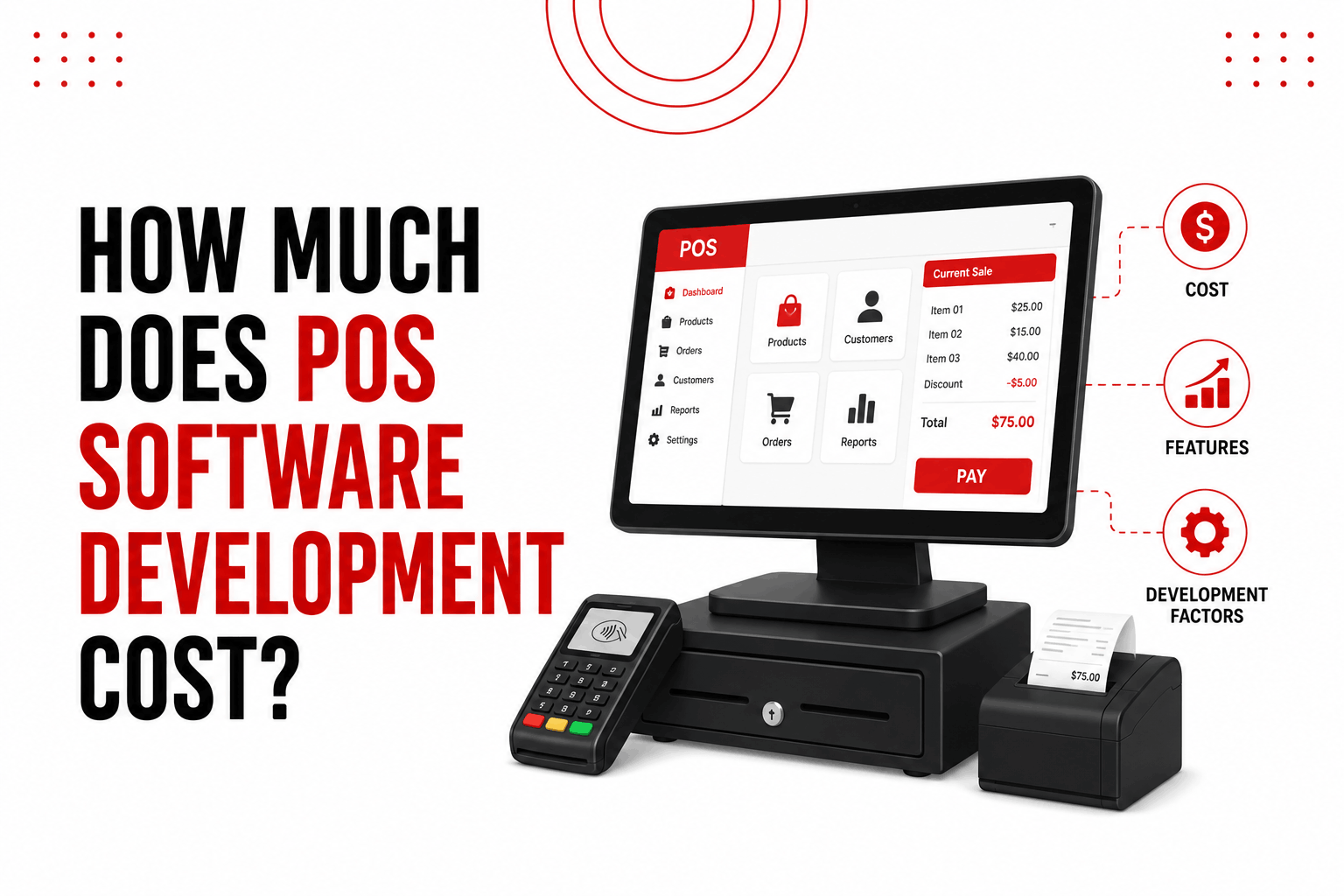
Hardware sits on the counter. Software runs the business. The cost of a point-of-sale system in 2026 divides cleanly into two different questions: what does it cost to subscribe to an existing POS platform, and what does it cost to build a custom one. These are not two points on the same spectrum. They are different decisions with different financial structures, and conflating them is the most common reason a POS budget ends up wrong.
This guide covers both, with a focus on custom development cost, including the PCI DSS v4.0 compliance obligation that is forcing upgrade cycles across the industry right now, and a forward-looking consideration most POS cost guides have not caught up with yet.
What Is POS Software?
Point-of-sale software is the system that processes transactions, manages inventory, tracks sales data, and in modern implementations, handles customer loyalty, staff management, and integrations with accounting, e-commerce, and ERP platforms. At a minimum, it records what was sold, at what price, and to whom. At an enterprise level, it becomes the central hub of a retail or hospitality operation, connecting every customer touchpoint to a single source of operational truth.
The cost of building one depends almost entirely on which of those two descriptions matches what is actually being built.
How Much Does It Cost to Build a POS System?
Custom POS software development cost in 2026 runs from approximately $8,000 for a basic system covering transaction processing and simple inventory, to $250,000 or more for an enterprise platform with multi-location support, offline capability, hardware integrations, and real-time analytics. The wide range reflects genuinely different scopes, not pricing inconsistency.
POS Software Development Cost by Build Tier
| Tier | Cost Range | What It Covers |
| Basic | $8,000 to $25,000 | Transaction processing, basic inventory, simple reporting |
| Mid-tier | $25,000 to $80,000 | Inventory management, CRM, loyalty, analytics, one payment gateway |
| Advanced | $80,000 to $150,000 | Multi-location, offline mode, multiple payment processors, advanced reporting |
| Enterprise | $150,000 to $250,000+ | Custom hardware integration, AI features, ERP/e-commerce sync, multi-region compliance |
The $8,000 to $25,000 figures cited across several current cost analyses typically reflect junior developer rates or agency entry-point pricing. A senior developer team billing at $90 to $150 per hour will price a mid-tier build higher than those entry figures suggest. Offshore teams in Eastern Europe or South Asia can deliver comparable quality at 40 to 60 percent lower labor cost, but this requires genuine retail or hospitality domain experience to deliver PCI-compliant output reliably.
POS Software Development Cost by Industry Vertical
A restaurant POS and a retail POS share a payment engine and very little else. The kitchen display system integration, table management logic, modifier cascades for menu items, and split-bill workflows that hospitality requires do not exist in a standard retail build. Building for the wrong vertical’s feature set is a reliable way to either overspend on functionality that won’t get used, or under-build and discover the gaps during a live service period.
Custom POS Software vs Off-the-Shelf: Vertical Cost Comparison
| Vertical | Key Differentiating Features | Custom Build Premium Over Basic |
| Retail (single location) | Barcode scanning, inventory sync, e-commerce integration | Low; basic build often sufficient |
| Retail (multi-location) | Centralized inventory, inter-store transfers, consolidated reporting | Moderate; adds significant backend complexity |
| Restaurant and QSR | Kitchen display integration, table management, modifiers, tip handling | High; genuinely different workflow architecture |
| Hospitality and hotel | Room charging, multi-outlet reporting, property management integration | High; requires PMS integration layer |
| Healthcare and clinics | HIPAA compliance layer, insurance billing integration, patient ID linkage | Very high; compliance layer roughly doubles development scope |
The PCI DSS v4.0 Cost Driver Almost Nobody Is Pricing
PCI DSS v4.0 compliance deadlines are creating a mandatory POS upgrade cycle across the industry in 2026. Businesses running POS software built or last updated against PCI DSS v3.x standards are now facing either a significant remediation effort or a full replacement cycle.
What is PCI DSS v4.0 and why does it affect POS development cost?
PCI DSS v4.0 is the current version of the Payment Card Industry Data Security Standard, which governs how any software processing, storing, or transmitting cardholder data must be built and operated. Version 4.0 introduced new requirements around multi-factor authentication, customized implementation approaches, and targeted risk analysis that older POS architectures were not designed to support natively. Building PCI DSS v4.0 compliance into a new custom POS from the start adds roughly $15,000 to $40,000 to development cost depending on system scope. Retrofitting it onto an existing non-compliant system typically costs considerably more, since the compliance requirements often conflict with architectural decisions already embedded in the existing codebase.
For any business evaluating a new POS build in 2026, PCI DSS v4.0 compliance is not a later-phase addition. It is a first-architecture requirement, and treating it otherwise produces a system that fails its first compliance audit.
Hidden Costs That Do Not Appear in the Development Quote
Payment Processor Lock-In
Many off-the-shelf POS platforms bundle their software with a proprietary payment processor, charging flat-rate fees like 2.6 percent plus $0.10 per transaction. This looks simple. At scale, it is expensive. A business processing $500,000 annually in card sales at that rate pays roughly $13,000 in processing fees per year. A processing-agnostic architecture, where the POS software connects to any payment processor rather than locking into one, can access interchange-plus pricing at 0.15 to 0.50 percent above interchange rather than a fixed percentage. At meaningful volume, annual savings can exceed the original development cost of building the processor-agnostic layer within two to three years.
What is a processing-agnostic POS system?
A processing-agnostic POS is one where the payment processing layer is independent of the POS software, allowing a business to choose, switch, or negotiate with payment processors without migrating their entire POS platform. It costs more to build than a single-processor integration but prevents vendor lock-in and enables meaningful cost savings at volume.
Hardware Integration Complexity
POS hardware, receipt printers, barcode scanners, cash drawers, customer-facing displays, kitchen display systems, and card terminals, each requires its own integration layer. Most development quotes price a single hardware configuration tested in a controlled environment. Real deployments involve a broader device mix, version inconsistencies across a fleet of devices, and connectivity failures that only surface under actual operating conditions. Budgeting $3,000 to $8,000 per additional hardware type beyond the base configuration is a realistic planning figure for enterprise deployments.
Offline Mode Architecture
A POS system that requires a live internet connection to process a transaction will fail at the worst possible moment, during a network outage at peak service hours. Building genuine offline capability, where the system queues transactions locally and syncs when connectivity is restored, adds $10,000 to $25,000 to development cost. It is frequently removed from initial scopes to reduce the headline number, then added back after the first real outage.
The Forward-Looking API Requirement Worth Planning Around Now
At NRF 2026, Google launched the Universal Commerce Protocol in collaboration with Shopify, Walmart, Target, Mastercard, Stripe, and Visa. UCP is an open standard that allows AI shopping agents to discover, browse, and purchase from businesses on behalf of consumers. POS systems that support UCP APIs become visible to this emerging class of AI-driven purchasing. Systems that don’t support it are invisible to it.
This is still early-stage, the way mobile commerce was early-stage in 2012. Businesses building custom POS systems in 2026 should confirm that their chosen architecture supports API extensibility sufficient to add UCP support when the standard matures. This is not a current cost requirement. It is an architectural consideration that costs almost nothing to accommodate at design time and considerably more if the POS architecture is fundamentally closed to API extension and needs to be rearchitected later.
Year 1 Total Cost by Business Profile
| Cost Category | Single-Location Retail | Multi-Location Restaurant | Enterprise Retail Platform |
| Core development | $25,000 | $70,000 | $150,000 |
| PCI DSS v4.0 compliance | $15,000 | $20,000 | $40,000 |
| Hardware integration (2 device types) | $8,000 | $15,000 | $30,000 |
| Payment processor integration | $5,000 | $8,000 | $15,000 |
| Offline mode | N/A | $15,000 | $25,000 |
| ERP/e-commerce integration | N/A | N/A | $30,000 |
| QA and testing | $5,000 | $12,000 | $25,000 |
| Cloud infrastructure (yr 1) | $3,000 | $8,000 | $18,000 |
| Year 1 total (approx.) | $61,000 | $148,000 | $333,000 |
Annual maintenance should be budgeted at 15 to 20 percent of original development cost per year, covering security updates, PCI compliance maintenance, platform updates, and bug fixes.
When Custom POS Development Is and Is Not Worth It
Custom POS development makes strong financial sense when a business processes enough volume that a processing-agnostic architecture produces annual savings that offset development cost within two to three years, when a vertical-specific workflow genuinely exceeds what a configurable off-the-shelf platform can accommodate without significant compromise, or when the POS is itself a product being built for resale or white-labeling rather than internal use only.
It makes less sense when the business has standard single-location retail or restaurant needs that an existing platform handles without significant compromise, since the faster deployment and lower upfront cost of an off-the-shelf platform outweigh the long-term advantages of ownership at smaller scale.
Working with retail software development companies with verified PCI-compliant transaction architecture experience is the most direct way to avoid the compliance gaps that turn a well-budgeted POS project into an over-budget one. For the restaurant and hospitality sector, restaurant software development companies with specific kitchen display and table management experience are the right fit, since these components are most commonly underscoped by teams without direct foodservice background.
Frequently Asked Questions
How much does it cost to build a basic POS system?
A basic POS system covering transaction processing, simple inventory tracking, and reporting costs approximately $8,000 to $25,000. This reflects simpler builds at lower labor rates; senior developer teams in the US or Western Europe will typically quote higher within this range.
What is PCI DSS v4.0 and why does it affect POS development cost?
PCI DSS v4.0 is the current version of the Payment Card Industry Data Security Standard. Its requirements for multi-factor authentication and targeted risk analysis must be built into a POS architecture from the start, adding $15,000 to $40,000 to development cost depending on scope. Retrofitting compliance onto a non-compliant existing system typically costs more than building it in correctly at the beginning.
What is a processing-agnostic POS system?
A processing-agnostic POS separates the payment processing layer from the POS software, allowing a business to choose or switch payment processors without changing their entire POS platform. At significant transaction volume, the annual savings in processing fees can exceed the additional development cost of this architecture within two to three years.
Is custom POS software worth building?
Custom development is generally worth evaluating for multi-location operations, vertical-specific workflows that off-the-shelf platforms handle poorly, and businesses processing enough transaction volume that processing-agnostic architecture produces meaningful savings. For single-location businesses with standard needs, an existing platform’s lower upfront cost and faster deployment usually wins the comparison.
What does offline mode add to POS development cost?
Building genuine offline capability typically adds $10,000 to $25,000 to a custom POS build. It is frequently removed from initial scopes to reduce the headline cost and added back after a network outage creates a real operational problem.