



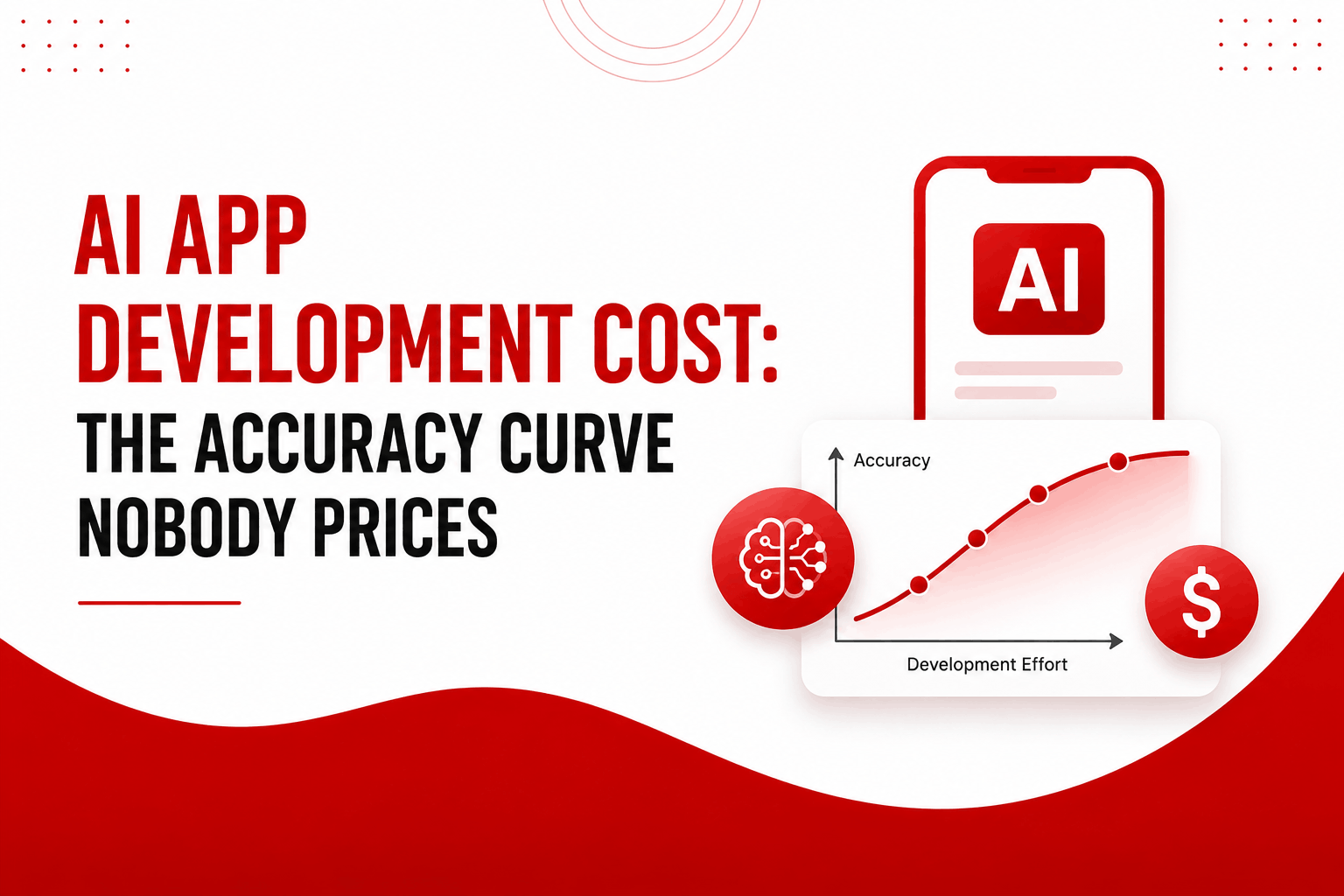
A demo that answers correctly eight times out of ten feels like a finished product. Getting that same app to answer correctly ninety-five times out of ten is not twice the work. It is frequently five to ten times the work, and almost no AI app development cost guide prices that curve directly, even the more thorough ones.
Most guides break AI app cost into the categories that matter: data readiness, model choice, integrations, security, testing, maintenance. Those categories are real and worth budgeting for. What they leave out is the relationship between cost and accuracy itself, which is not linear, and the closely related question of how much accuracy a given use case actually needs, since a support chatbot and a medical triage tool should never be priced against the same reliability bar.
What AI App Development Cost Actually Includes
AI app development cost is the full cost of building, launching, and maintaining an application that uses AI to generate, analyze, automate, or support decisions, including the application layer, data preparation, model usage, integration, security, and the ongoing cost of keeping the AI component accurate after launch.
The number that gets quoted publicly, commonly somewhere between $15,000 for a simple AI feature and $500,000 or more for an enterprise system, depends almost entirely on two questions that most quotes do not separate cleanly: how reliable does the output need to be, and what happens when it is wrong. Both questions matter more to the final cost than the feature list does, and neither gets a dedicated framework in most cost breakdowns.
The Accuracy-Cost Curve: Why the Last 10% Costs More Than the First 80
This is the core relationship that most AI app budgets miss entirely. Getting an AI feature to work most of the time is genuinely fast with modern pre-trained models. Getting it to work reliably enough for production, at a level a business is willing to put in front of real customers without constant human oversight, is a different and substantially more expensive project.
| Reliability Tier | What It Typically Requires | Relative Cost Multiplier |
| Demo-ready (roughly 70–80% correct) | A pre-trained model, basic prompting, minimal testing | 1x (baseline) |
| Pilot-ready (roughly 80–90% correct) | Prompt refinement, a curated knowledge base, structured evaluation, initial fine-tuning | 2–3x |
| Production-ready (roughly 90–97% correct) | Systematic evaluation pipelines, retrieval quality tuning, edge case handling, human review sampling | 4–7x |
| Mission-critical (97%+ correct, or formally bounded error rates) | Continuous evaluation, redundant verification layers, human-in-the-loop review at scale, regulatory-grade documentation | 8–15x+ |
The pattern driving this curve is well established in machine learning practice generally: the easy cases in any dataset get solved quickly, and the remaining errors cluster in genuinely hard edge cases that each require disproportionate effort to fix, a long-tail problem rather than a smooth, linear improvement path. Each additional percentage point of accuracy at the top of the curve typically requires identifying and specifically addressing a narrower, harder category of failure than the one before it.
The accuracy-cost curve describes the nonlinear relationship between the reliability target for an AI feature and the engineering cost required to reach it. Early gains in accuracy come cheaply from off-the-shelf models, while each additional increment of reliability beyond that point requires disproportionately more evaluation, edge case handling, and human review.
The practical implication for budgeting: the single most important question to answer before scoping an AI feature is not “what should it do” but “how reliable does it actually need to be for this specific use case.” Many AI projects overspend by chasing a reliability tier the business case never required, and just as many underspend by assuming a demo-ready prototype is most of the way to production-ready, when in cost terms it is closer to the starting line.
Risk-Tiered Cost: Why the Same Accuracy Target Costs Differently Depending on the Stakes
A second factor that compounds with the accuracy curve, and that almost no cost guide treats as its own variable, is what happens when the AI is wrong. The cost of reaching a given reliability tier is not the same across use cases, because the verification and safeguard work required scales with how bad a wrong answer actually is.
- Low-stakes failure modes. A content suggestion engine that recommends a mediocre product, or a chatbot that gives a slightly unhelpful answer, costs the business very little when it fails. These use cases can ship at a moderate reliability tier with minimal safeguard infrastructure.
- Moderate-stakes failure modes. A customer support assistant that gives an incorrect policy answer, or a sales tool that miscalculates a quote, creates real but recoverable cost when it fails: a frustrated customer, a correction email, a minor trust hit.
- High-stakes failure modes. A financial recommendation engine, a hiring screening tool, or a healthcare-adjacent application creates costly, sometimes irreversible harm when it fails, and frequently triggers regulatory or legal exposure on top of the direct business cost.
| Failure Severity | Required Safeguard Investment Beyond Base Accuracy Work | Typical Additional Cost |
| Low-stakes | Basic monitoring, occasional spot-checking | $2,000–$10,000 |
| Moderate-stakes | Structured human review sampling, clear escalation paths, user-facing confidence signaling | $15,000–$40,000 |
| High-stakes | Formal human-in-the-loop verification, audit logging, documented evaluation methodology, legal and compliance review | $50,000–$150,000+ |
A practical rule that follows directly from this: two AI features at the same accuracy tier do not cost the same to deploy responsibly if their failure modes differ in severity. Budgeting purely from a reliability target without accounting for what a failure actually costs the business is one of the more common ways AI app projects underbudget the safeguard layer specifically.
The Human-in-the-Loop Cost Line Nobody Separates From Compute
Most cost guides mention human review only inside the data preparation phase, as if labeling and cleaning data once at the start is the extent of the human labor involved. For any AI app operating above the demo-ready reliability tier, this understates a real and recurring cost category.
Human-in-the-loop review, meaning a person checking, correcting, or approving AI outputs before or after they reach a user, is not a one-time setup task for most production AI applications. It is an ongoing labor cost that scales with usage volume in a way that compute cost does not always match.
- Pre-launch evaluation labor. Building a representative test set and manually scoring model outputs against it, typically requiring 80 to 200 hours of subject-matter expert time depending on domain complexity.
- Production sampling review. Ongoing manual review of a percentage of live outputs to catch drift and edge cases before they compound, commonly costing $3,000 to $15,000 per month depending on volume and reviewer expertise required.
- Escalation handling. Human staff time spent resolving cases the AI flags as low-confidence or that users explicitly report as wrong, a cost that scales directly with user volume rather than with engineering effort.
- Specialist review for regulated domains. Healthcare, legal, and financial applications frequently require review by a licensed or credentialed professional, which costs meaningfully more per hour than general QA labor and is often legally required, not optional.
This cost category is easy to underbudget because it does not show up as a development invoice. It shows up as an ongoing operational expense, often absorbed into a department’s existing headcount until volume grows enough that it becomes visible as a real, separate line item that nobody planned for at launch.
Model Deprecation and Migration Risk
This risk is specific to AI applications in a way that does not have a clean equivalent in traditional software development, and it deserves its own line in any realistic AI app budget.
What is model deprecation risk in AI app development?
Model deprecation risk is the cost exposure created when an AI provider retires or significantly changes the specific model version an application was built and tuned around, requiring prompt engineering, evaluation, and sometimes architecture work to be redone against the replacement model.
Unlike a typical software dependency update, swapping AI models is not usually a drop-in replacement. Prompts tuned carefully against one model’s specific behavior frequently perform differently, sometimes worse, against a newer model, even from the same provider. Embeddings generated by one model are often not compatible with a different embedding model, which can mean re-processing an entire vector database. Evaluation work done to validate accuracy against the original model has to be substantially repeated against the replacement to confirm the reliability tier still holds.
This has happened repeatedly across the industry as providers have updated and retired model versions, and it is reasonable to expect it to continue happening on a similar cadence going forward, since the pace of model releases across major providers has if anything accelerated rather than slowed. A realistic budget for any AI application with meaningful prompt or embedding investment should include a recurring allocation, commonly $10,000 to $40,000 per major model transition depending on how deeply the application is tuned to model-specific behavior, treated as an expected operating cost rather than an unplanned emergency.
The mitigation available is architectural: building an abstraction layer between the application and the specific model provider, so swapping models is a contained, testable change rather than a ground-up re-validation. This costs more to build initially and substantially reduces the cost of every model transition afterward, which makes it a reasonable investment for any AI application expected to run for more than a year or two.
A Compiled Reference: Published Data Points on AI Development Cost and Adoption
The figures below are pulled from named, checkable sources rather than industry-wide informal consensus, compiled here as a single reference point.
| Data Point | Source |
| Roughly 88% of companies report using AI in at least one business function | McKinsey, State of AI research |
| AI Risk Management Framework defines trustworthy AI around reliability, safety, security, resilience, accountability, transparency, explainability, privacy, and fairness | NIST AI Risk Management Framework |
| Data collection, organization, and labeling commonly consumes a large majority of total time on AI projects | CloudFactory, cited across multiple AI development cost analyses |
| Gartner has forecast that the large majority of enterprises will have used generative AI APIs or deployed GenAI-enabled applications | Gartner enterprise AI adoption forecasts |
| Major model providers price usage on a per-token basis, with meaningfully different rates for input versus output tokens and across model tiers | Published pricing pages from OpenAI, Anthropic, and Google |
This reference table exists because most AI cost discussions cite numbers without attribution, which makes it hard to separate a verifiable figure from an informally repeated estimate. Pointing to named sources, even for figures that are widely repeated, is a small habit that makes the rest of a cost estimate easier to trust.
Realistic AI App Cost by Reliability Tier and Risk Class
Combining the accuracy curve and the risk tier produces a more useful cost estimate than either factor alone, since the two compound rather than simply add.
| Reliability Tier | Low-Stakes Use Case | Moderate-Stakes Use Case | High-Stakes Use Case |
| Demo-ready | $5,000–$20,000 | $10,000–$30,000 | Not recommended to ship at this tier |
| Pilot-ready | $20,000–$60,000 | $40,000–$100,000 | $80,000–$180,000 |
| Production-ready | $60,000–$150,000 | $100,000–$250,000 | $200,000–$450,000 |
| Mission-critical | Rarely required at this cost tier for low-stakes use cases | $250,000–$450,000 | $400,000–$800,000+ |
These figures include the application layer, data preparation, model integration, evaluation infrastructure, and the safeguard work appropriate to the risk tier. They do not include the ongoing human-in-the-loop labor cost or model transition risk covered above, both of which should be budgeted as separate, recurring operating costs rather than folded into the initial build estimate.
How to Budget Without Overpaying for Accuracy You Don’t Need
- Define the reliability tier before defining the feature set. A use case that genuinely only needs demo-level accuracy should not be budgeted, staffed, or evaluated as if it needs mission-critical reliability. Matching the tier to the actual business requirement is the single highest-leverage decision in the entire budget.
- Price the failure mode honestly before pricing the safeguards. A clear, specific answer to “what happens when this is wrong” determines how much safeguard investment is actually justified, rather than defaulting to either too little verification or an expensive blanket of caution the use case never needed.
- Budget human-in-the-loop review as a recurring operating line, not a one-time setup task. This is consistently the most underbudgeted category in AI app cost planning, and it scales with usage in a way that catches teams off guard specifically because it never appears on a development invoice.
- Build a model abstraction layer if the application is expected to run more than a year or two. The cost of model deprecation and migration compounds over the life of an application, and an abstraction layer is cheap insurance relative to a full re-validation cycle every time a provider updates its model lineup.
- Treat the accuracy curve as a stopping point, not a target to maximize. Pushing reliability beyond what the actual risk tier requires consumes budget that delivers little additional business value once the use case’s real failure cost has already been adequately covered.
If you are evaluating development partners with AI implementation experience, the software outsourcing directory on Suggestron lists teams with documented AI and machine learning delivery history. For enterprise-scale or regulated AI deployments, the enterprise software development directory covers teams with relevant compliance and governance experience.
Frequently Asked Questions
Why does AI app development cost increase so much for higher accuracy?
Accuracy improvements follow a long-tail pattern. Early gains come cheaply from pre-trained models, but each additional increment of reliability beyond roughly 80 to 90% requires identifying and fixing a narrower, harder category of edge case, which is disproportionately more expensive than the gains that came before it.
How much should I budget for human review of AI outputs after launch?
Ongoing production sampling review commonly costs $3,000 to $15,000 per month depending on usage volume and reviewer expertise required, separate from any one-time evaluation work done before launch. This should be budgeted as a recurring operating cost, not a development expense.
What is model deprecation risk and why does it matter for AI app budgets?
It is the cost exposure created when an AI provider retires or significantly updates the model version an application was tuned around, requiring prompts, embeddings, and evaluation work to be substantially redone. Budgeting $10,000 to $40,000 per major model transition as an expected recurring cost, rather than an emergency, is the realistic approach.
Does every AI app need to reach high accuracy before launch?
No. The required reliability tier should match the failure severity of the specific use case. A low-stakes feature can launch responsibly at a lower accuracy tier than a high-stakes one, and pushing accuracy beyond what the actual risk profile requires wastes budget without adding proportional business value.
The feature list tells you what an AI app is supposed to do. The accuracy curve and the failure severity tell you what it actually costs to get there responsibly, and that relationship, not the model or the integrations, is usually where an AI budget goes wrong first.