



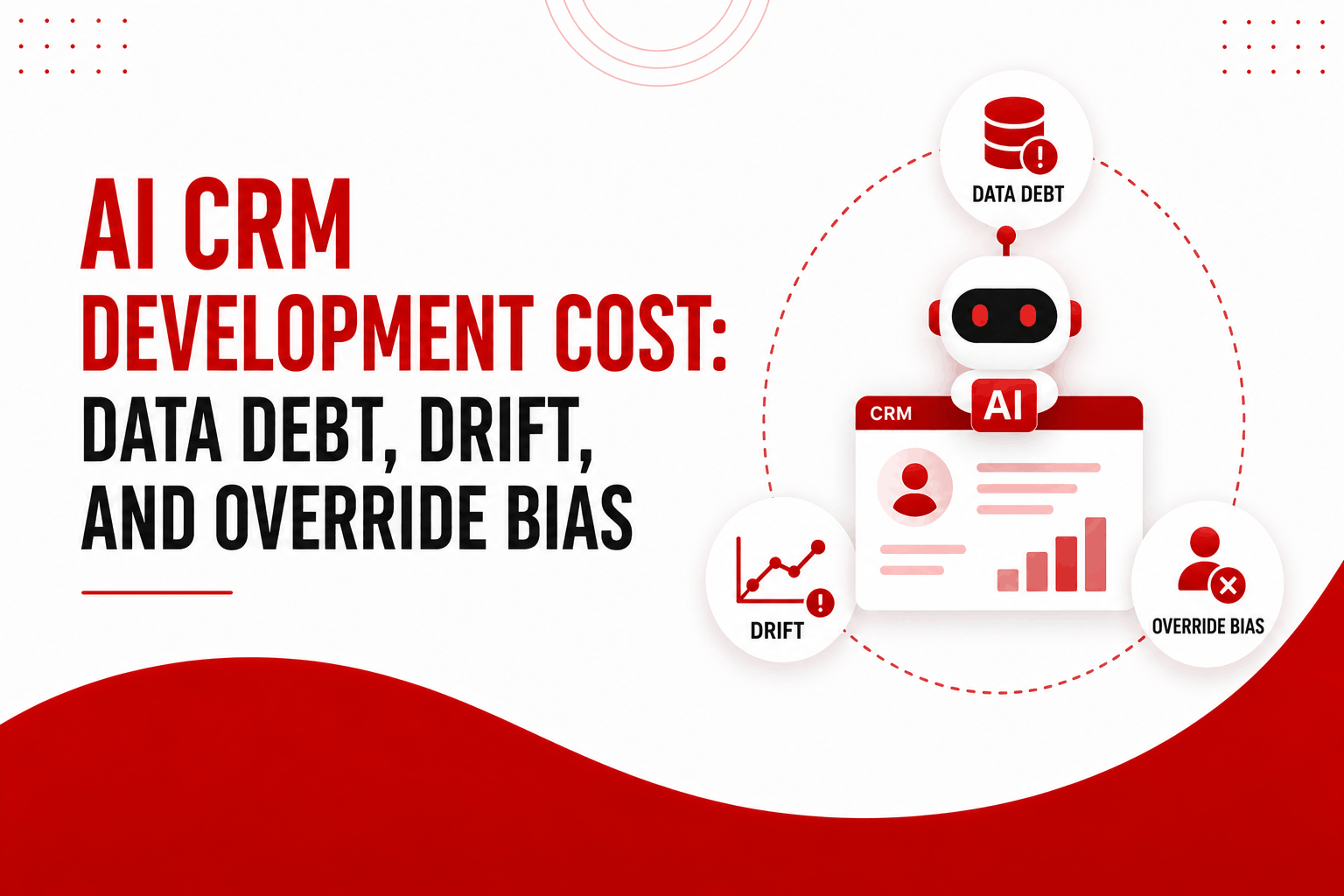
A lead scoring model trained on a year of clean CRM data can quietly become less accurate every month after launch, not because the model was built wrong, but because sales reps who do not trust the score start overriding it, and the model eventually retrains on outcomes shaped by those overrides rather than by what would have happened otherwise. This is one of the more expensive and least understood cost categories in AI CRM development, and it does not show up in any standard feature-based cost breakdown.
Most AI CRM cost guides price the visible categories well: base CRM development between $25,000 and $200,000, AI features like lead scoring or a conversational assistant adding $15,000 to $50,000 or more, integrations running $4,000 to $10,000 per connector. These numbers are accurate. What they consistently miss is what happens to an AI CRM’s accuracy and cost profile after launch, specifically the data condition the CRM was actually in before AI was added, and the feedback loop that forms once real sales reps start interacting with AI recommendations they did not ask for.
What AI CRM Development Cost Actually Includes
AI CRM development cost is the total cost of building or adding AI capabilities, such as predictive lead scoring, churn prediction, or AI-assisted communication, to a customer relationship management system, including the underlying CRM development, the AI layer itself, and the data and organizational work required for that AI layer to remain accurate after launch.
The headline cost ranges published across most guides are a reasonable starting point: a single, well-built AI capability like lead scoring for a team of 15 to 50 users commonly costs $20,000 to $60,000. A coordinated deployment of two to three capabilities for a 50 to 150 user team runs higher, often $60,000 to $150,000. The categories below are not separate from these ranges. They are the reason actual project costs frequently land at the higher end of a range, or exceed it after launch, even when the original feature scope did not change.
The Data Debt Precondition: Why Most CRMs Are Not Ready for AI on Day One
Nearly every AI CRM guide mentions that data quality matters. Almost none price what it actually costs to get years of accumulated CRM data into a state where an AI model can learn something reliable from it.
CRM data debt is the accumulated inconsistency in a customer relationship management system’s historical data, including duplicate contact records, stale or incorrectly advanced pipeline stages, inconsistent field usage across different sales reps, and incomplete or contradictory activity logs, built up over years of manual data entry without centralized data governance.
This debt is close to universal in CRMs that have been in active use for more than a couple of years, because CRM data entry quality depends heavily on individual rep habits, and habits vary widely across a sales team. A lead scoring model trained directly on this data without a cleanup pass will learn patterns from the noise as readily as from the signal, often producing a model that looks statistically reasonable in testing but performs poorly against real, current leads because it absorbed years of inconsistent labeling along the way.
| Data Debt Category | What It Looks Like in Practice | Typical Cleanup Cost |
| Duplicate and fragmented contact records | The same lead exists as three separate records with different activity histories | $8,000–$20,000 depending on database size |
| Stale or inconsistent pipeline stages | Deals sitting in “negotiation” for a year, or reps using stages inconsistently to track personal priorities rather than actual deal state | $5,000–$15,000 to audit and reconcile |
| Inconsistent field usage across reps | Some reps fill in custom fields diligently, others leave them blank or use them differently, making the field unreliable as a training signal | $6,000–$18,000 |
| Incomplete activity logging | Calls and emails that happened but were never logged, making engagement-based features unreliable | $5,000–$15,000, often requiring a data reconciliation pass against email and calendar systems |
A reasonable allocation for a comprehensive data debt audit and cleanup before any AI feature is trained is commonly $20,000 to $50,000 for a mid-sized CRM with several years of history, a cost that almost never appears as its own line item, and is instead either skipped entirely, producing a model trained on bad data, or discovered mid-project and absorbed as an unplanned overrun.
The Override Feedback Loop: How Sales Rep Distrust Quietly Corrupts the Model
This is the mechanism that most directly explains why an AI CRM feature can degrade in accuracy over time even without any change to the underlying model or its training process, and it is specific to how lead scoring and similar predictive features actually get used in practice.
When a sales rep sees an AI-generated lead score they disagree with, a common and entirely reasonable response is to ignore it and work the lead according to their own judgment instead. This is not a problem on its own. The problem appears later, when the model is retrained on outcome data, which deal closed, which lead went cold, because that outcome data was shaped by which leads reps actually worked, which was shaped by which scores reps trusted or ignored.
The override feedback loop occurs when sales reps override an AI model’s recommendations based on their own judgment, and the resulting deal outcomes, which reflect the reps’ overridden decisions rather than the model’s original recommendation, become part of the data the model later retrains on. This can cause the model to reinforce its own errors rather than correct them, since the ground truth it learns from is contaminated by the very distrust it is supposed to overcome.
A concrete version of this: if reps consistently override low scores on leads they personally believe in, and some of those leads do close, the model retrains believing its low-score predictions were wrong in exactly the cases where a rep happened to intervene, which can push the model to inflate scores in ways that have nothing to do with the lead’s actual underlying quality. Over enough cycles, the model’s relationship to ground truth degrades in a way that is difficult to detect from aggregate accuracy metrics alone, since the metrics are also being measured against an outcome dataset that the overrides have already shaped.
The mitigation has a real, specific cost: tracking overrides as their own labeled category, separate from the model’s original recommendation and the eventual outcome, so the model can be retrained against a dataset that distinguishes “the model predicted X and a rep did nothing differently” from “the model predicted X and a rep intervened, changing what would have happened.” Building this override-tracking infrastructure typically costs $10,000 to $25,000, and it is one of the more commonly skipped components in a first-generation AI CRM build, specifically because the problem it solves is not visible until several retraining cycles in, by which point reversing the contamination in historical training data is considerably harder than preventing it would have been.
The Adoption Resistance Cost Specific to Sales Teams
Generic change management advice treats AI adoption resistance as a training and communication problem. Sales teams carry a more specific reason for resistance that training alone does not fully address, and pricing it as standard change management understates what it actually takes to resolve.
A sales rep’s compensation is typically tied directly to closed deals, and a lead scoring system that deprioritizes a lead the rep was planning to work feels, from the rep’s perspective, like a direct threat to their income, not a productivity tool. This is structurally different from, say, a support agent adopting a new ticketing workflow, where the stakes are lower and the incentive misalignment is weaker. Sales-specific adoption resistance tends to show up as quiet workaround behavior, reps continuing their existing process while nominally using the new tool, rather than open resistance that a training program can directly address.
- Compensation and incentive alignment review. Confirming that the AI tool’s recommendations do not create a perceived conflict with how reps are compensated, or adjusting incentive structures so the AI genuinely helps reps hit their numbers rather than appearing to compete with their judgment, typically requires sales leadership involvement costing $5,000 to $15,000 in facilitation and process design time.
- Transparency into model reasoning. Reps are considerably more likely to trust and act on a score when they can see roughly why it was generated, which company history or behavior pattern drove it, rather than receiving an opaque number. Building this explanation layer into the interface costs $8,000 to $20,000 but meaningfully reduces both resistance and the override feedback loop covered above.
- Pilot with a credible internal champion before full rollout. A phased rollout led by a respected top performer who genuinely uses and benefits from the tool does more to drive adoption than a company-wide training session, and structuring a deliberate pilot phase, rather than a single launch event, costs little extra but requires real planning, commonly folded into $5,000 to $10,000 of structured rollout management.
Skipping this category does not eliminate the cost. It shows up later as low actual usage of an AI feature that was fully built and technically functional, which is a failure mode distinct from a technical bug and considerably harder to diagnose after the fact.
Model Drift Specific to Sales Cycles
Generic AI maintenance guidance covers model drift as a universal concern. Sales-specific drift has mechanics worth naming directly, since the triggers are tied to the business cycle rather than to the technology itself.
A lead scoring model trained during one pricing structure, one set of target verticals, or one competitive landscape can degrade meaningfully when any of those change, even if the change has nothing to do with the model’s technical design. A new pricing tier shifts what an ideal customer profile actually looks like. A new competitor entering the market changes which objections and signals actually predict a close. A territory realignment changes which reps are working which segments, which changes the behavioral patterns the model was trained to recognize.
| Sales Cycle Trigger | Effect on Model Accuracy | Typical Re-tuning Cost |
| Pricing or packaging change | Ideal customer profile shifts; historical scoring criteria partially outdated | $8,000–$20,000 |
| New competitive entrant | Win/loss signals shift; previously predictive behaviors become less reliable | $6,000–$15,000 |
| Territory or team realignment | Behavioral patterns tied to specific reps or regions no longer map cleanly | $5,000–$12,000 |
| Significant product expansion | New use cases and buyer personas the original model never saw | $10,000–$25,000 |
The practical budgeting implication: re-tuning cost should be tied to business change events, not to a fixed calendar schedule. A model that has not been retrained in a year but operates in an unchanged market may still be performing well, while a model retrained three months ago against a market that just shifted under a major pricing change may already need attention again.
Realistic AI CRM Development Cost by Capability Tier and Data Readiness
| Capability Tier | Clean, Well-Governed CRM Data | Significant Data Debt Present |
| Single AI capability (lead scoring or AI email assistant), 15–50 users | $25,000–$55,000 | $45,000–$90,000 |
| Multi-capability (lead scoring + email AI + chatbot), 50–150 users | $65,000–$140,000 | $100,000–$210,000 |
| Strategic deployment (4–6 capabilities including forecasting), 100+ users | $150,000–$350,000+ | $220,000–$450,000+ |
These figures include the override-tracking infrastructure and adoption planning covered above, alongside standard AI CRM development cost. They do not include ongoing re-tuning cost tied to business cycle changes, which should be budgeted as a recurring, event-triggered expense rather than folded into the initial build.
How to Budget Without Inheriting a Corrupted Model Later
- Audit CRM data debt before scoping any AI feature, not after the first model underperforms. A clean training dataset is cheaper to build deliberately than to reconstruct after a model has already learned the wrong patterns from years of inconsistent data entry.
- Build override tracking into the system from the first version, not as a later addition. Distinguishing “the model’s prediction stood unchanged” from “a rep intervened and changed the outcome” is the only way to retrain responsibly without reinforcing the model’s own errors.
- Treat sales adoption resistance as an incentive problem, not just a training problem. A rep who perceives the AI as a threat to their commission will find workarounds regardless of how good the training materials are, and addressing the underlying incentive concern is cheaper than diagnosing low adoption after launch.
- Schedule model re-tuning around business events, not a fixed calendar. A pricing change, a new competitor, or a territory realignment is a more reliable trigger for re-evaluation than an arbitrary quarterly or annual schedule.
- Pilot with a credible internal champion before a full rollout. This single decision does more to prevent both adoption resistance and the override feedback loop than any amount of post-launch troubleshooting.
If you are evaluating development partners with CRM and sales AI implementation experience, the software outsourcing directory on Suggestron lists teams with documented CRM integration history. For larger sales organizations evaluating multi-capability deployments, the enterprise software development directory covers teams with relevant data governance experience.
Frequently Asked Questions
Why does AI CRM lead scoring accuracy sometimes degrade after launch?
A common cause is the override feedback loop, where sales reps overriding AI recommendations shape the outcome data the model later retrains on, reinforcing the model’s own errors rather than correcting them. This is distinct from normal model drift and requires tracking overrides separately from outcomes to diagnose and fix.
How much does CRM data cleanup cost before adding AI features?
A comprehensive data debt audit and cleanup for a mid-sized CRM with several years of history commonly costs $20,000 to $50,000, covering duplicate contact resolution, pipeline stage reconciliation, and inconsistent field usage across the sales team.
Why do sales teams resist AI CRM features more than other departments?
Sales compensation is typically tied directly to closed deals, which makes an AI tool that deprioritizes a lead a rep was working feel like a direct threat to income rather than a productivity improvement. This requires addressing incentive alignment specifically, not just standard training and communication.
How often should an AI CRM model be retrained?
Retraining is more reliably triggered by business cycle events, a pricing change, a new competitor, a territory realignment, than by a fixed calendar schedule, since these events are what actually change the patterns the model needs to recognize.
The lead scoring model and the integrations get most of the attention in an AI CRM budget because they are the easiest to scope and quote. The data condition underneath them, the feedback loop forming around them, and the sales-specific resistance to trusting them are where the real, ongoing cost of an AI CRM project tends to live.