



Two AI tools with nearly identical clinical purpose, flagging an abnormality on a scan, can face development budgets that differ by hundreds of thousands of dollars and over a year of timeline, because one qualifies for a faster regulatory pathway and the other does not. That difference is not a build decision. It is a classification decision made early, often before a single model is trained, and it deserves far more attention in a cost estimate than it typically gets.
Most AI healthcare cost guides do a genuinely good job pricing the categories everyone expects: data preparation, model development, EHR integration, and a general allocation for compliance. What they consistently underprice is the regulatory pathway itself as a cost driver, the lifecycle cost of updating a cleared model after launch, the cost of validating performance across patient subgroups rather than just in aggregate, and the liability question nobody wants to ask out loud until something goes wrong.
What AI Healthcare Software Development Cost Actually Includes
Software as a Medical Device, commonly abbreviated SaMD, is software intended to diagnose, treat, monitor, or otherwise inform clinical decisions, which in most jurisdictions makes it subject to regulatory review before it can be marketed or used in patient care. Whether an AI healthcare tool qualifies as SaMD, and at what risk tier, determines which of several very differently priced regulatory paths it must take.
Published cost ranges in this category are genuinely useful as a starting point: simple administrative or patient-facing tools, $10,000 to $50,000; diagnostic AI for radiology or pathology, $50,000 to $300,000; full enterprise systems integrated across a hospital network, $300,000 and up, sometimes well past $1,000,000. These ranges are accurate, and they consistently bundle “regulatory compliance” as a single line within them, when it is actually one of the most variable cost categories in the entire project, capable of moving a tool from one end of its range to the other on its own.
The Regulatory Pathway Decision: 510(k) vs De Novo vs PMA
This is the single biggest lever in AI healthcare cost that most budgets treat as a fixed, already-known cost rather than an open decision with major financial consequences.
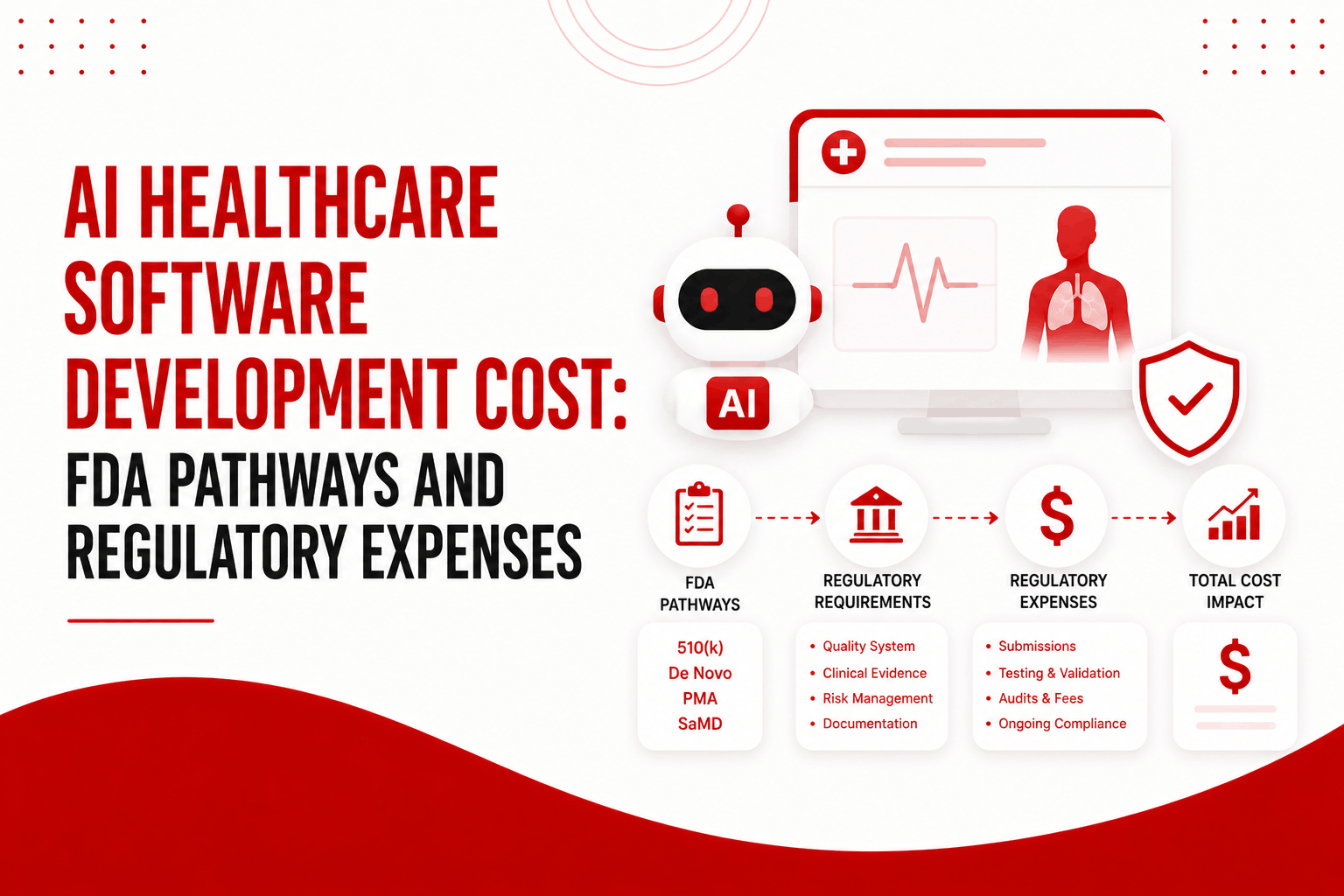
The FDA offers three primary pathways for medical device clearance or approval: the 510(k) pathway, which requires demonstrating substantial equivalence to an already-cleared predicate device; the De Novo pathway, used when no suitable predicate exists but the device’s risk is still manageable through general controls; and the Premarket Approval, or PMA, pathway, reserved for the highest-risk devices and requiring the most extensive clinical evidence.
| Pathway | When It Applies | Typical Cost | Typical Timeline |
| 510(k) | A similar, already-cleared device exists as a predicate; moderate risk | $200,000–$500,000, including documentation, testing, and review support | 6–12 months |
| De Novo | No predicate exists, but risk can be managed through standard controls | $400,000–$900,000, since more original evidence is required without a predicate to lean on | 10–18 months |
| PMA | Highest-risk devices, typically those directly driving treatment decisions with limited room for clinical correction | $1,000,000–$5,000,000+, including extensive clinical trials | 2–4 years, sometimes longer |
The cost gap between these pathways is not incremental. It is closer to an order of magnitude between 510(k) and PMA, and the pathway a specific tool qualifies for depends on its intended use and risk profile, not on which path a development team would prefer to take. A diagnostic aid that flags a finding for physician review, with the physician retaining full decision authority, typically sits in 510(k) or De Novo territory. A tool that directly drives a treatment decision with limited physician oversight built into the workflow is far more likely to require PMA, regardless of how technically similar its underlying model is to a lower-risk tool.
The practical implication for budgeting: the regulatory pathway should be assessed as early as possible, ideally before architecture decisions are finalized, because the intended use statement, how the tool is described and positioned in its regulatory submission, can sometimes be the difference between qualifying for 510(k) and being pushed into a substantially more expensive De Novo or PMA pathway. This is not about gaming the classification. It is about recognizing that small differences in how a tool is scoped and positioned can have six-figure cost consequences, which makes early regulatory strategy one of the highest-leverage conversations in the entire project.
The Predetermined Change Control Plan: Pricing the Lifecycle, Not Just the Launch
This is the cost category that almost no healthcare AI guide addresses, despite a real, increasingly important FDA framework built specifically to address it.
AI models are not static once cleared. They benefit from retraining as more data becomes available, and many healthcare AI vendors plan to improve their models over time. Without a specific mechanism to account for this, every meaningful model update technically requires a new regulatory submission, since the cleared version of the device is the specific version that was reviewed, not whatever version exists after retraining.
What is a Predetermined Change Control Plan? A Predetermined Change Control Plan, commonly abbreviated PCCP, is a regulatory mechanism that allows an AI device manufacturer to pre-specify, as part of the original submission, the types of future modifications the model may undergo and the protocol for validating those changes, without requiring a brand new submission for each update that falls within the pre-specified scope.
The cost trade-off here is real and rarely modeled explicitly:
| Approach | Upfront Regulatory Cost | Cost of Each Future Model Update |
| No PCCP, standard clearance only | Lower upfront, included in the base pathway cost | $50,000–$200,000+ per update, since each meaningful retraining may require a new or supplemental submission |
| PCCP included in original submission | $50,000–$150,000 additional upfront, since the change protocol itself must be defined and justified | $10,000–$40,000 per update within the pre-specified scope, primarily internal validation rather than full resubmission |
For a healthcare AI tool expected to be retrained or meaningfully updated more than once or twice over its commercial life, which describes most models trained on real-world clinical data that continues to evolve, the cumulative cost of the no-PCCP path frequently exceeds the upfront investment in a PCCP within two to three update cycles. Budgeting only for the initial clearance, without modeling this lifecycle cost, is one of the more consistent and avoidable gaps in healthcare AI financial planning, largely because the PCCP framework is still new enough that many cost guides have not caught up to including it.
Subgroup Validation: Why Aggregate Accuracy Is Not the Whole Story
Every healthcare AI cost guide mentions clinical validation as a budget line. Almost none separate aggregate validation, does the model perform well across the dataset as a whole, from subgroup validation, does the model perform comparably well across different patient populations within that dataset.
This distinction has real regulatory and clinical weight. A diagnostic model that performs at 95 percent accuracy in aggregate can still perform meaningfully worse for specific demographic subgroups if those subgroups were underrepresented in training data, a well-documented failure mode in medical AI generally. Regulators have increasingly expected performance to be reported and validated across relevant subgroups, not just in aggregate, specifically because aggregate accuracy can mask a model that works well for the majority population and poorly for others.
Subgroup validation is the process of testing and reporting a model’s performance separately across relevant patient subgroups, such as age, sex, race, or comorbidity status, rather than relying solely on an aggregate accuracy figure that can obscure meaningfully uneven performance across different populations.
This work has a real, separate cost: securing a sufficiently large and diverse validation dataset across the relevant subgroups, which is often harder and more expensive than securing a large aggregate dataset, running and reporting performance metrics separately for each subgroup, and in many cases iterating on the model specifically to close gaps identified during this process. A reasonable allocation for subgroup validation work, beyond standard aggregate clinical validation, is commonly $40,000 to $120,000 depending on how many subgroups are relevant and how accessible diverse data already is within the organization’s existing datasets. Organizations with historically homogeneous patient data face the higher end of this range, since acquiring genuinely diverse validation data from scratch is its own significant undertaking.
The Liability Layer Nobody Prices
This is the category that almost never appears in a healthcare AI cost guide, despite being one of the more consequential financial questions a healthcare organization or AI vendor will eventually have to answer.
When an AI tool contributes to a clinical decision that leads to a poor patient outcome, the liability question, who bears responsibility, the clinician who relied on the tool, the health system that deployed it, or the vendor that built it, is genuinely unsettled in many jurisdictions and depends heavily on how the tool was positioned, what its labeling claimed, and what oversight the clinical workflow actually required.
This uncertainty has real, priceable consequences:
- Liability insurance premiums. Healthcare AI vendors and health systems deploying AI-assisted diagnostic or treatment tools commonly carry specialized liability coverage, and premiums for AI-specific coverage are generally higher than for traditional clinical software, reflecting genuine uncertainty in how courts and regulators will eventually resolve these cases.
- Indemnification negotiation. Contracts between AI vendors and health systems increasingly include detailed indemnification clauses specifying which party bears financial responsibility under which circumstances, and negotiating these terms properly requires legal expertise specific to healthcare AI, not generic technology contract review.
- Documentation and audit trail cost. A robust audit trail showing exactly what the AI recommended, what the clinician saw, and what decision was ultimately made is both a regulatory expectation and a practical necessity if liability is ever contested, and building this properly is a real engineering cost, not an afterthought.
A reasonable allocation for legal review, indemnification negotiation, and liability-specific insurance setup during initial development is commonly $20,000 to $60,000, with ongoing insurance premium cost varying significantly based on the tool’s risk classification and deployment scale. This is a category many smaller healthcare AI projects skip or underbudget specifically because it does not block a launch the way a regulatory clearance does, but it remains a real financial exposure that grows, not shrinks, as deployment scale increases.
Realistic AI Healthcare Software Development Cost by Risk Class and Pathway
| Risk Class | Pathway | Realistic Total Cost (Including Pathway, PCCP, Subgroup Validation, Liability Setup) |
| Low risk (administrative, scheduling, non-diagnostic patient tools) | Often exempt or minimal regulatory burden | $20,000–$80,000 |
| Moderate risk (diagnostic aid with physician oversight, predicate exists) | 510(k) | $300,000–$700,000 |
| Moderate-high risk (diagnostic aid, no predicate available) | De Novo | $550,000–$1,100,000 |
| High risk (directly drives treatment with limited oversight) | PMA | $1,500,000–$6,000,000+ |
These figures include the development cost, the regulatory pathway cost appropriate to the risk class, an upfront PCCP allocation where applicable, subgroup validation work, and initial liability and legal setup. They do not include ongoing model update costs beyond the PCCP’s pre-specified scope, EHR integration cost, which varies independently based on the specific hospital systems involved, or the recurring liability insurance premium, which should be budgeted as an ongoing operating cost rather than a one-time development expense.
How to Budget Without Underpricing the Regulatory Layer
- Determine the likely regulatory pathway before finalizing the tool’s intended use statement, not after. Small differences in how a tool is scoped can shift it between pathways with a cost difference measured in hundreds of thousands of dollars, making this one of the earliest and highest-leverage decisions in the entire project.
- Model the lifecycle cost of model updates, not just the initial clearance. A tool expected to be retrained multiple times over its commercial life should have a PCCP evaluated seriously, since the cumulative cost of resubmitting for each update frequently exceeds the upfront PCCP investment within a few update cycles.
- Budget subgroup validation separately from aggregate clinical validation. Treating these as the same line item risks underbudgeting the harder and more expensive work of securing genuinely diverse validation data, and risks shipping a tool with meaningfully uneven performance across patient populations.
- Address liability and indemnification during development, not after a deployment-stage legal review surfaces it as a blocker. This is a relatively modest cost to address early and a substantially more expensive and disruptive one to address after a contract is already being negotiated under time pressure.
- Treat the regulatory and liability layer as proportional to clinical risk, not as a flat percentage applied uniformly. A low-risk administrative tool genuinely does not need PMA-level investment in any of these categories, and applying enterprise-grade regulatory spend to every healthcare AI project regardless of actual risk wastes budget that the project’s risk profile never required.
Frequently Asked Questions
How much does FDA clearance add to AI healthcare software development cost?
It depends heavily on the pathway. A 510(k) submission commonly costs $200,000 to $500,000, while a De Novo pathway can run $400,000 to $900,000, and PMA approval for the highest-risk tools can exceed $1,000,000 to several million dollars, largely due to the extensive clinical trial requirements involved.
What is a Predetermined Change Control Plan and why does it matter for cost?
A PCCP lets an AI device manufacturer pre-specify how a model may be updated in the future without requiring a full new submission for each change. It costs more upfront but commonly saves money over the tool’s lifecycle if the model is expected to be retrained or updated more than once or twice after initial clearance.
Why does subgroup validation cost more than standard clinical validation?
Subgroup validation requires a sufficiently large and diverse dataset across relevant patient populations, which is often harder to secure than a large aggregate dataset, plus separate performance reporting and potential model iteration to close any gaps identified across subgroups, rather than relying on a single aggregate accuracy figure.
Who is liable if an AI healthcare tool contributes to a poor patient outcome?
This remains genuinely unsettled in many cases and depends on the tool’s labeling, the oversight built into the clinical workflow, and the specific contractual indemnification terms between the vendor and the health system. This uncertainty is exactly why liability insurance and indemnification negotiation should be budgeted as real costs during development rather than addressed only after a dispute arises.
The development categories every cost guide covers, data, models, integration, are necessary but not sufficient for an accurate healthcare AI budget. The regulatory pathway, the lifecycle cost of future updates, subgroup validation, and liability exposure are where the real budget risk concentrates, and they deserve the same deliberate planning as the engineering work everyone already expects to pay for.