



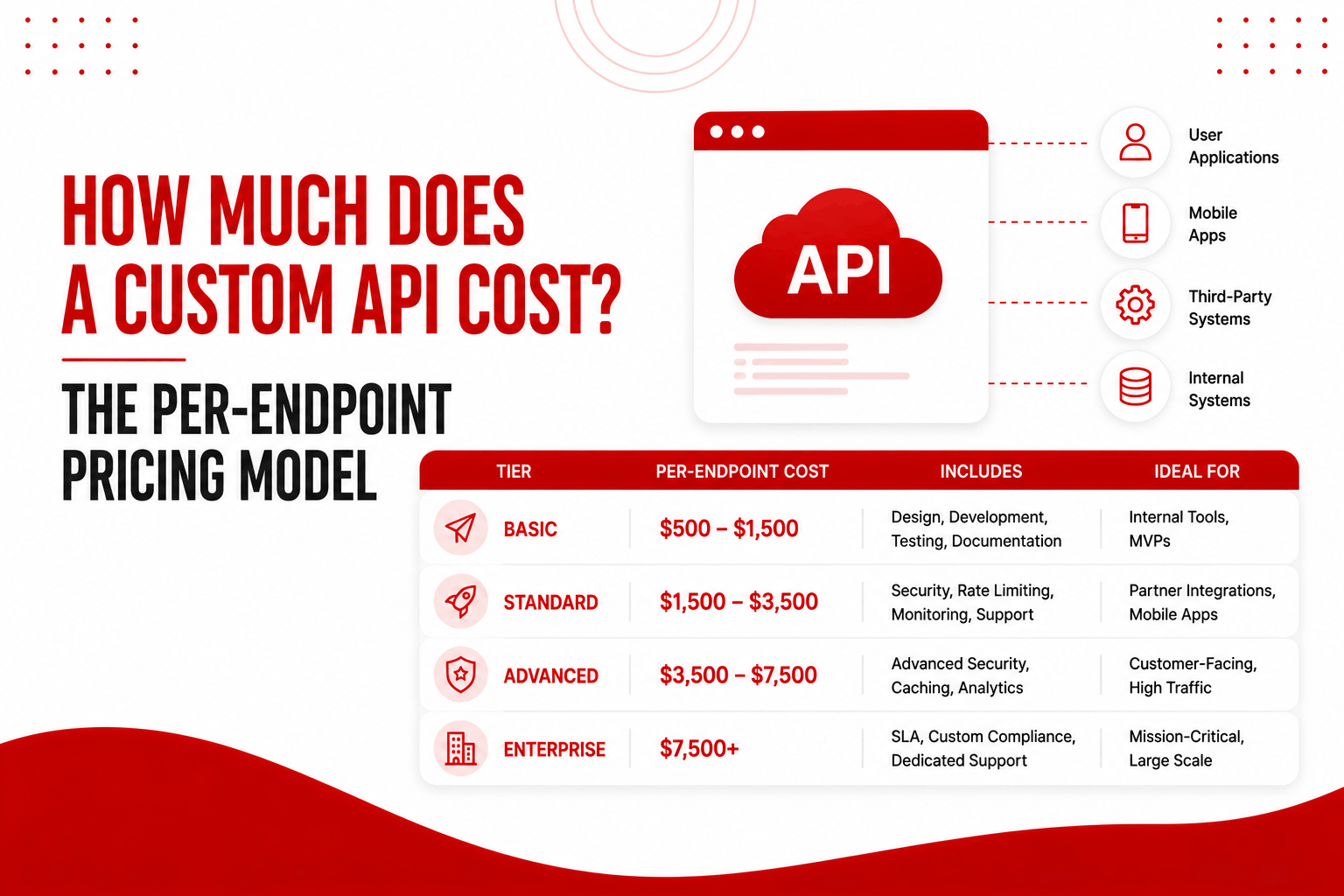
| Endpoint count describes 40% of what actually gets built. Authentication, rate limiting, error handling, versioning, documentation, and third-party integration work are in every API. They are in almost no quote. This guide shows what the invisible 60% costs and how to prevent it from appearing as a change order. |
I. THE SCOPE PROBLEM
Every API project that overruns budget does so for the same reason: the quote was built around the endpoint list.
The endpoint list is accurate. It describes every URL the API will expose. What it does not describe is the authentication system that gates every one of those URLs, the rate limiting that protects every one of those URLs, the error schema that every one of those URLs must return, the documentation that describes every one of those URLs, or the versioning strategy that governs what happens when any one of those URLs changes.
Acquaint Softtech’s 2026 analysis of API budget overruns found this pattern consistent across project sizes: endpoint-count quoting covers approximately 40% of what actually ships. The remaining 60% appears mid-project as change orders, or at launch when the client asks who handled rate limiting, or six months later when the first breaking change happens and there is no versioning strategy to manage it.
Per-endpoint pricing is not inherently wrong. It is a useful unit for estimating the visible layer of an API. The problem is that buyers use it as the whole budget. This guide separates the two layers, shows what each invisible component costs, and gives buyers the questions to ask before any quote is signed.
II. WHAT IS INSIDE A SINGLE ENDPOINT (AND OUTSIDE EVERY QUOTE)
The table below dissects eight representative endpoints. The left column shows what gets quoted. The right column shows what ships with every one of those endpoints in any production-quality API. The right column is almost never in the initial scope document.
| Endpoint in the quote | Work that actually ships with it (not in the quote) |
| GET /users | Auth middleware, role check, pagination, cursor tokens, rate limit per IP |
| POST /users | Input validation schema, duplicate detection, email verification trigger, audit log write |
| PUT /users/{id} | Partial update logic, field-level permission check, optimistic lock, change event emit |
| DELETE /users/{id} | Soft delete vs hard delete decision, cascade policy, GDPR erasure confirmation, webhook fire |
| GET /orders | Multi-tenant filter, date range query optimisation, nested resource serialiser, N+1 query prevention |
| POST /orders | Idempotency key handling, inventory check, payment intent creation, rollback on partial failure |
| PATCH /orders/{id}/status | State machine validation, disallowed transition error, downstream notification, SLA timestamp |
| POST /auth/token | Refresh token rotation, concurrent session limit, device fingerprint, brute-force lockout |
| Why this matters to the budget
At $80 to $120 per hour for a mid-market development team, the invisible work on the right side of that table adds between 2 and 5 hours per endpoint in a well-scoped project. On a 30-endpoint API, that is 60 to 150 hours of unquoted work — $4,800 to $18,000 at mid-market rates before a single piece of the invisible layer is discussed. On a 100-endpoint enterprise API, the invisible layer commonly exceeds the visible layer in total hours. |
III. THE COST MULTIPLIER: HOW EACH INVISIBLE LAYER SCALES WITH AMBITION
The invisible layer is not a fixed cost. Each component scales with the level of production quality required. The table below shows four quality levels for six core invisible layers, with the multiplier each level applies to the base endpoint cost. A 0.5x implementation is minimum viable. A 3x implementation is enterprise-grade. Most SaaS products land between 1x and 2x on each layer.
| Layer | 0.5x (quoted minimum) | 1x (standard production) | 2x (SaaS-grade) | 3x (enterprise/regulated) |
| Authentication system | Basic API key | OAuth 2.0 + JWT | OAuth 2.0 + RBAC + SSO | OAuth 2.0 + RBAC + SSO + PKCE + MFA |
| Rate limiting | IP-level throttle | Per-user rate limit | Tiered quotas by plan | Dynamic burst control + quota enforcement API |
| Error handling | HTTP status + message | RFC 7807 error schema | Structured errors + retry guidance + correlation IDs | Full observability events + circuit breaker pattern |
| API documentation | Inline code comments | OpenAPI 3.0 spec | OpenAPI + interactive sandbox + changelog | Developer portal + code samples in 4 languages + webhooks docs |
| Versioning strategy | None (v1 only) | URI versioning (/v1, /v2) | Header versioning + sunset policy | Multi-version parallel support + migration guides |
| Testing coverage | Happy path only | Unit tests + contract tests | Integration + load tests + chaos tests | Full test suite + automated regression in CI/CD |
| How to use this table
Identify which column applies to each layer for your specific product. Sum the column selections across all six layers to produce a rough quality-adjusted cost multiplier. A product selecting 1x on every layer will cost approximately 1x the endpoint price times the endpoint count. A product selecting 2x on every layer will cost approximately 2x to 2.5x. A product mixing 1x and 2x will land between those figures. This is a directional tool, not a precise calculator, but it resolves the most common budget miss: treating every invisible layer as a 0.5x when the product requires a 2x. |
IV. REST, GRAPHQL, GRPC, WEBSOCKET: THE CHOICE THAT SETS THE COST FLOOR
Architecture selection happens before any endpoint is scoped. It sets the cost floor for every other decision. The table below maps each API type to its appropriate use case, team requirement, and the hidden cost trigger that teams discover after the decision is locked.
| Type | Choose when | Team requirement | Advantage | Hidden cost trigger |
| REST | Standard CRUD app, SaaS backend, public third-party API | Any developer; universal tooling (Swagger, Postman) | Simple to version, cache, and debug; proven patterns | Over-fetching on complex screens; multiple round trips for nested data |
| GraphQL | Complex frontend with many data shapes; multi-client (mobile + web) | Specialist needed; resolver logic adds scope | Single endpoint; client controls query shape; strong typing | No HTTP caching out-of-box; schema design adds weeks; query complexity attack surface |
| gRPC | Internal microservices; high-frequency inter-service calls | Senior backend; Protobuf expertise required | Fastest serialisation; strongly typed contracts; streaming native | Binary protocol; browser-hostile without proxy; debugging harder |
| WebSocket | Real-time features: notifications, live dashboards, collaborative tools | Standard skill; stateful connection management needed | Persistent connection; low-latency; server push | No REST semantics; requires connection state; scales differently from HTTP |
| Webhook (outbound) | Event-driven integrations; notifying third parties of state changes | Standard skill; signature verification required | Decoupled; no polling; third-party integration standard | Retry logic, idempotency, and payload security must be built; no query interface |
| The most common wrong architecture choice in 2026
GraphQL is frequently selected because it sounds modern. It costs significantly more to build and requires specialist expertise in schema design, resolver optimization, and query complexity limiting. For a straightforward SaaS backend with a web app and a mobile app consuming the same data, a well-designed REST API with resource nesting is cheaper to build, easier to cache, and faster to debug. GraphQL earns its cost premium only when you have multiple clients with genuinely different data shape requirements or a frontend team sophisticated enough to write efficient queries. |
V. WHAT DEVELOPERS ACTUALLY CHARGE IN 2026
Developer hourly rates for API work span a 10-to-1 range. The rate differential between US senior engineers and Southeast Asia generalists is real. So are the cases where the rate premium is worth it and the cases where it is not. The distinction matters more for API development than for most software categories because architectural decisions made in the first 10% of the project determine maintenance costs for years.
| Developer type | US (senior) | Eastern Europe | India / Southeast Asia | When the premium is worth it |
| REST API generalist | $120-$160/hr | $45-$75/hr | $20-$40/hr | Never for CRUD; US rates rarely justified for standard REST |
| GraphQL specialist | $130-$175/hr | $55-$85/hr | $30-$55/hr | When schema design errors cost more than the rate premium saves |
| API security engineer | $150-$200/hr | $70-$100/hr | $40-$65/hr | Any public API; any regulated vertical. Do not cut this rate |
| API architect (system design) | $175-$250/hr | $80-$120/hr | $50-$80/hr | First 10-20 hours of any project above 50 endpoints. Saves multiples |
| Technical writer (API docs) | $80-$120/hr | $35-$60/hr | $20-$40/hr | Developer portals and partner APIs; saves 10x in integration support cost |
| The role where cutting rate is most expensive: API architect
The first 10 to 20 hours of any API project above 50 endpoints should be spent with an API architect whose rate reflects their experience. A $200/hour API architect who prevents a poor versioning decision saves more than the $3,000 to $4,000 rate premium at the first breaking change. A $30/hour generalist who makes that versioning decision incorrectly creates a migration project that costs $20,000 to $60,000 to fix. Rate optimization on the architect role is the highest-risk API budget decision. |
VI. THE BUDGET RISK REGISTER: EIGHT SCENARIOS THAT CAUSE OVERRUNS
The eight risks below account for the majority of API development budget overruns reported in 2026. Each has a documented cost impact and a specific prevention measure that costs nothing if applied at scoping and a great deal if applied after launch.
| # | Risk | Severity | Cost impact | Prevention |
| 01 | Scope described by endpoint list only | HIGH | 30-60% cost overrun | Require a full technical specification covering auth, error schema, rate limiting, versioning, and docs before any quote is accepted |
| 02 | Authentication scoped as ‘basic auth’ | HIGH | $8,000-$25,000 mid-project addition | Specify OAuth 2.0, RBAC roles, token lifecycle, and SSO requirements at scoping. Auth always costs more than the quote assumes |
| 03 | No API versioning strategy at project start | MED | Expensive breaking change migrations 6-18 months post-launch | Decide URI vs header versioning, sunset policy, and multi-version support before the first endpoint ships. Retroactive versioning is a rebuild |
| 04 | Documentation treated as deliverable at end | MED | $10,000-$30,000 in developer onboarding and integration support costs in year one | OpenAPI spec generated from code, not written separately. Documentation written concurrent with development, not after |
| 05 | Rate limiting added post-launch | HIGH | Architectural refactor required; abuse incidents before mitigation | Rate limiting is infrastructure, not a feature. Specify per-user, per-IP, and per-plan limits before development begins |
| 06 | Third-party integration complexity underestimated | HIGH | $5,000-$20,000 per poorly-documented third-party API | Audit each third-party API before scoping: does it have a sandbox? Is the documentation current? Who is responsible for breaking changes? |
| 07 | Testing scoped as ‘basic unit tests’ | MED | 3-5x higher post-launch bug fix cost vs test-first development | Require contract tests for every integration, load tests before launch, and automated regression in CI. Testing is 15-20% of build cost |
| 08 | No error handling standard agreed upfront | LOW | Inconsistent consumer experience; support requests per error type | Adopt RFC 7807 (Problem Details for HTTP APIs) at project start. One error schema across all endpoints |
VII. THE PROCUREMENT CHECKLIST: QUESTIONS TO ASK BEFORE SIGNING ANY QUOTE
The table below is a pre-signature checklist. Eight binary questions whose answers determine whether a quoted number is reliable. Every YES means the quote accounts for a known cost component. Every NO means that component will appear later, at a higher cost.
| Question to ask before signing | If YES | If NO |
| Does the quote specify which authentication standard will be implemented (OAuth 2.0, API key, JWT, session)? | Quote is scoped correctly for auth | Expect auth to be quoted separately mid-project at $8K-$25K |
| Does the quote include rate limiting architecture (per-user, per-IP, per-plan)? | Infrastructure is accounted for | Rate limiting added post-launch requires request handling refactor |
| Is an OpenAPI 3.0 specification listed as a deliverable? | Documentation will be machine-readable and maintainable | Documentation will be manual, expensive to update, and incomplete |
| Does the quote specify the error response schema (RFC 7807 or equivalent)? | Consistent error handling across all endpoints | Error handling will vary by endpoint; debugging costs compound |
| Is a versioning strategy documented (URI, header, or sunset policy)? | Breaking changes can be managed without consumer impact | First breaking change will require a full migration project |
| Are third-party integrations individually scoped with sandbox access confirmed? | Integration estimates are reliable | Each unknown third-party API adds $5K-$20K to actual cost |
| Does the quote include load and performance testing before launch? | Scale issues discovered before they affect customers | First traffic spike is also your performance test |
| Is there a post-launch maintenance arrangement covering breaking dependency changes? | API stays functional when third-party dependencies update | Each API provider update becomes an unbudgeted emergency fix |
| A lower quote is not cheaper if it cannot support the decision you need to make next. — PrilixLabs API Development Analysis, 2026 |
VIII. REALISTIC COST RANGES IN 2026: FROM FIVE ENDPOINTS TO FIVE HUNDRED
The following ranges reflect production-quality API development at 1x to 2x quality level on the invisible layer. They include authentication, basic rate limiting, OpenAPI documentation, standard error handling, and URI versioning. They do not include a developer portal, multi-version parallel support, load testing, or compliance work.
| Scope | Endpoint count | Timeline | Cost range (mid-market team) | What pushes you to the top of the range |
| Internal integration (webhook + read) | 5-10 | 2-4 weeks | $5,000-$15,000 | Third-party APIs without sandbox; custom auth requirements |
| Startup product MVP | 15-30 | 5-10 weeks | $15,000-$45,000 | RBAC, multi-tenancy, or real-time requirements |
| SaaS product backend | 30-60 | 10-20 weeks | $40,000-$100,000 | GraphQL choice; compliance requirements; developer portal |
| Platform API (external developers) | 60-120 | 20-35 weeks | $80,000-$200,000 | OpenAPI portal, multi-version support, SLA guarantees, SDK generation |
| Enterprise API ecosystem | 120-500+ | 6-18 months | $200,000-$500,000+ | Regulated vertical; API gateway; multiple auth schemes; 99.99% uptime SLA |
THE NUMBER THAT SURVIVES A CHANGE ORDER
Every API development budget should be built twice. Build it once from the endpoint list. Then add the invisible layer: authentication, rate limiting, error handling, versioning, documentation, and testing. Price each at the quality level the product requires. The sum of those two passes is the number that survives a change order.
The endpoint list is not dishonest. It is incomplete. Vendors who quote on endpoint count alone are not trying to mislead their clients. They are quoting the visible surface because that is what they were asked to scope. The responsibility for surfacing the invisible layer sits with the buyer, which means asking the eight checklist questions before any quote is signed.
The API market was valued at $3.5 billion in 2024 and is projected to reach $10.2 billion by 2033 (Verified Market Reports, 2026). Every product in that market depends on an API that works correctly under load, fails gracefully under error conditions, and can absorb a breaking change without a production incident. That version of the API costs more than the endpoint list suggests. Scoping it accurately before the contract is signed is the only way to build it for the price in the quote.