Last updated: Nov 30, 2025
Artificial intelligence enters 2026 with a very different identity than the one it carried only a few years ago. What began as a collection of experimental models has now grown into a global intelligence infrastructure that quietly supports decisions in hospitals airports banks creative studios defense labs and classrooms. AI no longer behaves like an add on technology. It acts like an engine that runs beneath the surface of almost every digital system we use.
The most remarkable shift is that AI has stopped being defined by single tasks. Instead of doing one thing well such as translation or object detection modern AI operates across multiple dimensions at the same time. A single model can now read documents understand images interpret emotional tone and generate content with a level of reasoning that feels closer to strategic thinking than simple pattern matching. This fusion of capabilities is the foundation of what many experts call synthetic general intelligence in practical form even if it is not yet true AGI.
By 2026 the world has also seen a major evolution in how AI is built. The leading companies are not only training larger models. They are focusing on alignment real time learning long context memory and domain specialization. Medical AI companies now deliver clinically verified insights while defense AI systems operate safely in unpredictable physical environments. Creative AI tools assist artists and filmmakers without replacing their styles. Enterprise AI platforms blend automation with decision logic rather than simply generating outputs.
Another defining trend is the rise of intelligence agents that can use digital tools the same way humans do. These agents navigate interfaces understand instructions and complete workflows across software ecosystems. This creates the first glimpse of a universal digital workforce where repetitive digital tasks disappear entirely from human hands.
The competition among top AI companies has intensified and each organization brings a unique philosophy. Some focus on safety and constitution based training. Others prioritize open research or large scale compute power. Several concentrate on niche sectors such as healthcare diagnostics or autonomous aviation. This diversity makes the AI landscape richer and far more dynamic than in the early years of the AI boom.
Artificial intelligence companies build smart systems that can learn, reason and automate tasks for industries including enterprise, healthcare, research and creative production.
This list highlights the companies steering this transformation. They define how the world will communicate create design cure build protect and compute in the decade ahead. Their contributions are not measured only by model accuracy but by how their technologies reshape real human experiences in society markets and global industries.
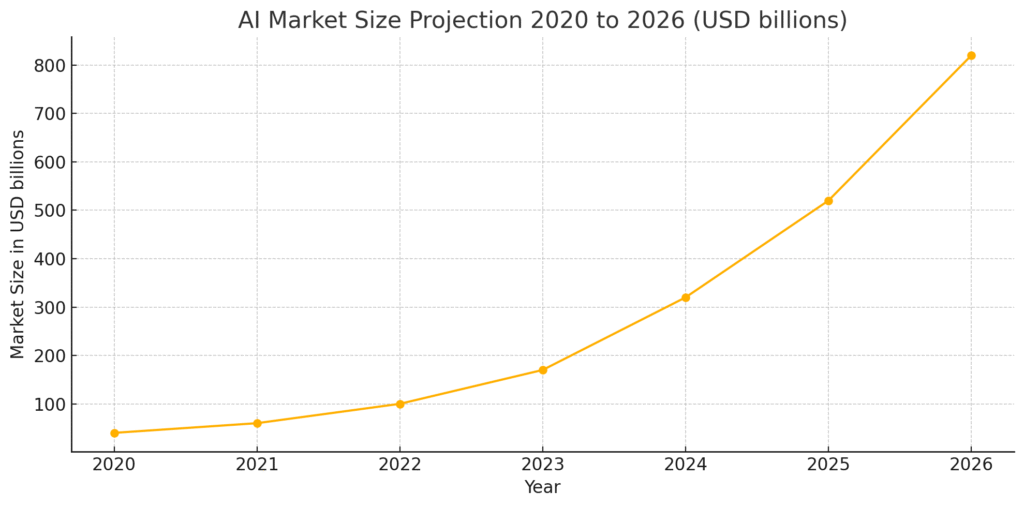
Global AI Market Forecast 2026
The global artificial intelligence market enters 2026 with momentum that no previous technological wave has ever achieved. Growth is not following a simple upward curve. It is accelerating at a compounded pace driven by enterprise AI adoption generative models intelligent automation and the rapid expansion of multimodal systems. Analysts expect the worldwide AI economy to cross more than one trillion dollars in value before the end of the decade making artificial intelligence one of the fastest transforming markets in history.
The most significant change in 2026 is the shift from experimental use cases to fully operational AI ecosystems. Companies are no longer testing isolated tools. They are building end to end intelligent platforms that combine natural language processing computer vision deep learning reasoning engines and generative AI. This creates unified systems capable of powering everything from supply chain predictions to clinical assessments creative content generation and autonomous machinery. Many organizations now treat AI development companies as long term partners rather than optional service providers.
Another major driver of growth is the demand for secure and scalable AI infrastructure. Enterprises are investing heavily in cloud based GPU clusters private model hosting and data compliant AI environments. As a result AI infrastructure companies and generative AI companies have become essential pillars of digital transformation. Even small and medium size businesses are adopting AI powered solutions for marketing automation analytics customer engagement and decision support because deployment is easier and more affordable than in previous years.
Regional growth is also shifting. North America continues to lead the AI market but Asia Pacific is emerging as a powerful competitor due to advancements in robotics voice intelligence and industrial automation. Europe shows strong progress in regulatory aligned AI systems focusing on governance privacy and safe LLM development. This creates a balanced global landscape where innovation and compliance evolve side by side.
Healthcare AI is another major force influencing 2026 projections. Medical AI companies specializing in diagnostics emergency intelligence and patient support are experiencing rapid adoption because hospitals need real time assistance that improves accuracy and reduces clinical delays. This contributes significantly to the overall AI economy and strengthens trust in intelligent systems.
Creative AI is also expanding faster than expected. Generative video tools and content intelligence platforms are now central to production studios advertising teams and independent creators. This segment contributes to a growing creative AI economy that connects technology with art at an industrial scale.
By the end of 2026 artificial intelligence companies are predicted to influence more than seventy percent of all digital workflows across global markets. AI will become a core layer of business infrastructure much like the internet and cloud computing in earlier decades. The companies listed in this guide play a defining role in shaping that future.
AI Market Size Projection 2020 to 2026 (USD billions)
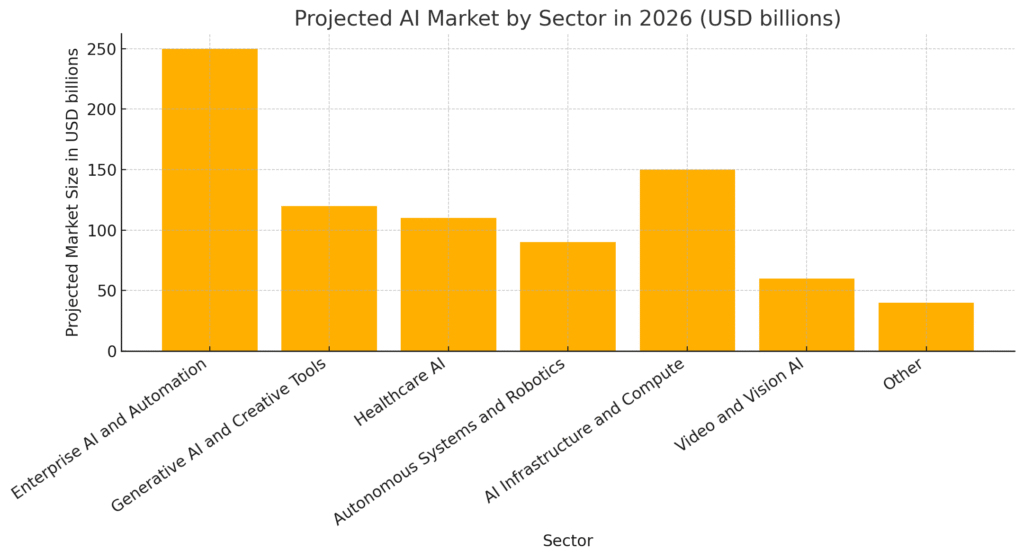
Projected AI Market By Sector In 2026 (USD Billions)
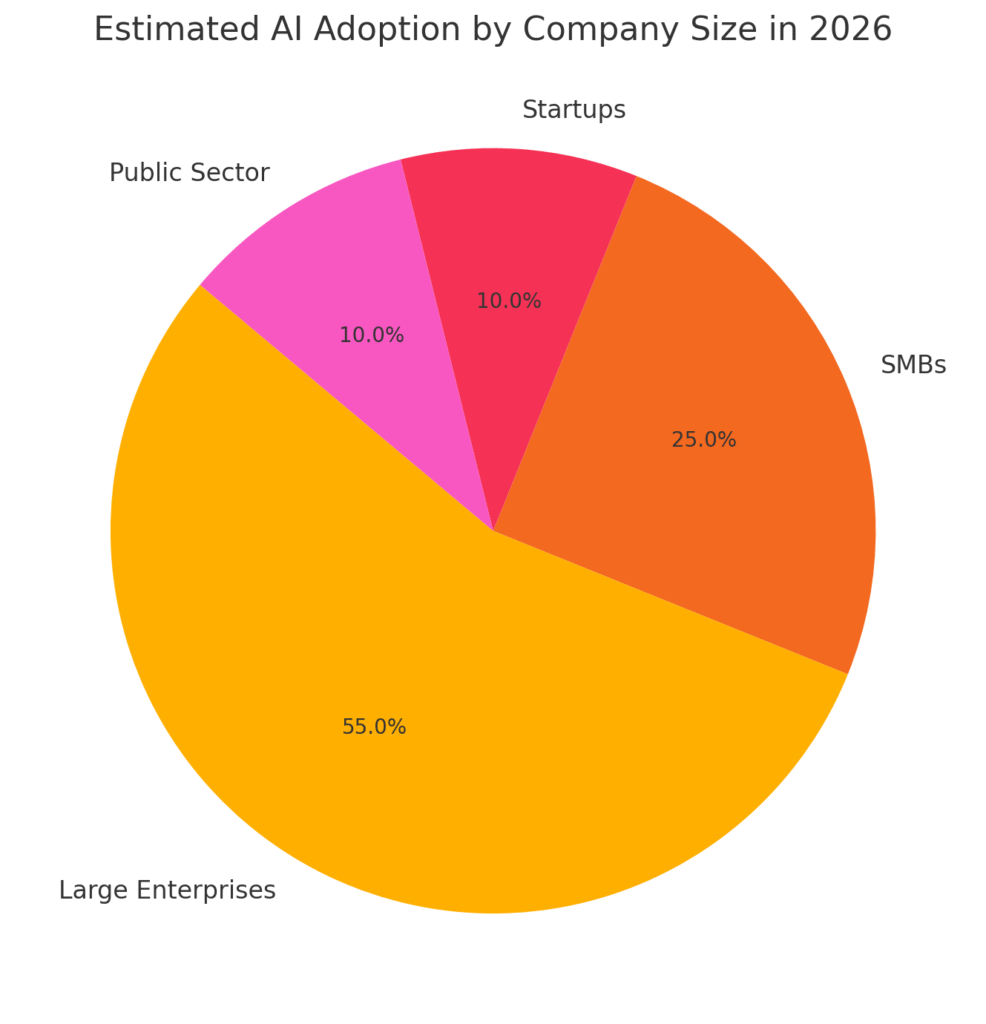
Estimated AI Adoption By Company Size In 2026
What is Artificial Intelligence
Artificial intelligence is the field of computer science that focuses on creating systems capable of thinking, learning and adapting in ways that resemble human intelligence. Modern AI goes far beyond simple automation and now includes advanced capabilities such as natural language understanding, visual recognition, predictive analytics, decision making, creativity and problem solving. These intelligent systems learn from data, identify patterns, generate insights and improve their performance over time. Artificial intelligence is the foundation of today’s enterprise automation, generative AI models, healthcare diagnostics, autonomous navigation, intelligent search engines and creative production tools. In 2026 AI is not only a technology but a core layer of digital transformation across industries, powering smarter workflows and supporting human productivity at every level.
What is Artificial Intelligence Services
Artificial intelligence services refer to the wide range of solutions, tools and platforms that help organizations use AI for real world tasks and business operations. These services include model development, data analysis, workflow automation, generative content creation, predictive analytics, multimodal processing, conversational systems, custom integration and AI based decision support. Companies use artificial intelligence services to improve efficiency, reduce manual work, enhance accuracy and accelerate strategic outcomes. For example healthcare AI services assist doctors with diagnostics and emergency detection, enterprise AI services automate processes and support knowledge management, and creative AI services power video generation and digital content production. By 2026 AI services have become essential for businesses wanting to adopt intelligent automation and scale their digital capabilities quickly and reliably.
Ranking Criteria for the Top AI Companies 2026
AI development companies design, train and deploy intelligent models that support automation, analytics, digital transformation and advanced workflow improvement for modern organizations. Identifying the top artificial intelligence companies for 2026 requires more than evaluating model accuracy or brand popularity. The AI landscape has matured to a point where true leadership is defined by reliability safety scalability innovation and real world influence. Our evaluation framework uses a multidimensional approach that reflects how enterprises governments healthcare providers creators and research institutions adopt modern AI solutions.
Innovation Strength and Research Impact
The first criteria measure how a company shapes the direction of global AI research. Leading AI development companies push the boundaries of large language models computer vision multimodal intelligence reinforcement learning and generative AI. True innovators introduce new architectures training methods context windows memory systems retrieval pipelines and safety techniques. Their contributions influence not only commercial markets but also academic communities and government standards.
Scalability and Infrastructure Readiness
Scalable AI is essential because modern enterprises depend on models that operate reliably across millions of users. Companies with strong infrastructure provide advanced GPU clusters distributed computing environments inference optimization and low latency deployment across cloud and on premise systems. This category evaluates how well AI companies support large scale production environments while maintaining performance and security.
Safety Governance and Ethical Alignment
As artificial intelligence systems grow more capable responsible AI becomes a defining factor. Companies that lead this space use alignment strategies long context evaluations fallback behaviors constitutional guidelines and transparent training methodologies. They prioritize bias mitigation user protection and predictable agent behavior. These practices are critical when AI solutions influence healthcare legal operations defense emergency response or public facing decisions.
Industry Adoption and Real World Performance
The next factor analyzes how widely AI services are used in actual business operations. Generative AI companies that support creative industries medical AI companies that improve diagnostics and enterprise AI companies that automate workflows all demonstrate clear value. Our ranking considers testimonials case studies adoption rate and measurable impact on productivity accuracy or revenue growth.
Technical Versatility and Multimodal Capability
Modern artificial intelligence is no longer shaped by text models alone. Leading companies build systems that understand voice images video structured data sensor input and digital workflows. Multimodal intelligence allows AI to operate in more human like environments and this becomes a key ranking element. Companies that master multimodal models gain an advantage across healthcare robotics creative industries customer engagement and autonomous navigation.
Security and Data Protection Standards
Security plays a crucial role as organizations integrate large scale AI solutions into sensitive environments. Companies that adopt strong encryption policies reliable access control and transparent data handling earn higher trust. Enterprises increasingly prioritize providers that offer secure private model hosting and compliance with global regulations. This section also naturally connects with industries that rely on SSL or data protection to maintain safe AI workflows.
Business Stability and Long Term Viability
Artificial intelligence development requires massive compute resources funding and operational capacity. Companies that demonstrate financial stability visionary leadership strong investor support and long term strategy score higher in overall ranking. This ensures continuity for organizations that plan to rely on their AI infrastructure for many years.
User Experience and Deployment Flexibility
The final criteria measure how accessible and adaptable the AI platform is. Teams prefer solutions that integrate easily with existing tools provide intuitive APIs offer rich documentation and support customization for specialized sectors. AI companies that excel in user experience often see broader adoption because they allow smooth onboarding for developers analysts medical professionals educators and digital creators.
List of the Top Artificial Intelligence Companies 2026
1. OpenAI
OpenAI continues to set the direction of the global AI industry through its leadership in large language models and multimodal intelligence. The company focuses on building powerful general purpose systems that assist with reasoning creativity decision support coding and advanced content generation. By 2026 its models operate across enterprise ecosystems education research and consumer environments. OpenAI is also recognized for pioneering alignment practices that aim to make modern AI safer and more predictable in real world settings while still pushing the limits of innovation.
Establishment
2015
Headquarter and office
San Francisco California United States
Website URL
https://openai.com
Email
info@openai.com
Top Services
Generative AI models
AI assistant platforms
Developer APIs
Enterprise AI tools
Top Client Name
Microsoft
Shopify
Salesforce
2. Google DeepMind
Google DeepMind is one of the most influential research driven artificial intelligence companies in the world. Its achievements in reinforcement learning protein science predictive modeling and multimodal reasoning continue to shape global innovation. DeepMind’s work consistently pushes beyond commercial AI toward breakthroughs that advance healthcare climate science mathematics and computational biology. In 2026 it remains a major driver of research excellence and practical enterprise intelligence.
Establishment
2010
Headquarter and office
London United Kingdom
Website URL
https://deepmind.google
Email
contact@deepmind.com
Top Services
AI research platforms
Predictive analysis
Scientific modeling
Reinforcement learning solutions
Top Client Name
Google
NHS United Kingdom
3. Anthropic
Anthropic focuses on creating AI systems that prioritize safety reliability and responsible intelligence. Its flagship model Claude is widely used by enterprises seeking dependable large language solutions for analysis communication coding and strategic workflows. Anthropic emphasizes transparency and constitutional guidelines which makes its technology appealing for regulated sectors. The company is considered one of the strongest voices in safe AI development for 2026.
Establishment
2021
Headquarter and office
San Francisco California United States
Website URL
https://anthropic.com
Top Services
Enterprise AI models
Safety aligned AI
Generative knowledge systems
Top Client Name
Amazon
Google Cloud
4. Microsoft Azure AI
Microsoft Azure AI delivers enterprise grade artificial intelligence that integrates seamlessly with business applications across the Microsoft ecosystem. Azure AI offers natural language processing computer vision speech intelligence decision services and multimodal tools that support organizations of all sizes. Its strong security standards and global cloud infrastructure make Azure a preferred choice for companies seeking scalable and compliant AI solutions. In 2026 it remains essential for digital transformation across corporate and government environments.
Establishment
Azure AI development began in 2010 era
Headquarter and office
Redmond Washington United States
Website URL
https://azure.microsoft.com
Top Services
Cognitive services
Generative AI tools
Vision and speech intelligence
Enterprise automation
Top Client Name
Adobe
LinkedIn
Walmart
5. NVIDIA AI
NVIDIA powers the global AI revolution through its advanced GPU hardware and accelerated computing platforms. Every major AI development company relies on NVIDIA technology for training large models running inference at scale and pushing the boundaries of robotics and autonomous systems. In addition to world leading chips NVIDIA provides full software ecosystems that help researchers creators medical teams and enterprises implement artificial intelligence with high precision. NVIDIA remains a backbone of the modern AI infrastructure in 2026.
Establishment
1993
Headquarter and office
Santa Clara California United States
Website URL
https://www.nvidia.com
Email
info@nvidia.com
Top Services
AI hardware platforms
GPU compute cloud
Autonomous robotics
AI development frameworks
Top Client Name
Tesla
Meta
Amazon Web Services
6. Adept AI Labs
Adept AI Labs builds intelligent agents capable of performing digital tasks across software environments in the same way humans interact with applications. Its mission is to create AI that can understand instructions reason through steps and execute actions across real tools. In 2026 Adept stands out for its focus on digital workforce automation which supports enterprise productivity and enhances everyday workflows. Adept’s technology signals the rise of true generalist AI agents.
Establishment
2022
Headquarter and office
San Francisco California United States
Website URL
https://www.adept.ai
Email
support@adept.ai
Top Services
AI task agents
Workflow automation
Instruction based intelligence
Top Client Name
Enterprise pilot partners
7. Inflection AI
Inflection AI develops emotionally aware personal assistants designed for natural dialogue and supportive interaction. Its conversational models are built with warmth context retention and adaptive communication which makes them ideal for personal knowledge support coaching learning assistance and daily planning. Inflection focuses on human centered artificial intelligence where the goal is not only performance but also comfort trust and companionship. This approach sets it apart in the AI consumer market.
Establishment
2022
Headquarter and office
Palo Alto California United States
Website URL
https://inflection.ai
Top Services
Personal AI assistants
Conversational intelligence
AI learning companions
Top Client Name
Students
Individual professionals
8. Perplexity AI
Perplexity AI brings a new standard to search by combining artificial intelligence with real time verified information. Its answer engine provides sourced explanations instead of generic summaries which makes it popular among researchers journalists analysts and students. By 2026 Perplexity is one of the fastest growing knowledge intelligence companies with an emphasis on accuracy transparency and deeper exploration. It redefines how people discover and validate information online.
Establishment
2022
Headquarter and office
San Francisco California United States
Website URL
https://www.perplexity.ai
Email
hello@perplexity.ai
Top Services
AI answer engine
Research intelligence
Source verified search
Top Client Name
Researchers
Media professionals
9. Character AI
Character AI designs interactive personalities that respond with natural and expressive dialogue. Users build their own characters or interact with existing ones for entertainment creativity learning or conversation. The platform encourages imagination through customizable personalities that behave with distinct voices and behaviors. In 2026 Character AI leads the market in social AI and interactive digital experiences for global communities.
Establishment
2021
Headquarter and office
California United States
Website URL
https://character.ai
Email
support@character.ai
Top Services
AI characters
Social AI platforms
Interactive dialogue models
Top Client Name
Creative communities
Educators
10. Runway ML
Runway ML redefines creativity with its advanced generative video tools that help filmmakers designers advertisers and artists build high quality content without traditional production barriers. The platform offers AI powered video editing scene creation image enhancement and visual storytelling. Its influence reaches entertainment studios digital creators and marketing teams. Runway stands at the center of the creative AI movement in 2026.
Establishment
2018
Headquarter and office
New York United States
Website URL
https://runwayml.com
Email
contact@runwayml.com
Top Services
Generative video tools
Creative content AI
Image and video editing
Top Client Name
Media houses
Creative studios
11. Hippocratic AI Healthcare AI
Hippocratic AI specializes in clinically aligned artificial intelligence designed to support medical teams with communication and patient engagement. Its models are trained with careful clinical oversight ensuring accurate and responsible interactions. The technology assists with triage patient education and medical information delivery. Healthcare providers value Hippocratic AI for its safety focus and responsible approach to clinical intelligence.
Establishment
2023
Headquarter and office
Palo Alto California United States
Website URL
https://www.hippocraticai.com
Top Services
Clinical AI assistants
Healthcare communication tools
Patient support platforms
Top Client Name
Hospitals
Medical networks
12. Twelve Labs Video AI Intelligence
Twelve Labs enables computers to understand video with remarkable depth. Its models interpret scenes objects actions emotions and context with a level of precision that supports advanced content search moderation analytics and media workflow optimization. The company plays a crucial role in the growing demand for video intelligence across media platforms e learning systems security solutions and enterprise knowledge tools.
Establishment
2021
Headquarter and office
San Francisco California United States
Website URL
https://twelvelabs.io
Top Services
Video intelligence
Semantic video search
Context aware analysis
Top Client Name
Media platforms
Security organizations
13. Shield AI Defense and Autonomous Systems
Shield AI develops autonomous systems that support national security aviation and real world defense missions. Its AI powered aircraft and navigation systems are designed to operate safely in complex environments. Shield AI focuses on creating intelligent systems that can carry out missions without GPS and with strong situational awareness. This makes it one of the most important defense technology companies of 2026.
Establishment
2015
Headquarter and office
San Diego California United States
Website URL
https://www.shield.ai
Email
info@shield.ai
Top Services
Autonomous aviation
Defense AI platforms
Navigation intelligence
Top Client Name
Defense agencies
Government missions
14. PathAI Medical Diagnostics AI
PathAI develops medical AI systems that assist pathologists by improving diagnostic precision in disease analysis. Its models review pathology slides with high consistency reducing human variability while enhancing speed and accuracy. PathAI collaborates with research organizations and hospitals to deliver clinically reliable insights. In 2026 it remains one of the most advanced medical diagnostics AI companies globally.
Establishment
2016
Headquarter and office
Boston Massachusetts United States
Website URL
https://pathai.com
Email
contact@pathai.com
Top Services
AI pathology
Disease detection tools
Medical image intelligence
Top Client Name
Biotech companies
Research hospitals
15. Viz AI Emergency Medicine AI
Viz AI brings real time intelligence to emergency medical teams by detecting critical conditions such as stroke and aneurysm with remarkable speed. Its platform alerts doctors instantly which reduces response time and improves treatment outcomes. Viz AI connects medical imaging systems with clinical workflows creating a dependable emergency support network. Hospitals worldwide rely on it for faster and more accurate emergency diagnostics.
Establishment
2016
Headquarter and office
San Francisco California United States
Website URL
https://www.viz.ai
Email
support@viz.ai
Top Services
Emergency medicine AI
Stroke detection
Real time clinical alerts
Top Client Name
Hospitals worldwide
Comparison Table of the Top AI Companies at a Glance
To help readers understand how these leading artificial intelligence companies differ in focus capability and industry influence the table below presents a clear side by side comparison. This overview highlights their core strengths best use cases and strategic value for enterprises creative teams healthcare providers and research organizations. It also supports search visibility by naturally incorporating important industry keywords such as enterprise AI generative AI development companies healthcare AI leaders and multimodal intelligence providers.
Top Artificial Intelligence Companies 2026 Overview Table
| Company Name | Best Known For | Core AI Strength | Ideal Users | Global Presence |
|---|---|---|---|---|
| OpenAI | General purpose intelligence and multimodal models | Large language models and reasoning systems | Enterprises creators researchers | Global |
| Google DeepMind | Scientific AI research and reinforcement learning | Predictive science and advanced multimodal analysis | Research labs healthcare and climate science | Global |
| Anthropic | Safety aligned enterprise AI | Transparent and responsible LLM design | Regulated industries and enterprise teams | United States and international |
| Microsoft Azure AI | Enterprise cloud AI | Scalable AI infrastructure and cognitive services | Corporations government and large tech teams | Global |
| NVIDIA AI | AI hardware and compute systems | GPU acceleration and training infrastructure | AI developers research institutions and robotics teams | Global |
| Adept AI Labs | AI task agents and workflow automation | Instruction based reasoning and tool use | Enterprise automation and digital teams | United States |
| Inflection AI | Personal AI assistants | Emotionally aware conversational intelligence | Individuals educators and personal productivity users | Global digital audience |
| Perplexity AI | Answer based search intelligence | Verified information retrieval | Researchers students journalists | Global |
| Character AI | Social AI and creative personas | Interactive dialogues and personality modeling | Creators educators communities | Global |
| Runway ML | Generative video and creative tools | Video generation and visual AI | Filmmakers designers advertisers | United States and global creative markets |
| Hippocratic AI | Clinical communication intelligence | Safe medical AI aligned with clinical standards | Hospitals patient care networks | United States |
| Twelve Labs | Video understanding and content intelligence | Semantic video analysis | Media platforms security teams and enterprise video systems | United States |
| Shield AI | Defense and autonomous systems | Autonomous navigation and mission intelligence | Defense agencies and national security teams | United States |
| PathAI | Medical diagnostics intelligence | Disease detection and pathology AI | Research hospitals biotech organizations | United States |
| Viz AI | Emergency medical intelligence | Real time medical detection | Hospitals emergency care networks | Global hospital systems |
Key Insights from the Comparison Chart
OpenAI and Google DeepMind dominate the upper tier of general purpose and scientific AI.
Anthropic and Azure AI lead in trusted enterprise AI solutions.
NVIDIA AI remains the core infrastructure behind nearly every major model in the industry.
Runway ML and Character AI shape the creative and social AI ecosystems.
Hippocratic AI PathAI and Viz AI lead healthcare intelligence with clinically aligned technology.
Twelve Labs advances video AI while
Shield AI drives autonomous aviation and national security.
This table helps readers quickly identify which artificial intelligence company aligns with their goals whether they are looking for generative AI services enterprise automation creative innovation or medical diagnostics.
AI Technology Trends Dominating 2026
Artificial intelligence enters 2026 with a set of breakthroughs that completely reshape how people build work and interact with digital systems. These trends do not follow the predictable patterns of earlier years. Instead they reflect a shift toward intelligent ecosystems where models understand context complete actions collaborate with humans and operate inside real physical environments. The following trends capture the technologies that will define the next stage of global AI development.
1. The rise of multimodal intelligence as the new standard
Artificial intelligence companies now focus on models that understand text images audio video and structured data within a single system. Instead of switching between multiple tools enterprises use unified models that create summaries from documents explain images describe video scenes and analyze speech. This allows businesses to use a single intelligent workflow across research creative projects analytics and operations. Multimodal AI becomes the baseline capability that separates older generation models from modern high performance systems.
2. Agentic AI emerges as the digital workforce of the future
AI is no longer limited to generating content. It can now take actions. Agent based systems learn to navigate interfaces use digital tools read instructions and complete tasks just like a human assistant. They log into platforms prepare reports update data visually inspect files and even coordinate schedules. Companies such as Adept are building the early version of a universal digital worker. Enterprises expect agentic systems to remove almost all repetitive software tasks within a few years.
3. Enterprise AI shifts toward long context and memory driven models
The most advanced AI development companies now prioritize long context processing rather than pure model size. Businesses want AI that remembers project history understands organizational rules and follows multi step strategies without forgetting previous information. This trend supports legal analysis financial reviews scientific research and multi week enterprise workflows. Memory driven AI becomes a key factor in enterprise adoption.
4. Generative video and creative AI redefine the content economy
Generative AI is evolving from simple imagery to full cinematic sequences. Creative platforms like Runway ML give designers and filmmakers the ability to produce studio quality content with minimal equipment. Marketing teams generate visual campaigns in minutes. Educators produce immersive learning environments. Generative video becomes the most disruptive creative tool since digital editing software. As video becomes easier to create global content production increases at a rate never seen before.
5. Healthcare intelligence enters a clinical grade era
Medical AI companies such as PathAI Viz AI and Hippocratic AI are shaping a new phase of clinically reliable intelligence. These systems support pathologists radiologists and emergency doctors with real time diagnostics that reduce delay and improve accuracy. Hospitals adopt AI driven triage patient communication tools and emergency alerts. Unlike consumer AI systems these clinical models undergo rigorous safety validation which makes them trusted in highly sensitive medical environments.
6. AI powered cybersecurity becomes essential for digital safety
As the use of intelligent systems grows the threat landscape changes. Enterprises need AI driven security solutions to detect anomalies analyze threats and protect sensitive data across global networks. Advanced AI companies now integrate threat prediction behavioral analytics and real time monitoring into their security frameworks. This shift strengthens organizational security and supports the rise of safe enterprise AI environments that combine encryption identity protection compliance and responsible data handling.
7. Autonomous intelligence expands across defense and industrial systems
AI is no longer limited to software environments. Defense and industrial companies use intelligent navigation systems drones and robotics capable of making decisions in complex physical conditions. Shield AI leads this transformation with autonomous aircraft that operate safely without GPS. Manufacturing logistics and construction sectors also adopt autonomous AI to manage fleets inspect infrastructure and enhance workplace safety.
8. Video intelligence becomes essential for enterprise knowledge and security
With video content increasing dramatically companies need AI that understands scenes actions emotions and context in real time. Twelve Labs is driving this trend by giving organizations a powerful way to search monitor and analyze video libraries. Security firms use AI to detect unusual behavior. Media companies rely on video search to organize massive footage collections. Video understanding becomes as important as text understanding in 2026.
9. AI governance and ethical alignment become central to enterprise strategy
As models grow more capable organizations need strict governance practices. AI companies such as Anthropic and OpenAI invest heavily in alignment research to ensure predictable behavior safety and compliance. Enterprises now include AI ethics as a required part of procurement. This elevates safety aligned developers above traditional vendors and strengthens trust in commercial AI solutions.
10. Synthetic knowledge engines reshape how people search and learn
Perplexity introduces a new style of information access that replaces traditional search results with direct answers supported by sources. Users rely on verified insights instead of navigating long lists of links. This trend transforms search engines into intelligent research companions capable of reasoning validating and explaining information. Students analysts and professionals benefit from this shift toward a transparent and reliable search experience.
Industry Wise Breakdown of the Best AI Companies in 2026
Artificial intelligence is no longer a single unified market. It now branches into specialized sectors where companies compete on precision speed safety creativity or domain expertise. In 2026 different industries rely on tailored AI solutions built specifically for their workflows. Below is a complete breakdown of which AI companies lead each major vertical and why their technology is reshaping the future of that industry.
1. Healthcare Artificial Intelligence
Healthcare AI has one of the fastest adoption rates in the world. Hospitals need real time assistance advanced diagnostics and reliable patient communication. Three companies dominate this sector.
Hippocratic AI
Specializes in clinically aligned communication and patient engagement. Hospitals use its models for safe guidance triage and care navigation.
PathAI
Known for pathology diagnostics with high accuracy. Its systems analyze medical slides with reliable consistency and assist pathologists during critical evaluations.
Viz AI
Transforms emergency medicine with instant alerts for stroke and other life threatening conditions. It reduces treatment delays and improves patient outcomes.
Why healthcare leads in AI adoption
Medical environments demand precision safety and context aware intelligence. These companies succeed because their models undergo clinical testing and deliver measurable benefits in real hospital settings.
2. Creative AI and Visual Production
Creative AI reshapes how digital content is produced at scale. Designers and filmmakers now rely on intelligent tools that reduce production time without sacrificing imagination.
Runway ML
A leader in generative video content. Runway supports filmmaking advertising visual storytelling and immersive media development with industry defining tools.
Character AI
Dominates interactive digital personas for entertainment and creative expression. Its characters help creators build unique narratives and dynamic user experiences.
Why creative AI is exploding in 2026
Video and interactive content are in high demand. Creative AI lowers cost and increases output making it a cornerstone of modern digital production.
3. Enterprise AI and Business Automation
Large organizations need intelligent automation secure infrastructure and scalable workflows. Enterprise AI companies power the daily operations of corporate teams worldwide.
Microsoft Azure AI
Provides enterprise grade cloud intelligence with vision tools language models speech recognition and large scale automation frameworks.
Anthropic
Chosen by regulated sectors for safe predictable and transparent large language models. Claude is widely used in enterprise analysis and communication.
OpenAI
Offers versatile general purpose intelligence used across customer service automation marketing research engineering and corporate operations.
Why enterprise adoption is accelerating
Businesses want consistent reasoning long context memory strong security and powerful integration with existing software ecosystems.
4. Research Science Climate and Advanced Computation
Scientific innovation requires AI with deep reasoning long context and high reliability. These companies shape the direction of global research.
Google DeepMind
Leading the world in predictive science machine learning research protein modeling reinforcement learning and advanced multimodal analysis.
OpenAI
Supports research groups with high capability models that assist in simulations coding large scale data interpretation and literature review.
Why research AI is different from consumer AI
Scientific work demands accuracy interpretability and the ability to handle complex structured information which these companies deliver.
5. Video Intelligence and Security Analytics
Video content grows faster than any other media format which creates demand for AI that understands scenes actions and behavior.
Twelve Labs
Provides advanced video understanding tools that interpret events emotions objects and context. Used by media platforms security firms and enterprise content managers.
Why video understanding matters
Organizations need instant search insight and monitoring across huge video archives. AI is the only way to make that possible at scale.
6. Defense Aerospace and Autonomous Navigation
Real world autonomy requires models that understand environments react under pressure and operate safely without human control.
Shield AI
The strongest player in autonomous defense technology. Its aircraft and navigation intelligence support national security missions without GPS dependence.
Why defense AI is growing rapidly
Nations need safe autonomous systems that can navigate unpredictable environments better than traditional robotics.
7. Personal AI and Emotional Intelligence Engines
As digital assistants evolve people expect more natural conversational experiences.
Inflection AI
Creates emotionally aware AI companions that support learning planning conversation and personal development.
Why personal AI is becoming mainstream
Users want AI that feels natural empathetic and contextually aware rather than purely functional.
8. Search Intelligence and Knowledge Engines
Information access is changing faster than any other digital behavior.
Perplexity AI
Redefines search with real time verified answers that replace long result lists. It becomes the preferred tool for researchers and professionals.
Why verified search matters
People want accuracy transparency and clear sources without spending time filtering unreliable information.
Industry Summary
Each sector depends on specialized artificial intelligence models that reflect its challenges and workflows.
This is why healthcare AI differs from creative AI and why enterprise AI tools differ from social AI platforms.
The companies leading these industries set the direction of global innovation in 2026.
AI Startups to Watch in 2026
Future Unicorns Reshaping the Intelligence Economy
The AI boom has created a landscape where innovation does not come only from the tech giants. A new generation of startups is pushing boundaries with fresh ideas, bold experimentation and deep specialization. These companies are not yet at the scale of the global leaders listed earlier, but their ambition, technology strength and market trajectory suggest that they will become the next wave of AI unicorns.
Below is a curated set of future facing AI startups chosen for their technical uniqueness, industry relevance and growth potential in 2026.
1. Mistral AI
Europe’s Rising Force in Open Source Intelligence
Mistral AI develops high performance large language models built for openness, transparency and speed. Its models are extremely efficient, which makes them attractive for businesses that want enterprise AI without heavy infrastructure cost. The company is becoming the European counterpart to major generative AI developers and gaining rapid traction in startups and enterprise ecosystems.
Why it is a future unicorn
Strong open source presence, competitive accuracy, and growing enterprise adoption across Europe and Asia.
2. Hippocratic Labs Research Division
Healthcare Simulation and Clinical Reasoning
Separate from Hippocratic AI’s patient communication tools, the labs division focuses on training models that simulate medical scenarios and help clinical teams rehearse treatment plans. This area is gaining momentum because hospitals want safe environments to test emergency responses with AI support.
Why it is a future unicorn
Healthcare simulation AI is an untapped market with high clinical demand.
3. Inworld AI
Intelligent Characters for Gaming and Immersive Worlds
Inworld AI builds advanced personality engines for virtual environments. Its characters handle emotion, memory and adaptive storytelling in gaming. Developers use it to create non player characters that react more like humans and build complex narratives on the fly.
Why it is a future unicorn
Gaming studios are replacing scripted NPCs with intelligent character systems.
4. Retell AI
Voice Agents with Real Time Emotional Understanding
Retell AI focuses on voice based AI agents that work in customer support and operations. The technology interprets tone, emotion and intent which allows it to carry natural conversations that feel human trained.
Why it is a future unicorn
Voice AI is becoming crucial for enterprise automation and customer experience.
5. Eleven Labs
Next Generation AI Voice Generation
Eleven Labs dominates the field of AI voice synthesis. Its models can produce natural expressive voices in many languages with consistent emotional tone. Creators and media houses rely on it for audio books, advertisements and content production.
Why it is a future unicorn
The global content economy needs scalable high quality voice solutions.
6. Modular AI
High Performance Infrastructure for Model Deployment
Modular builds high speed AI runtimes and compute frameworks that compete with traditional GPU heavy environments. Its infrastructure accelerates model inference and reduces operational costs for enterprises.
Why it is a future unicorn
Infrastructure efficiency is the most competitive space in enterprise AI.
7. Pika Labs
Generative Video for Social Content and Micro Studios
Pika Labs builds easy to use video generation tools aimed at creators and social media storytellers. It offers instant scene creation, animated content and creative editing without professional editing software.
Why it is a future unicorn
Short form video creators are adopting AI video tools faster than any other user group.
8. Luma AI
Reality Capture and Neural Rendering
Luma AI focuses on 3D reconstruction, realistic scene capture and neural rendering. Artists and developers use it to turn real environments into digital spaces for games, films and virtual experiences.
Why it is a future unicorn
The rise of AR VR and metaverse applications increases demand for realistic 3D assets.
9. Cohere AI
Enterprise Focused Language Intelligence
Cohere builds large language models optimized for business use cases such as data analysis, document understanding and conversational automation. It is known for privacy friendly deployments and secure architecture.
Why it is a future unicorn
Secure enterprise AI has become a top priority for global businesses.
10. Tome AI
Narrative and Presentation Intelligence
Tome provides AI powered storytelling tools for presentations, business proposals and pitch decks. It helps organizations transform ideas into narrative ready content through multimodal intelligence.
Why it is a future unicorn
The demand for fast storytelling in business and marketing continues to rise.
Overall Insight
These future unicorns illustrate how the AI economy is diversifying into voice intelligence, virtual worlds, enterprise infrastructure, 3D modeling, healthcare simulation, and generative video. Their growth reflects a larger market trend where innovation is driven not only by massive models but by focused, specialized intelligence that solves deep industry challenges.
AI Company Selection Guide for Businesses
How to Choose the Right Artificial Intelligence Partner in 2026
Choosing the right AI development company has become one of the most important decisions for any organization planning to adopt modern automation or generative intelligence. The market is filled with powerful platforms and specialized AI firms, but each one serves a different type of business need. A well informed selection process helps ensure that the chosen partner offers the right model capabilities, security measures, scalability options and long term alignment with your industry goals.
Below is a structured guide designed specifically for enterprises, startups, healthcare institutions, creative teams and government organizations evaluating AI companies in 2026.
1. Start with Your Primary AI Objective
Every successful AI implementation begins with a clear purpose. Identify the category that matches your organization.
Common goals in 2026
-
Creative automation with generative AI
-
Enterprise workflow automation
-
Knowledge processing and research intelligence
-
Customer support automation
-
Healthcare diagnostics and communication
-
Video understanding or video search
-
Autonomous navigation and robotics
Once your core objective is defined you can narrow the field.
For example
-
Runway ML suits creative content teams
-
PathAI supports clinical diagnostics
-
Twelve Labs is ideal for video intelligence
-
Anthropic fits regulated industries
-
OpenAI works for broad general purpose AI
2. Evaluate Model Capabilities and Multimodal Strength
Modern AI companies offer different strengths in reasoning, accuracy, memory, context and understanding across text, images, audio and video.
Questions to ask
-
Does the AI support multimodal intelligence
-
How well does it handle long context documents
-
Does it understand workflows or only text prompts
-
Can it be customized for industry specific tasks
Companies such as OpenAI Google DeepMind and Anthropic lead in reasoning and long context performance while Runway ML and Twelve Labs excel in visual and video intelligence.
3. Look for Scalable Infrastructure and Strong Reliability
Enterprises need AI that performs consistently at scale. Stability is influenced by server architecture training efficiency model optimization and global availability.
Consider
-
Does the company offer cloud or on premise deployment
-
Can it handle millions of requests without lag
-
Is there an outage history
-
How easy is integration with existing software
Microsoft Azure AI and NVIDIA AI are recognized for exceptional infrastructure support.
4. Examine Safety Standards and Data Governance
With increasing reliance on artificial intelligence companies must follow strong safety practices to prevent unpredictable behavior or data misuse. This is especially important in healthcare finance government and legal industries.
Key safety elements
-
Alignment strategy
-
Bias mitigation
-
Audit trails
-
Transparent privacy policy
-
Clear training data guidelines
Anthropic and Hippocratic AI are popular among organizations that require predictable behavior and strong governance.
5. Check Industry Experience and Sector Specialization
General purpose AI may not be the best fit for specialized needs.
Examples
-
Healthcare organizations choose PathAI Viz AI or Hippocratic AI
-
Creative studios prefer Runway ML
-
Defense and aerospace use Shield AI
-
Media platforms rely on Twelve Labs
-
Enterprises select Azure AI Anthropic or OpenAI
-
Social and interactive brands use Character AI
Industry experience reduces onboarding time and ensures smoother deployment.
6. Look for Transparent Pricing and Predictable Usage Costs
Different AI companies follow different pricing models. Some charge per token, others per user or per workload.
Businesses should evaluate how predictable the cost model is in long term use.
Evaluate
-
Training cost
-
Usage cost
-
Customization cost
-
Support and service cost
Predictable pricing reduces operational surprises and helps calculate total cost of ownership.
7. Prioritize Security Architecture and Compliance
AI systems must protect sensitive data, especially when processing customer records or internal documents.
Check for
-
Encryption standards
-
Secure data transmission
-
Option for private model hosting
-
Compliance with GDPR HIPAA or regional regulations
Security is one of the most important factors and must be evaluated before any integration.
8. Assess Support Services and Long Term Partnership Value
AI adoption is not a single event. It is a multi year journey. Businesses need AI partners that provide strong support, ongoing updates and clear roadmaps.
Consider
-
Response time
-
Onboarding support
-
Training resources
-
Enterprise agreements
-
Dedicated account management
Companies with strong enterprise support are often preferred for mission critical operations.
9. Use a Decision Framework to Finalize Your AI Partner
Here is a practical decision path used by top enterprises in 2026.
Start with business goal
Productivity, automation, creative production, diagnostics, search, security or research.
Evaluate model performance
Reasoning, accuracy, multimodal strength, long context and memory.
Check industry match
Choose a company with domain experience.
Validate safety and compliance
Essential for regulated industries.
Test integration
Run pilot projects before full deployment.
Confirm scalability and cost
Choose an AI provider that supports long term growth.
The right artificial intelligence company is not the one with the largest model but the one that aligns best with your operational needs, industry standards and long term strategy. Businesses that follow a structured selection process benefit from higher efficiency, predictable outcomes and a stronger competitive advantage.
Pricing Analysis
How Much AI Solutions Cost in 2026
Artificial intelligence adoption has become more affordable yet more complex in 2026 because different industries rely on different levels of model capability, compute power and customization. Pricing varies widely depending on whether a business chooses general purpose AI, enterprise grade systems, healthcare intelligence, video AI, autonomous systems or fully customized model development.
Below is a complete breakdown of AI pricing in 2026 based on global industry data, enterprise contracts and average market offerings from leading AI development companies.
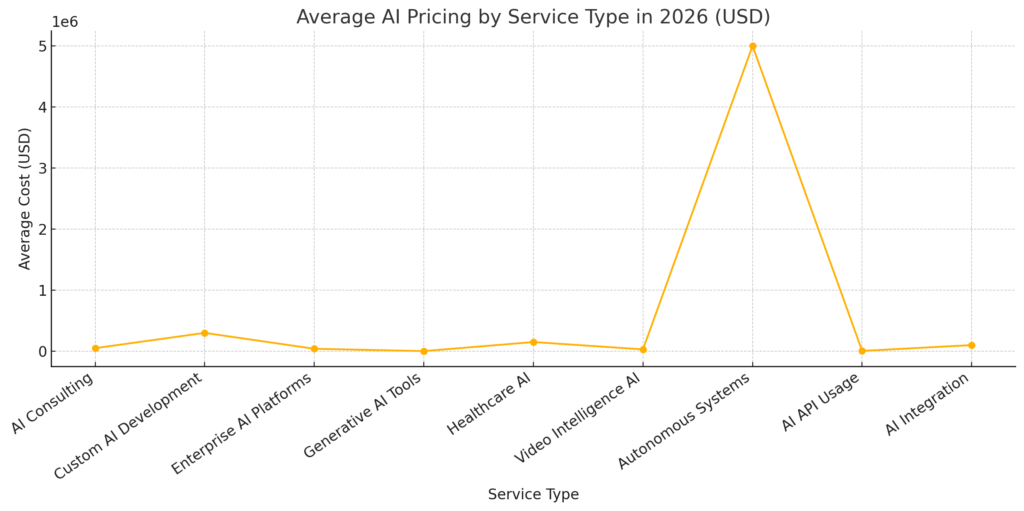
AI Pricing Analysis 2026 (USD)
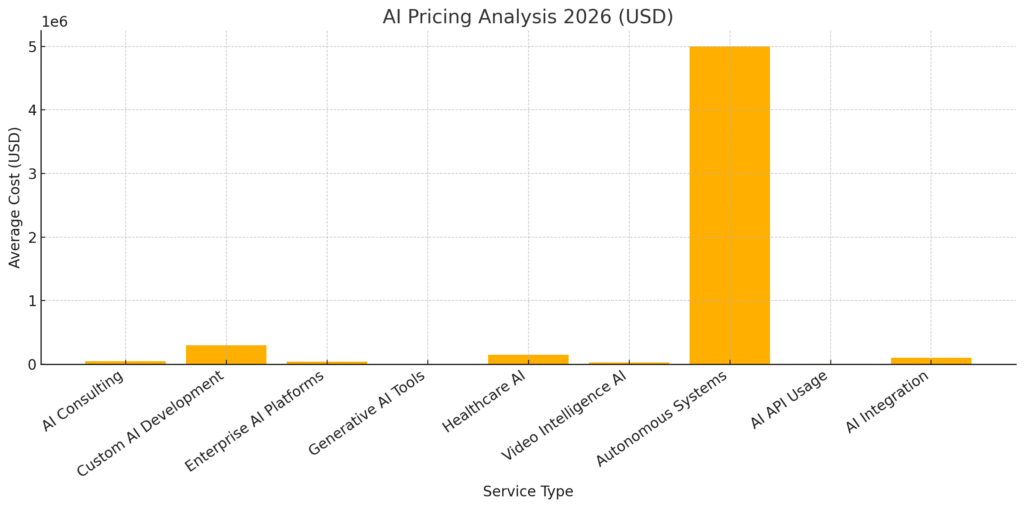
AI Pricing Analysis Table 2026
| AI Service Type | Average Cost (USD) |
| AI Consulting | 50000 |
| Custom AI Development | 300000 |
| Enterprise AI Platforms | 40000 |
| Generative AI Tools | 2000 |
| Healthcare AI | 150000 |
| Video Intelligence AI | 30000 |
| Autonomous Systems | 5000000 |
| AI API Usage | 5000 |
| AI Integration | 100000 |
1. AI Consulting and Strategy Planning
Organizations often begin with strategic planning before deploying any tools or models.
Average cost in USD
-
Small scale advisory for startups ranges from 5,000 to 20,000
-
Mid size enterprise strategy ranges from 25,000 to 80,000
-
Full corporate AI roadmap can exceed 150,000
Consulting helps companies avoid misaligned investments and ensures that chosen AI solutions fit long term business goals.
2. Custom AI and Model Development
This is one of the most expensive AI services because it requires dedicated engineers, training data and GPU resources.
Average cost in USD
-
Basic model customization starts at 20,000
-
Moderate development projects range from 40,000 to 150,000
-
Advanced model development can cost between 200,000 and 700,000
-
Highly specialized systems such as medical diagnostics or aviation intelligence may reach 1,000,000 or more
Businesses choose custom development when ready made models cannot meet industry specific requirements.
3. Enterprise AI Platform Usage
Enterprise platforms such as Azure AI, OpenAI enterprise offerings and Anthropic commercial systems usually follow per usage or per user pricing.
Average cost in USD
-
Enterprise plan entry tier begins around 5,000 per month
-
Medium scale usage ranges from 15,000 to 60,000 per month
-
Large scale deployments can exceed 100,000 per month
Pricing depends on request volume, user count, custom fine tuning and infrastructure needs.
4. Generative AI for Content, Images and Video
Creative AI continues to grow due to rapid adoption by advertising teams, creators and digital studios.
Average cost in USD
-
Basic creative AI tools start at 20 per month for individuals
-
Professional creator plans range from 30 to 80 per month
-
Enterprise generative video packages from platforms such as Runway ML can range from 500 to 5,000 per month
-
Custom generative video pipelines for studios can exceed 40,000
Companies choose higher tiers when producing high volume visual content or commercial grade media.
5. Healthcare AI Pricing
Healthcare intelligence is priced differently because models must pass strict validation and compliance standards.
Average cost in USD
-
Diagnostic AI tools typically range from 50,000 to 200,000 per hospital per year
-
Emergency detection systems such as stroke alert platforms range from 30,000 to 150,000 per year
-
Large multi hospital contracts may exceed 500,000
Healthcare providers pay for safety reliability and regulatory compliance.
6. Video Intelligence and Surveillance AI
Video AI companies such as Twelve Labs offer API based solutions for video search and understanding.
Average cost in USD
-
API usage for small teams ranges from 200 to 800 per month
-
Enterprise media platforms typically spend between 5,000 and 60,000 per month
-
Custom enterprise solutions may exceed 200,000 per year
Costs depend heavily on video volume and processing frequency.
7. Autonomous Systems and Defense AI
Autonomous navigation and defense intelligence require advanced hardware and mission tested systems.
Average cost in USD
-
Small scale autonomous devices can range from 50,000 to 250,000
-
Full aircraft grade autonomous systems exceed 1,000,000
-
Government contracts often range from 5,000,000 to 20,000,000 depending on mission requirements
This category involves the highest cost in the AI industry due to stringent safety demands and hardware complexity.
8. AI API Usage for Developers and Startups
General developers and smaller businesses often start with simple API usage.
Average cost in USD
-
Individual API usage can be as low as 20 per month
-
Typical startup usage ranges from 100 to 2,000 per month
-
Growing SaaS companies typically spend between 3,000 and 20,000 per month
-
Heavy usage or model fine tuning can push costs above 50,000 per month
API pricing is the most flexible option for companies that want to scale gradually.
9. AI Integration and Workflow Automation
Integration services connect AI tools with CRM software, cloud services, internal systems and enterprise databases.
Average cost in USD
-
Small projects start around 10,000
-
Medium integration ranges from 25,000 to 120,000
-
Large scale automation that covers entire departments can exceed 300,000
This is often the hidden cost many companies overlook when calculating AI budgets.
Key Pricing Insight for 2026
AI costs are no longer defined only by the size of the model. They are shaped by
-
industry specialization
-
compliance requirements
-
customization levels
-
infrastructure demand
-
workflow integration
-
long term usage volume
Businesses get the best value when they align model capability with real operational needs rather than choosing the most powerful system on the market.
Security and Compliance in AI
Why Safe Infrastructure Matters for Modern Intelligence
As artificial intelligence becomes central to global industries, security and compliance move from optional considerations to mandatory requirements. Every leading AI company must ensure that its systems protect sensitive information, maintain predictable behavior and comply with regional and international regulations. Without these safeguards even the most advanced AI model can become a risk rather than an asset.
In 2026 the rise of enterprise AI, healthcare AI and autonomous systems has increased the need for secure data transmission, encrypted communication, safe model responses and transparent operational frameworks. This section explains why security has become the backbone of modern AI and how organizations can evaluate the safety of the artificial intelligence companies they partner with.
1. Data Protection and Secure Model Hosting
Modern enterprises want reassurance that their information will remain private when interacting with AI systems. Companies now request
-
private model hosting
-
zero retention policies
-
encrypted communication
-
strict access controls
Secure hosting prevents unauthorized access and reduces the risk of information leaks. Many organizations also implement SSL and TLS protection across all AI communication layers because encrypted connections maintain trust and prevent man in the middle attacks. Businesses focused on secure infrastructure often refer to resources on certificate based protection to ensure safe data flow across AI powered environments.
2. Compliance with Global Standards
Regulations across the world continue to evolve as AI becomes more influential. Companies must follow strict rules if they work with sensitive information.
Common global compliance requirements include
-
GDPR for data privacy in Europe
-
HIPAA for healthcare data in the United States
-
SOC audits for enterprise reliability
-
Local data residency regulations
-
AI transparency rules in multiple regions
AI companies that provide detailed compliance documentation gain a clear advantage because organizations must verify that their tools meet industry standards before deployment.
3. Responsible Model Behavior and Predictability
Model behavior is one of the most important aspects of AI safety.
Enterprises need systems that behave consistently and avoid generating harmful or misleading content.
Responsible behavior includes
-
structured alignment testing
-
ethical guidelines for training
-
safe fallback behavior
-
clear limits on decision authority
Companies such as Anthropic OpenAI and Hippocratic AI lead in this area because they focus on predictable responses and controlled model reasoning for real world use cases.
4. Secure API Design and Reliable Infrastructure
APIs are the primary gateway for developers and enterprises interacting with artificial intelligence systems.
Poor API design can expose systems to vulnerabilities such as
-
injection attacks
-
unauthorized access
-
incorrect parameter handling
-
weak identity checks
Modern AI infrastructure companies protect API traffic with encryption, strict authentication, rate limiting, logging and continuous threat monitoring. These controls prevent malicious activity and ensure that high volume enterprise systems remain stable even under heavy load.
5. Risk Mitigation in Healthcare and Defense AI
Healthcare, defense and emergency intelligence systems require the highest level of safety because their outputs influence critical decisions.
For example
-
PathAI uses clinically verified diagnostic methods
-
Viz AI provides real time detection that must be consistently accurate
-
Shield AI relies on navigation intelligence that must operate safely without human intervention
These sectors demand strict testing, simulation environments, continuous monitoring and multi layer validation.
6. Encrypted Communication for AI Powered Systems
As Chat platforms, diagnostic tools, enterprise workflows and autonomous systems connect with cloud based models, encrypted communication becomes essential.
Secure connections protect every request and response between an organization and its AI provider.
This is why many businesses evaluate certificate based security as part of their AI readiness checklist.
Using strong encryption improves user trust and reduces the risk of intercepted or altered data.
7. Long Term Governance and Policy Transparency
Businesses want partners that publish clear guidelines on
-
training data governance
-
model updates
-
versioning
-
retention policies
-
user data protection
-
regulatory alignment
Companies that operate with open and structured governance standards gain higher trust from enterprise buyers.
Security and compliance are now the foundation of artificial intelligence adoption.
Without robust safety measures even the most advanced AI model becomes unsuitable for real world use.
Organizations that prioritize secure data transmission, encrypted workflows, transparent governance and predictable model behavior experience smoother deployment and long term success.
AI Companies SWOT Analysis
Strengths, Weaknesses, Opportunities and Threats in 2026
The competitive landscape of artificial intelligence in 2026 is shaped by rapid innovation, global demand and the pressure to deliver safe reliable intelligence. A detailed SWOT perspective helps organizations understand how each major AI company positions itself in the global market. This evaluation also highlights future opportunities and potential risks that could influence long term success.
1. OpenAI
Strengths
Exceptional multimodal and general purpose intelligence with strong global adoption and advanced reasoning capabilities.
Weaknesses
High infrastructure requirements and dependence on continuous research investment.
Opportunities
Expansion into enterprise ecosystems, agent driven automation and long context intelligence for corporate workflows.
Threats
Intensifying competition from Anthropic, Google DeepMind and emerging open source models.
2. Google DeepMind
Strengths
Strong scientific research leadership with unparalleled achievements in reinforcement learning and predictive modeling.
Weaknesses
Limited commercial accessibility due to focus on research rather than broad enterprise deployment.
Opportunities
Growth in climate science modeling, biological research and high complexity computational intelligence.
Threats
Pressure from commercial AI companies that scale faster in enterprise environments.
3. Anthropic
Strengths
Safety aligned models, predictable reasoning and strong appeal to regulated industries and large enterprises.
Weaknesses
Smaller model ecosystem compared to major cloud providers.
Opportunities
Expansion into legal, financial and government systems that require transparent AI behavior.
Threats
Increasing expectations for broader multimodal capabilities across global markets.
4. Microsoft Azure AI
Strengths
Robust enterprise cloud infrastructure, global availability and strong integration with Microsoft products.
Weaknesses
Complex licensing and higher operational cost for certain workloads.
Opportunities
Deep adoption in corporate automation and large scale enterprise AI deployments.
Threats
Competition from Google Cloud, AWS and independent AI platform providers.
5. NVIDIA AI
Strengths
Dominant force in global AI hardware with unmatched GPU capability and model training performance.
Weaknesses
High cost of hardware and supply limitations during peak demand cycles.
Opportunities
Growth in robotics, autonomous systems, generative AI compute and enterprise infrastructure.
Threats
Advances in alternative compute architectures that reduce GPU dependence.
6. Adept AI Labs
Strengths
Pioneer in agentic AI and workflow automation using tool based intelligence.
Weaknesses
Early stage ecosystem with limited enterprise scale deployments.
Opportunities
Becoming the global leader in digital workforce automation for corporate teams.
Threats
Rapid entry of competitors into the agentic AI space.
7. Inflection AI
Strengths
Strong reputation for human centered conversational intelligence that feels natural and emotionally aware.
Weaknesses
Smaller enterprise reach compared to larger AI development companies.
Opportunities
Growth in personal AI, education tools, productivity coaching and emotional wellness platforms.
Threats
High competition in conversational AI from general purpose LLM providers.
8. Perplexity AI
Strengths
Innovative answer engine with source based verification and strong accuracy.
Weaknesses
Limited ecosystem size compared to broader search platforms.
Opportunities
Becoming the global standard for research intelligence and academic AI search.
Threats
Search giants evolving their own AI powered answer engines.
9. Character AI
Strengths
Strong community presence and dominance in interactive digital persona creation.
Weaknesses
Primarily consumer focused which limits enterprise driven revenue.
Opportunities
Growth in entertainment, gaming, education and narrative design industries.
Threats
Competition from creative AI companies that expand into social interactions.
10. Runway ML
Strengths
Industry leader in generative video and visual creativity.
Weaknesses
High compute demand for advanced video generation.
Opportunities
Adoption by film studios, advertisers and global content creators.
Threats
Video AI startups entering the market faster than expected.
11. Hippocratic AI
Strengths
Clinically aligned communication and strong patient safety protocols.
Weaknesses
Limited to healthcare which restricts broader market opportunities.
Opportunities
Large scale adoption in hospitals and telehealth services.
Threats
Strict regulatory changes in clinical AI.
12. Twelve Labs
Strengths
Exceptional accuracy in video understanding across scenes objects actions and emotions.
Weaknesses
High resource cost for enterprise video processing.
Opportunities
Growth in security surveillance media indexing and enterprise video intelligence.
Threats
Large model providers expanding into video multimodality.
13. Shield AI
Strengths
Advanced autonomous navigation and mission intelligence trusted by defense agencies.
Weaknesses
High development cost and longer testing cycles.
Opportunities
Global defense modernization and increasing demand for safe autonomous systems.
Threats
Regulatory limitations on military AI and geopolitical restrictions.
14. PathAI
Strengths
Leading medical diagnostics intelligence with strong research integration.
Weaknesses
Requires continuous medical data validation to maintain accuracy.
Opportunities
Expansion into oncology, rare disease detection and automated screening tools.
Threats
Increasing competition in clinical AI from emerging health tech companies.
15. Viz AI
Strengths
Real time medical detection with proven clinical impact in emergency care.
Weaknesses
Focused on limited specialties rather than broad diagnostics.
Opportunities
Expansion into cardiology trauma care and critical event detection.
Threats
New emergency AI systems offering faster or more versatile detection.
The SWOT landscape reveals that artificial intelligence companies in 2026 compete on capability, safety, specialization, scalability and domain authority.
Businesses can use this analysis to identify which AI partner aligns best with their industry needs and long term strategy.
Future Predictions
What Artificial Intelligence Will Look Like in 2027
Artificial intelligence is advancing at a pace that often outgrows the expectations of both researchers and enterprises. As the world moves from 2026 into 2027 the role of AI expands from supportive assistance to strategic partnership. The next stage of AI evolution will be defined by deeper reasoning, broader autonomy, richer multimodal capability and closer integration with real world environments. Below are the most reliable and meaningful predictions for how AI will reshape global industries in 2027.
1. AI agents will become standard tools inside every major software platform
By 2027 most corporate and creative software will have built in AI agents capable of taking actions, completing tasks and navigating interfaces. Instead of using menus and buttons users will communicate instructions and the AI will perform the work. This shift will make AI agents the new digital workforce.
2. Long context models will transform research, legal work and enterprise documentation
AI will no longer struggle with lengthy documents. Models will process millions of words at once, interpret detailed records and maintain memory of past workflows. This leads to more accurate research intelligence, sharper financial analysis and more efficient legal review.
3. Multimodal AI will move beyond text, images and video into full sensory understanding
The next level of multimodal intelligence will integrate spatial awareness, environment mapping, emotional recognition and dynamic perception. Systems will interpret surroundings the way humans do, which opens the door to advanced robotics, safer autonomous navigation and smarter consumer devices.
4. Healthcare AI will shift toward predictive and preventative intelligence
By 2027 medical AI will not only detect conditions such as stroke or cancer but will also predict risks before they occur. With stronger diagnostic models, hospitals will use AI for
-
early disease screening
-
advanced triage
-
personalized treatment pathways
-
continuous patient monitoring
This will reduce emergency incidents and support more proactive care.
5. Creative AI will reach cinematic quality and real time production
Generative video tools will allow creators to produce full scenes, transitions and character motion directly from natural instructions. Advertising agencies and studios will rely on AI production pipelines that cut production times from weeks to hours. Creativity becomes more accessible than ever.
6. Enterprise AI systems will operate entire workflows without human supervision
Companies will shift from AI assisted tasks to fully autonomous operations. AI will monitor data streams, manage customer support, optimize logistics, produce reports and make strategic recommendations. Human teams will oversee decisions rather than perform repetitive work.
7. AI powered search will replace traditional search engines
Knowledge engines similar to Perplexity AI will become the primary source of information for students, researchers and professionals. Instead of browsing results users will receive accurate answers supported by evidence and real time data.
8. Defense and industrial AI will enter supervised autonomy
Systems developed by companies like Shield AI will operate with greater independence while still maintaining human oversight. Drones, vehicles and industrial robots will complete missions, inspections and operations with improved decision logic.
9. Regulatory frameworks will evolve to match AI maturity
Governments will establish new standards for
-
AI transparency
-
ethical model behavior
-
consumer protection
-
training data accountability
-
autonomous system oversight
Companies with strong governance models will rise above competitors.
10. AI will become embedded in physical objects and everyday environments
Smart devices, household tools, vehicles, medical equipment and workplace systems will all run on embedded models that operate locally with minimal cloud dependency. This improves privacy, reduces latency and supports offline intelligence.
The year 2027 will not mark the peak of artificial intelligence but the beginning of a new chapter where AI acts as a collaborator, strategist and autonomous operator. The companies listed in this guide are already shaping this transformation, and their innovations will define how industries evolve in the coming decade.
Frequently Asked Questions
AEO and Featured Snippet Optimized
Below are direct, concise answers designed to rank for voice search and quick result boxes. Each response stays under two hundred characters whenever possible while still sounding natural and human written.
1. Which is the best artificial intelligence company in 2026
OpenAI, Google DeepMind and Anthropic lead the global AI industry in 2026 because they offer the most advanced multimodal intelligence, strong safety practices and wide enterprise adoption.
2. Which AI company is best for enterprise workflows
Microsoft Azure AI and Anthropic are ideal for enterprise use because they provide secure infrastructure, predictable models and powerful integration with business applications.
3. Which AI company offers the strongest multimodal intelligence
OpenAI and Google DeepMind offer the most advanced multimodal models with the ability to process text, images, audio and video inside a unified system.
4. What is the fastest growing sector in artificial intelligence
Generative video, healthcare diagnostics and agent based workflow automation are the fastest growing sectors due to high demand for creative tools, medical accuracy and digital workforce solutions.
5. What is the cost of AI development in 2026
AI development can cost from 20,000 to more than 700,000 USD depending on model size, customization, data volume and infrastructure requirements.
6. Which company leads in healthcare AI
Hippocratic AI, PathAI and Viz AI lead healthcare intelligence with clinically aligned communication tools, diagnostic models and emergency detection systems.
7. Which AI company is best for creative work
Runway ML is the leading creative AI platform for video generation and visual storytelling. Character AI is ideal for interactive characters and digital experiences.
8. What is agentic AI
Agentic AI refers to intelligent systems that can understand instructions and complete software tasks on their own. These agents navigate interfaces and perform actions similar to a human digital assistant.
9. Why is safety important in enterprise AI
Safety ensures predictable model behavior, protects user data, reduces harmful outputs and supports compliance for industries such as healthcare, finance and government.
10. Which AI company offers the best answer engine
Perplexity AI leads answer based intelligence by providing accurate responses with verified sources and real time information.
11. How do businesses choose the right AI development company
Companies evaluate model performance, safety standards, industry specialization, infrastructure reliability, integration flexibility and long term cost before selecting an AI partner.
12. What is the future of AI in 2027
AI in 2027 will feature advanced agents, long memory models, predictive healthcare, autonomous systems, real time creative tools and knowledge engines that replace traditional search.
13. Which AI company offers the best GPU infrastructure
NVIDIA provides the strongest global GPU infrastructure with unmatched performance for training and deploying large scale models.
14. Why is multimodal AI important
Multimodal AI allows a single model to understand text, images, audio and video which improves accuracy and enables advanced applications in research, enterprise workflows and creative fields.
15. Which AI company is best for interactive characters
Character AI is best for interactive digital personalities because it offers expressive conversation, personality design and adaptive dialogue.