



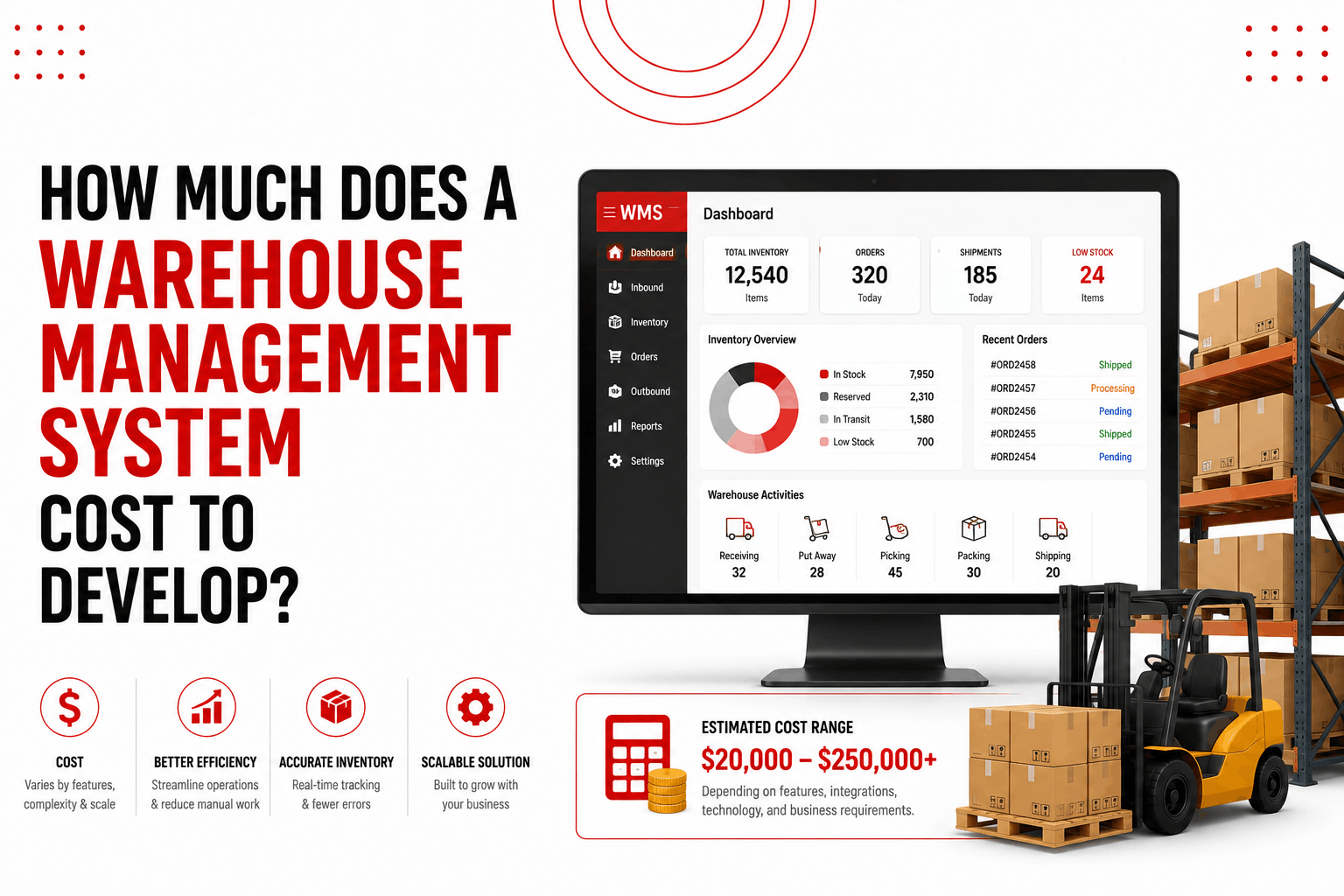
The average WMS project comes in 25 to 40 percent over its original budget, and the reason is consistent enough to name specifically: ERP and e-commerce integration work, data migration from legacy systems, and the productivity loss during a multi-week transition rarely appear as line items in the vendor proposal that won the deal. The number quoted at signing is real. It just isn’t the whole number.
This guide breaks down what actually drives WMS cost, starting with the variable that swings the budget furthest, how much physical automation the warehouse runs, then itemizing the specific hidden costs that account for most of that 25 to 40 percent overrun, so they can be budgeted upfront instead of discovered mid-project.
| $5K–$3M+<br>Realistic cost range across automation levels | 25–40%<br>Average overrun vs original vendor quote | $1,500–$4,000<br>Hardware cost per warehouse worker, paper to WMS | 8–16 weeks<br>Productivity disruption during transition |
Automation level is the variable that actually moves the number
A WMS coordinating barcode scanners and manual picking is a fundamentally different system from one directing conveyors, automated storage and retrieval systems, and robotic picking arms. The software has to talk to physical machinery in real time, handle exception cases when a robot or conveyor fails mid-task, and synchronize inventory state across mechanical systems that don’t pause for human error correction the way a manual process does.
| Manual / barcode-based | Partial automation | Full automation (AS/RS, robotics, conveyors) |
| $10,000–$75,000 | $75,000–$300,000 | $300,000–$3,000,000+ |
| RF scanners, mobile devices, manual pick-pack-ship workflows | Conveyor or sortation integration alongside manual picking | Full AS/RS, robotic picking, conveyor-directed putaway |
| Lowest integration complexity; software directs people, not machines | Moderate complexity; software must handle mixed manual/automated exception flows | Highest complexity; real-time machine control, fault recovery, safety interlocks |
| Why the jump from partial to full automation isn’t linear<br>Adding one conveyor lane to an otherwise manual warehouse is an incremental integration. Running a fully automated facility means the WMS becomes the system of record for machine state, not just inventory state, since a robotic picker that stalls mid-cycle, a conveyor jam, or an AS/RS shuttle fault all have to be detected, logged, and routed to a recovery workflow in real time. This is why full automation projects don’t scale up gradually from partial automation costs. They cross into an entirely different category of real-time systems engineering, which is reflected in the order-of-magnitude jump in the cost range above. |
The specific costs vendor proposals leave out
This is the itemized version of the 25 to 40 percent overrun figure, broken into the categories that actually account for it.
| Hidden cost category | Typical cost | Why it’s missed in the original quote |
| ERP/e-commerce integration development | $25,000–$150,000 | Vendor proposals often price the WMS license, not the custom work to connect it to SAP, Oracle, NetSuite, or Shopify |
| Data migration and legacy data cleansing | $15,000–$75,000 | Nobody audits how messy the existing inventory data actually is until migration begins |
| Change management and productivity loss | 8–16 weeks of reduced throughput | Treated as a training afterthought rather than a real operational cost with a dollar value |
| Hardware refresh (scanners, printers, access points) | $1,500–$4,000 per warehouse worker | Quoted separately from the software, then forgotten when comparing vendor bids |
| Custom report development | $5,000–$25,000 | Standard reporting rarely matches how a specific operation actually tracks performance |
| Annual infrastructure upgrades (on-premise only) | Varies by scale | On-premise deployments carry an ongoing hardware refresh cycle that cloud deployments don’t |
Cloud versus on-premise: a cost shape decision, not just a price decision
The deployment model changes the entire shape of the cost curve, not just the total. Cloud WMS deployments are reported to run 30 to 40 percent more cost-effective than on-premise over a 3 to 5 year period for small and mid-sized operations, primarily because the cloud model bundles maintenance, updates, and hosting into the subscription rather than requiring separate, periodic infrastructure investment.
| Deployment model | Upfront cost | Ongoing cost pattern | Best fit |
| Cloud / SaaS | Low ($2,000–$15,000 setup) | Predictable monthly subscription, $100–$500+ per user/month | Most small to mid-sized operations; fewer than 5 warehouse locations |
| On-premise / perpetual license | High ($25,000–$100,000+) | 15–20% annual maintenance fee plus periodic hardware refresh | Enterprises needing deep customization, data residency control, or unreliable internet connectivity |
| Hybrid (HQ on-premise, satellite sites cloud) | Mixed | Mixed | Multi-site operations balancing central control with site-level flexibility |
Realistic first-year cost by warehouse profile
| Cost category | Single warehouse, manual/barcode | Mid-size, partial automation, ERP integration | Multi-site, advanced automation | Enterprise, full AS/RS + robotics |
| Core WMS license/development | $20,000 | $90,000 | $250,000 | $600,000 |
| ERP/e-commerce integration | $10,000 | $50,000 | $100,000 | $150,000 |
| Data migration and cleansing | $5,000 | $25,000 | $40,000 | $60,000 |
| Hardware (scanners, printers, per worker) | $15,000 | $40,000 | $80,000 | $150,000 |
| Automation/robotics integration | N/A | $50,000 | $200,000 | $800,000 |
| Training and change management | $5,000 | $15,000 | $30,000 | $60,000 |
| Annual support/maintenance (yr 1) | $5,000 | $20,000 | $50,000 | $120,000 |
| Year 1 total (approx.) | $60,000 | $290,000 | $750,000 | $1,940,000 |
Pricing this honestly before the vendor proposal arrives
The pattern behind most WMS budget overruns isn’t a single bad estimate. It’s a vendor quote that accurately prices the software license and just as accurately omits everything the software needs to actually function inside a specific operation: connected to the ERP that already runs the business, populated with inventory data that’s been cleaned rather than just exported, and rolled out to a workforce that needs real time to adjust without throughput collapsing during the transition.
Before comparing vendor quotes against each other, confirm each one is scoped against the same automation level, since a barcode-only quote and a robotics-integrated quote aren’t comparable numbers even when both are labeled “WMS.” Then add the itemized hidden costs above explicitly, rather than assuming the headline number is the total investment. A quote that looks 30 percent cheaper than a competitor’s is worth checking specifically for which of these categories it left out, since that gap rarely disappears, it just shows up later as an unplanned change order.