



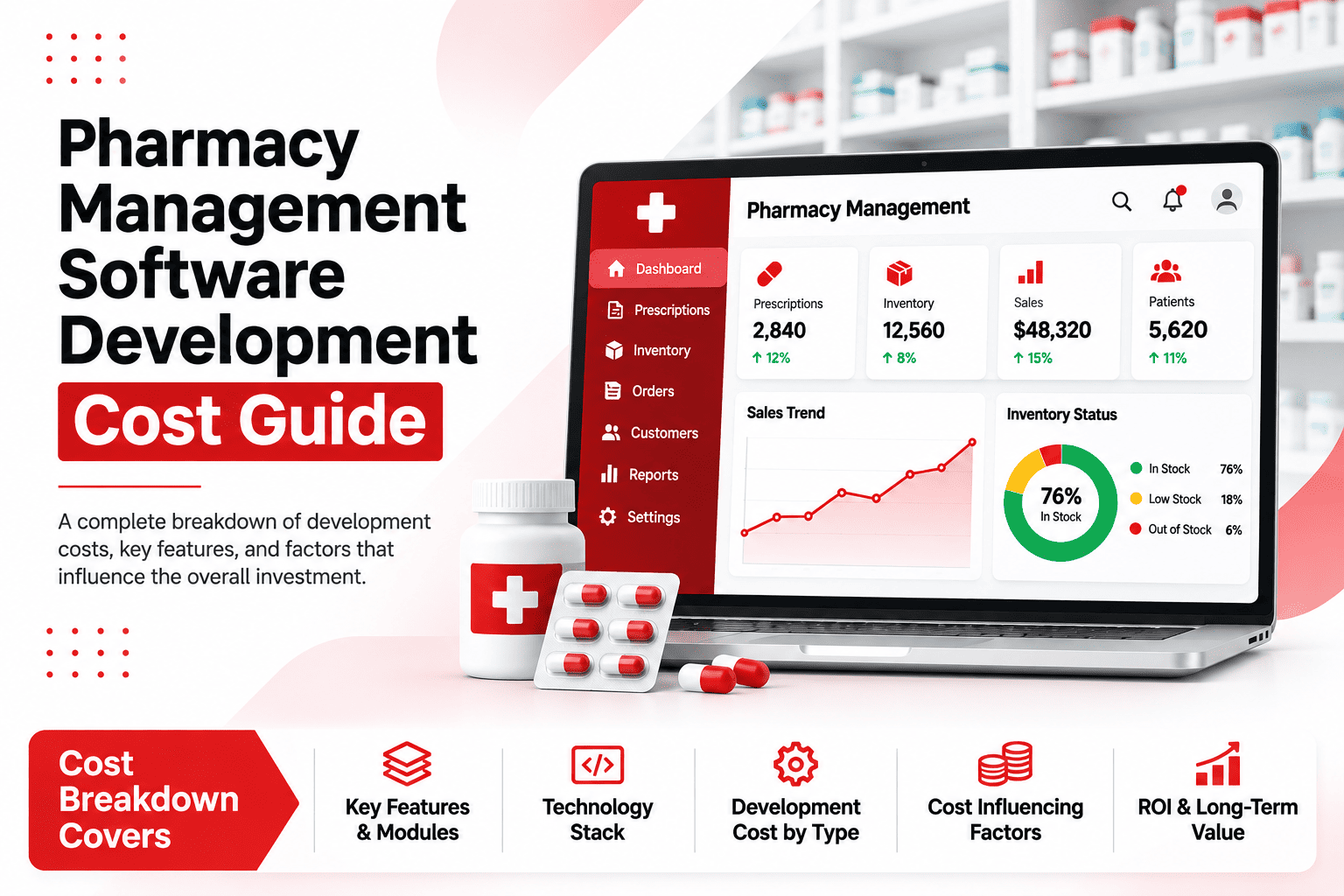
Pharmacy management software development typically costs $40,000 to $250,000 for most custom retail and multi-location pharmacy platforms in 2026. A focused minimum viable product (MVP) may start around $25,000 to $40,000, while hospital-grade pharmacy systems, specialty pharmacy platforms, and enterprise healthcare integrations can exceed $500,000.
The difference between these estimates comes down to what the software needs to manage. A single-store pharmacy may need prescription processing, billing, stock control, and expiry alerts. A pharmacy chain may require centralized inventory, multiple branches, supplier coordination, insurance claims, and advanced reporting. A hospital pharmacy has additional requirements involving electronic health records, medication administration, clinical workflows, and automated dispensing equipment.
The development budget also needs to account for security, regulatory requirements, third-party integrations, testing, deployment, and ongoing maintenance. These are not optional extras for software handling prescription and patient information.
This guide breaks down pharmacy management software development costs by project size, feature, integration, development stage, and business model. It also explains where additional expenses arise and how to prepare a realistic development budget before approaching software development companies.
How Much Does It Cost to Develop Pharmacy Management Software in 2026?
The estimated cost of developing pharmacy management software ranges from $25,000 for a focused MVP to more than $500,000 for a large enterprise platform.
The following estimates represent planning budgets for custom development, not subscription prices for ready-made pharmacy products.
| Software Type | Estimated Development Cost | Development Timeline |
|---|---|---|
| Basic pharmacy management MVP | $25,000–$40,000 | 2–4 months |
| Small pharmacy management system | $40,000–$80,000 | 3–5 months |
| Mid-sized pharmacy platform | $80,000–$150,000 | 5–8 months |
| Multi-location pharmacy system | $150,000–$250,000 | 7–10 months |
| Enterprise pharmacy management platform | $250,000–$500,000+ | 9–15 months |
| Hospital or specialty pharmacy platform | $500,000–$1 million+ | 12–24 months |
These are indicative estimates. Actual development costs depend on the number of workflows, user roles, integrations, regulatory obligations, supported locations, and technical requirements.
A pharmacy startup building an MVP does not need the same infrastructure as a hospital network managing thousands of prescriptions across multiple departments. Including every enterprise feature in the first release can increase development expenses without providing corresponding value during the initial launch.
For a more useful estimate, the project should be divided into functional modules and evaluated according to their complexity.
Pharmacy Management Software Development Cost by Business Type
The type of pharmacy operating the software has a direct impact on the development budget. Different businesses have different dispensing procedures, inventory requirements, payment workflows, and reporting responsibilities.
1. Independent Retail Pharmacy
Estimated cost: $25,000–$60,000
An independent pharmacy generally needs a straightforward platform that manages daily counter operations. The system should allow pharmacists and staff to process prescriptions, maintain stock records, generate invoices, and monitor product availability.
Typical functionality includes:
- Prescription entry and processing
- Medicine inventory management
- Batch and expiry tracking
- Point-of-sale billing
- Supplier and purchase order management
- Customer records
- Sales and stock reports
- User permissions
A single-location pharmacy can start with a web-based application and an administrative dashboard. Mobile applications, advanced analytics, and multi-branch management can be introduced later.
The main cost consideration is how much the system needs to differ from existing pharmacy workflows. A pharmacy with straightforward inventory and billing requirements will generally require less customization than one with specialized dispensing or reimbursement procedures.
2. Multi-Location Pharmacy Chain
Estimated cost: $100,000–$250,000
Pharmacy chains require more than a collection of independent billing systems. Management needs visibility into stock levels, sales, procurement, pricing, and operational performance across every location.
The software should support centralized administration while allowing individual branches to manage their daily activities.
Important features include:
- Centralized inventory management
- Branch-wise stock monitoring
- Inter-branch stock transfers
- Centralized purchasing
- Supplier management
- Consolidated financial reports
- Branch-level employee permissions
- Stock replenishment automation
- Performance dashboards
For example, if one branch has excess stock while another experiences a shortage, the system should help management identify the difference and coordinate stock transfers.
The development cost increases when branches operate under different pricing structures, tax rules, inventory policies, or reporting requirements.
3. Hospital Pharmacy Management Software
Estimated cost: $250,000–$600,000+
Hospital pharmacy software has a wider operational scope than retail pharmacy applications. It may need to coordinate medication orders, inpatient prescriptions, discharge medication, department-level inventory, and clinical information.
Depending on the hospital’s requirements, the platform may include:
- Inpatient and outpatient prescription management
- Medication order processing
- Ward-wise inventory
- Drug interaction and allergy alerts
- Medication administration integration
- Electronic health record connectivity
- Pharmacy billing and charge capture
- Controlled medication records
- Clinical reporting
- Automated dispensing cabinet integration
Hospital deployments also involve coordination with existing hospital information systems, laboratory platforms, and electronic medication administration systems.
The cost depends heavily on the number of external systems involved and whether the hospital is implementing a new platform or replacing an existing application.
For a broader understanding of healthcare platform requirements, see the guide to hospital management system development companies.
4. Specialty Pharmacy Software
Estimated cost: $150,000–$500,000+
Specialty pharmacies handle medications that often require additional coordination, documentation, reimbursement management, and patient support.
Examples include specialty medications used for cancer treatment, autoimmune conditions, and rare diseases.
The software may need:
- Prior authorization workflows
- Patient onboarding and eligibility checks
- Specialty medication tracking
- Reimbursement management
- Cold-chain shipment monitoring
- Patient adherence programmes
- Refill coordination
- Clinical documentation
- Manufacturer and payer integrations
Specialty pharmacy systems become particularly expensive when they connect several external organizations and need to maintain a complete record of medication handling and patient communication.
Pharmacy Management Software Feature-Wise Development Cost
Features are one of the most important variables in a pharmacy software estimate. A project with basic inventory and billing functionality has a different development workload from one involving electronic prescriptions, insurance claims, clinical decision support, and healthcare interoperability.
The following table provides indicative development budgets for individual modules.
| Feature or Module | Estimated Development Cost |
|---|---|
| User registration and access management | $3,000–$8,000 |
| Pharmacy administration dashboard | $5,000–$12,000 |
| Medicine inventory management | $8,000–$18,000 |
| Prescription management | $8,000–$20,000 |
| Billing and payment processing | $5,000–$15,000 |
| Batch and expiry management | $4,000–$10,000 |
| Supplier and purchase management | $5,000–$12,000 |
| Patient management | $5,000–$15,000 |
| E-prescription integration | $10,000–$30,000 |
| Insurance claim integration | $10,000–$35,000 |
| Advanced analytics and reporting | $8,000–$20,000 |
| Multi-location management | $15,000–$40,000 |
| Mobile application development | $15,000–$40,000 |
| Healthcare system integration | $15,000–$50,000+ |
These are standalone planning estimates, not fixed vendor prices. Some modules share authentication, databases, APIs, and administrative components. Therefore, adding individual estimates together will not necessarily produce the final project quotation.
Prescription Management
Prescription management is a central component of pharmacy software. It allows authorized pharmacy personnel to receive, review, process, and maintain prescription information.
The module may include prescription status tracking, patient details, medication information, refill history, and pharmacist review workflows.
Additional complexity arises when the system supports electronic prescriptions from external prescriber platforms. Such functionality requires integration with the appropriate networks and validation of the relevant prescription data.
Medicine Inventory Management
Inventory management controls the movement of medicines throughout the pharmacy.
A well-designed module should maintain stock quantities, purchase records, batch details, expiry dates, and reorder levels. It should also identify medicines that are running low or approaching their expiry dates.
For pharmacy chains, inventory management needs additional functionality for branch-level stock allocation and transfers.
Billing and Payment Management
The billing module handles customer invoices, payment records, discounts, refunds, and transaction history.
Depending on the business model, the software may also support insurance-related transactions, multiple payment methods, tax calculations, and integration with existing accounting systems.
Patient Management
Patient management stores relevant customer information and supports prescription history, refill reminders, and communication.
For healthcare applications, patient information must be protected through appropriate access controls and security policies. The development team should define which employees can view or modify sensitive records.
Analytics and Reporting
Reporting functionality helps pharmacy owners understand operational performance.
Common reports include:
- Daily and monthly sales
- Medicine-wise sales performance
- Expiring inventory
- Low-stock products
- Supplier performance
- Purchase and sales trends
- Branch-wise profitability
- Prescription processing volumes
Advanced reporting may include forecasting and inventory recommendations based on historical sales and seasonal demand.
What Are the Major Factors Affecting Pharmacy Software Development Costs?
Feature count alone does not determine the development budget. Several technical and operational decisions can significantly change the final quotation.
1. Software Complexity and Workflow Requirements
A basic billing application has fewer development requirements than a platform supporting prescription verification, insurance claims, controlled medication records, and multiple pharmacy locations.
Complex workflows require additional business analysis, development, testing, and validation.
For example, inventory software that only records stock quantities is relatively straightforward. A system that tracks medicines by batch, supplier, expiry date, storage condition, and location requires more detailed data structures and business rules.
The development team should document these workflows before estimating the project.
2. Number of Users and Pharmacy Locations
A single pharmacy may have a limited number of employees and one administrative account.
A pharmacy chain may require different access levels for pharmacists, branch managers, inventory teams, finance personnel, and head-office administrators.
The platform must also handle simultaneous users, branch-level permissions, centralized reporting, and synchronized data.
More locations do not automatically multiply development costs. However, they can introduce additional infrastructure and operational requirements.
3. Web Application Versus Mobile Application
A pharmacy management platform can be delivered through a web application, mobile application, or both.
| Platform | Estimated Cost |
|---|---|
| Web-based pharmacy application | $25,000–$80,000 |
| Android application | $15,000–$30,000 |
| iOS application | $15,000–$35,000 |
| Cross-platform mobile application | $20,000–$40,000 |
| Web and mobile ecosystem | $60,000–$150,000+ |
These estimates depend on whether the applications share a backend and how much functionality each user interface needs.
A pharmacy may need a web dashboard for administrators and a mobile application for delivery personnel or patients. A pharmacist-facing mobile application may require a different set of permissions and workflows.
4. Third-Party Integrations
Integrations can account for a substantial part of the development budget.
Pharmacy platforms often need to exchange information with external systems rather than operate independently.
Potential integrations include:
- Electronic prescription networks
- Electronic health record systems
- Hospital information systems
- Insurance and claims processors
- Payment gateways
- Accounting applications
- Wholesaler and distributor platforms
- Barcode scanners and label printers
- SMS and email services
- Delivery and logistics platforms
The cost depends on API availability, documentation quality, authentication requirements, transaction volume, and the complexity of data exchange.
Connecting to a modern, documented API is generally less expensive than integrating with an older platform that requires custom connectors or manual data synchronization.
5. Security and Regulatory Requirements
Pharmacy management systems handle information that can include patient identities, prescription histories, medication records, payment details, and other sensitive business data.
Security must be considered during architecture and development rather than added immediately before launch.
Depending on the market and intended use, requirements may include:
- Role-based access control
- Multi-factor authentication
- Data encryption
- Audit logs
- Secure backups
- Session management
- Access monitoring
- Data retention policies
- Security testing
- Incident response procedures
For US deployments, the HIPAA Security Rule requires applicable covered entities and business associates to implement appropriate administrative, physical, and technical safeguards for electronic protected health information.
Read the HHS HIPAA Security Rule guidance when defining the security requirements.
The cost of compliance depends on the organization’s obligations and the actual functions of the software. HIPAA compliance should not be treated as a single development feature or a certification that automatically applies to every pharmacy application.
6. Custom UI/UX Design
Pharmacy software is used throughout the working day. Pharmacists and counter staff need to complete common tasks quickly without navigating unnecessary screens.
The interface should support:
- Fast prescription searches
- Clear medication information
- Easy stock adjustments
- Efficient billing
- Visible expiry alerts
- Simple reporting
- Accessible administrative controls
A custom interface also needs to account for different screen sizes and employee roles.
Designing separate interfaces for patients, pharmacists, administrators, and delivery personnel increases the amount of design and development work.
7. Data Migration
Replacing an existing pharmacy application requires transferring operational data into the new system.
This may include medicine catalogs, supplier details, inventory records, patient profiles, prescription history, and transaction records.
Migration complexity depends on the condition and structure of the existing data. Poorly formatted spreadsheets, duplicate records, inconsistent product codes, and incomplete batch information require additional cleaning and validation.
Data migration should be estimated separately from new feature development.
Pharmacy Software Development Cost by Development Stage
A pharmacy software project generally moves through several stages before it becomes ready for commercial use.
Each stage has its own responsibilities and cost implications.
| Development Stage | Estimated Budget Allocation |
|---|---|
| Discovery and requirement analysis | 5–10% |
| UI/UX design | 8–12% |
| Architecture and backend development | 20–25% |
| Frontend and mobile development | 20–25% |
| Integrations and data migration | 10–15% |
| Quality assurance and security testing | 10–15% |
| Deployment and initial training | 5–8% |
The percentages are indicative and may overlap depending on the engagement model.
Requirement Analysis and Discovery
The discovery stage establishes what the pharmacy software needs to accomplish.
The development team should identify user roles, prescription workflows, inventory requirements, external systems, reporting needs, and applicable compliance obligations.
The output should be a documented scope, feature list, technical approach, project roadmap, and preliminary cost estimate.
UI/UX Design
Designers create the screens and user journeys for different pharmacy roles.
The work includes wireframes, interface prototypes, navigation, dashboard layouts, and design validation.
The objective is to make the software practical for everyday pharmacy operations rather than simply creating an attractive interface.
Software Development
This stage involves building the frontend, backend, database, APIs, authentication, and core business logic.
Development may be organized into smaller releases so that the pharmacy can review working functionality before the complete platform is delivered.
Integration and Data Migration
The development team connects the platform with required external services and transfers existing records.
Each integration should be tested for data accuracy, authorization, failure handling, and recovery procedures.
Testing and Quality Assurance
Testing verifies that the software performs correctly under normal and exceptional conditions.
Pharmacy applications need particular attention to prescription accuracy, inventory calculations, access permissions, transaction integrity, and audit records.
Security testing should also examine common vulnerabilities and unauthorized access scenarios.
Deployment and Training
The final stage includes production deployment, configuration, data validation, staff training, and operational handover.
A pharmacy should test its critical workflows before switching completely from the previous system.
How Much Does Pharmacy Management Software Maintenance Cost?
Development expenditure does not end when the application goes live.
Pharmacy software needs ongoing maintenance to address bugs, security vulnerabilities, infrastructure changes, integration updates, and evolving business requirements.
A reasonable initial planning allowance is 15–20% of the original development cost annually for maintenance and support. This is a budgeting assumption rather than a universal industry rate. Actual expenditure depends on service levels, system complexity, hosting arrangements, and the amount of ongoing development required.
| Maintenance Category | Indicative Annual Cost |
|---|---|
| Basic bug fixes and technical support | $3,000–$8,000 |
| Security updates and vulnerability management | $3,000–$10,000 |
| Cloud infrastructure and hosting | $2,000–$12,000+ |
| Integration maintenance | $3,000–$12,000 |
| Performance monitoring and optimization | $2,000–$8,000 |
| Feature improvements and enhancements | Based on scope |
These costs should not be added mechanically. For example, a support contract may already include routine bug fixes and monitoring.
Cloud Hosting and Infrastructure
Cloud expenses depend on the number of users, data volume, storage, application architecture, backup frequency, and availability requirements.
A single-store pharmacy application may have modest infrastructure requirements. A hospital platform with multiple integrations and high transaction volumes requires a more substantial environment.
Security Updates
Security maintenance includes dependency updates, access reviews, vulnerability remediation, backup testing, and periodic security assessments.
Organizations handling sensitive healthcare information should also review their security controls regularly.
Integration Maintenance
Third-party services can change their APIs, authentication methods, and transaction requirements.
The pharmacy software must remain compatible with the systems it depends on. This work should be included in the annual maintenance plan.
Pharmacy Software Regulatory Requirements That Can Affect Development Costs
Regulatory requirements deserve separate attention because the applicable rules depend on where the software operates and what it actually does.
A pharmacy application used for billing and stock management may have different obligations from a platform that processes electronic prescriptions, maintains protected health information, or supports clinical decision-making.
HIPAA and Patient Data Protection
For applicable US healthcare organizations, HIPAA establishes requirements for protecting protected health information.
The software architecture should support appropriate access controls, auditability, data protection, and secure information exchange.
The exact implementation should be based on a risk assessment and the responsibilities of the pharmacy and its technology providers.
Drug Supply Chain Security Act
The US Drug Supply Chain Security Act (DSCSA) establishes requirements for electronic, interoperable tracing of certain prescription drugs at the package level.
Pharmacy systems involved in relevant supply-chain activities may need to support product identification, transaction information, verification, and related recordkeeping.
The FDA also publishes information concerning small dispensers and exemptions. Its August 2026 update provides specific exemption information through November 27, 2027, for qualifying small business dispensers.
Review the FDA DSCSA requirements and FDA guidance for small dispensers.
NCPDP and Healthcare Interoperability
Pharmacy software that exchanges prescription and clinical information needs appropriate interoperability standards.
The National Council for Prescription Drug Programs (NCPDP) publishes standards and technical resources relevant to pharmacy transactions and healthcare information exchange.
Its November 2026 Pharmacist/Pharmacy Electronic Health Record Resource Document v2.0 provides guidance on essential EHR functionality, standards, and interoperability requirements for pharmacies.
Explore the NCPDP pharmacy technology resources during the requirements and integration planning stage.
International Compliance Requirements
Pharmacy applications operating outside the United States need to consider the regulations of their target markets.
For example:
- European deployments may need to account for GDPR and applicable healthcare regulations.
- UK deployments may need to consider UK GDPR and relevant NHS interoperability requirements.
- Indian deployments should assess the Digital Personal Data Protection framework, applicable healthcare requirements, and drug-related regulations.
- Australian deployments may need to consider the Privacy Act and applicable healthcare information requirements.
The final compliance scope should be confirmed with qualified legal and regulatory specialists. A development estimate should identify which requirements are included rather than assuming one global compliance checklist applies everywhere.
Custom Pharmacy Management Software vs Ready-Made Software
Not every pharmacy needs to develop a custom platform.
Ready-made pharmacy management software may be suitable for businesses that can operate within existing workflows. Custom development becomes more relevant when the business has requirements that existing products cannot support effectively.
| Comparison Factor | Ready-Made Software | Custom Software |
|---|---|---|
| Initial investment | Usually lower | Higher |
| Time to launch | Generally faster | Requires development |
| Custom workflows | Limited by product | Designed around business needs |
| Feature flexibility | Depends on vendor | Greater control |
| Integrations | Available connectors | Can be developed as required |
| Ownership | Depends on licensing | Ownership depends on contract |
| Maintenance | Often vendor-managed | Organization and development partner |
| Scalability | Depends on product architecture | Can be planned around growth |
A pharmacy with one location and standard billing requirements may find an existing solution sufficient.
A growing pharmacy network, hospital group, or healthcare technology startup may need more control over integrations, data workflows, and product development.
The financial decision should be based on the expected total cost of ownership, not simply the initial purchase price or development quotation.
How to Reduce Pharmacy Management Software Development Costs
Reducing the development budget does not mean removing essential security, testing, or operational functionality.
A better approach is to control the initial scope and introduce advanced capabilities when there is a clear business requirement.
Start With an MVP
Identify the workflows that the pharmacy cannot operate without.
A typical first release may include prescription management, billing, inventory, batch tracking, supplier management, and basic reporting.
Advanced analytics, patient applications, and complex integrations can be scheduled for later releases if they are not essential to the initial operation.
Prioritize Features Based on Business Value
Not every requested feature needs to be included in the first release.
For example, a single-store pharmacy may not need centralized branch management. A hospital may not need a retail loyalty programme.
Each feature should be evaluated according to its operational importance, implementation effort, and long-term value.
Choose Integrations Carefully
Every integration introduces development, testing, and maintenance work.
The project team should identify essential integrations before development begins and confirm whether the relevant APIs and vendor access are available.
Avoid building connections that duplicate functionality already provided by the existing pharmacy or healthcare infrastructure.
Use a Phased Development Approach
Divide the project into releases with clearly defined deliverables.
A practical roadmap could include:
| Release | Main Functionality |
|---|---|
| Phase 1 | Core pharmacy operations, billing, inventory |
| Phase 2 | Supplier management, advanced reports, patient records |
| Phase 3 | E-prescriptions and healthcare integrations |
| Phase 4 | Multi-location management and advanced analytics |
This allows the business to evaluate the initial platform before committing the full enterprise budget.
Select the Development Partner Carefully
The lowest quotation does not necessarily represent the lowest total project cost.
A team without pharmacy or healthcare software experience may underestimate integrations, data migration, and compliance-related requirements.
Evaluate potential partners based on relevant healthcare projects, technical expertise, security practices, delivery processes, and post-launch support.
Businesses comparing development vendors can use the healthcare software development companies directory to explore potential technology partners.
How to Choose a Pharmacy Management Software Development Company
Selecting the right development company is an important part of budget planning.
A capable partner should understand both software engineering and the operational requirements of pharmacy businesses.
Before signing an agreement, evaluate the following areas.
Relevant Healthcare Development Experience
Ask whether the company has developed pharmacy management platforms, healthcare applications, EHR integrations, prescription workflows, or similar systems.
Request project examples that demonstrate the actual functionality delivered.
Technical and Integration Expertise
The team should understand API development, database design, cloud infrastructure, secure authentication, and healthcare interoperability.
Ask how it plans to connect the pharmacy platform with existing systems and how integration failures will be handled.
Security and Compliance Knowledge
Ask how the development company approaches sensitive information, access management, encryption, audit logs, backups, and security testing.
The company should be able to explain the technical controls included in its proposal and identify which compliance responsibilities remain with the pharmacy.
Transparent Project Estimates
A professional proposal should explain the cost of each major component.
It should distinguish between:
- Discovery and planning
- UI/UX design
- Frontend and backend development
- Third-party integrations
- Data migration
- Testing
- Deployment
- Maintenance and support
Avoid accepting a single development figure without a documented scope and delivery plan.
Post-Launch Support
The agreement should define bug-fixing responsibilities, response times, maintenance coverage, security updates, and ownership of the source code.
The pharmacy should also understand how it can access its data and move to another service provider if required.
Pharmacy Management Software Development Cost: Sample Budget
Consider a pharmacy chain planning to develop a custom platform for five locations.
The organization needs centralized inventory, prescription processing, billing, supplier management, reporting, and an administrative dashboard.
A possible preliminary budget could look like this:
| Project Component | Estimated Cost |
|---|---|
| Requirement analysis | $8,000 |
| UI/UX design | $10,000 |
| Backend development | $25,000 |
| Frontend development | $20,000 |
| Inventory and prescription modules | $25,000 |
| Billing and supplier management | $12,000 |
| Multi-location functionality | $18,000 |
| Third-party integrations | $15,000 |
| Testing and security validation | $10,000 |
| Deployment and training | $7,000 |
| Estimated Total | $150,000 |
This example represents a planning scenario, not a supplier quotation. The final amount may change depending on the integration requirements, number of users, existing data quality, and the complexity of the pharmacy’s workflows.
The organization should also reserve a contingency budget for unexpected requirements and changes identified during implementation.
How Long Does It Take to Develop Pharmacy Management Software?
Development time depends on the number of modules, integrations, platforms, and testing requirements.
| Project Type | Estimated Timeline |
|---|---|
| Basic pharmacy MVP | 2–4 months |
| Independent pharmacy platform | 3–5 months |
| Mid-sized pharmacy application | 5–8 months |
| Multi-location platform | 7–10 months |
| Enterprise pharmacy solution | 9–15 months |
| Hospital pharmacy platform | 12–24 months |
These timelines assume that the project has a defined scope and that required third-party access is available.
External vendor approvals, healthcare integration testing, data migration, and regulatory reviews can extend the overall delivery schedule.
Future Trends That May Influence Pharmacy Software Development Costs
Pharmacy software is expanding beyond billing and inventory management. New capabilities are creating opportunities for better operational visibility, patient engagement, and more connected healthcare services.
However, each additional capability needs to be evaluated against its development and operating cost.
AI-Based Inventory Forecasting
AI-based forecasting can analyze historical sales, seasonal patterns, stock movements, and supplier lead times to estimate future inventory requirements.
It can help pharmacy managers identify potential stock shortages and make better purchasing decisions.
The cost depends on data quality, model complexity, forecasting requirements, and integration with existing inventory systems.
Automated Prescription Workflows
Automation can reduce repetitive administrative work in prescription intake, refill coordination, and status notifications.
However, clinical decisions, prescription validation, and dispensing approval must remain subject to the appropriate professional oversight and regulatory requirements.
Predictive Expiry Management
Predictive analytics can help identify products at risk of expiring before they are sold.
The system can use batch-level inventory, expiry dates, sales history, and stock movement to generate alerts and recommendations.
Connected Patient Applications
A patient application can provide refill requests, prescription status, reminders, and access to relevant pharmacy services.
Organizations developing these applications need to plan patient identity verification, permissions, privacy, and secure communication.
Advanced Pharmacy Analytics
Advanced dashboards can provide insights into sales, inventory turnover, purchasing, branch performance, and operational efficiency.
For pharmacy chains, consolidated reporting can help management make purchasing and resource allocation decisions across multiple locations.
Final Thoughts
Pharmacy management software development is a significant investment, and the right budget depends on the business’s operational requirements rather than the number of features listed in a proposal.
An independent pharmacy may be able to launch a useful custom platform for $25,000 to $60,000. A growing pharmacy chain may need $100,000 to $250,000, while a hospital or enterprise healthcare organization may require $500,000 or more.
The best approach is to establish the essential workflows first, identify the required integrations, assess the applicable security and regulatory obligations, and divide development into manageable releases.
Before selecting a development company, compare its healthcare experience, technical capabilities, project estimates, and long-term support arrangements. A properly scoped pharmacy platform should address today’s operational requirements while providing a practical foundation for future expansion.
Frequently Asked Questions
1. How much does it cost to develop pharmacy management software?
Custom pharmacy management software generally costs $25,000 to $250,000 for basic through multi-location platforms. Hospital-grade and enterprise systems can exceed $500,000. The final cost depends on features, integrations, security, compliance, and business size.
2. How much does a basic pharmacy management system cost?
A basic custom pharmacy management system generally costs $25,000 to $60,000. It can include prescription management, inventory tracking, billing, supplier records, and basic reporting for an independent pharmacy.
3. How much does hospital pharmacy software development cost?
Hospital pharmacy software development can cost approximately $250,000 to $600,000 or more. Systems requiring complex EHR integration, inpatient medication workflows, automated dispensing connectivity, and enterprise reporting may require a substantially higher investment.
4. How long does it take to build pharmacy management software?
A basic pharmacy application may take two to four months. A mid-sized platform generally requires five to eight months, while enterprise and hospital pharmacy applications can take 12 to 24 months.
5. What features should pharmacy management software include?
Core features include prescription processing, medicine inventory, batch and expiry tracking, billing, supplier management, patient records, user permissions, and reporting. Larger platforms may also require e-prescribing, insurance claims, multi-location management, and EHR integrations.
6. Is custom pharmacy management software better than ready-made software?
Custom software is useful when a pharmacy has specialized workflows, complex integrations, or multi-location requirements that existing products cannot support. Ready-made software may be more economical for independent pharmacies with standard operational needs.
7. Does pharmacy management software need HIPAA compliance?
Software used by US covered entities and business associates that handles electronic protected health information must support applicable HIPAA requirements. The exact responsibilities depend on the organization’s role and how the software processes and stores information.
8. What programming technologies are used to develop pharmacy management software?
Common technology choices include React, Angular, or Vue for web interfaces; Node.js, .NET, Java, or Python for backend development; and PostgreSQL, MySQL, or other suitable databases. Mobile applications may use native Android and iOS technologies or cross-platform frameworks. The final stack should be selected according to integration requirements, security, performance, and long-term maintenance.
9. How much does pharmacy software maintenance cost?
A preliminary maintenance budget of 15–20% of the initial development cost annually is a reasonable starting assumption. Hosting, third-party service charges, security assessments, integration updates, and major feature development may require separate budgets.
10. Can pharmacy management software integrate with EHR systems?
Yes. Pharmacy software can integrate with compatible EHR and hospital information systems to exchange relevant patient, prescription, and clinical information. The integration method depends on the external platform, available APIs, and applicable interoperability standards.
11. Can AI be integrated into pharmacy management software?
Yes. AI can support inventory forecasting, demand prediction, operational analytics, and administrative automation. Clinical decision-support functionality requires additional validation, appropriate oversight, and careful assessment of applicable regulatory requirements.
12. What is the most important factor when estimating pharmacy software development costs?
The most important starting point is the actual operational scope. The number of workflows, integrations, locations, user roles, and regulatory requirements determines the engineering effort. A detailed discovery process helps establish a realistic budget before development begins.